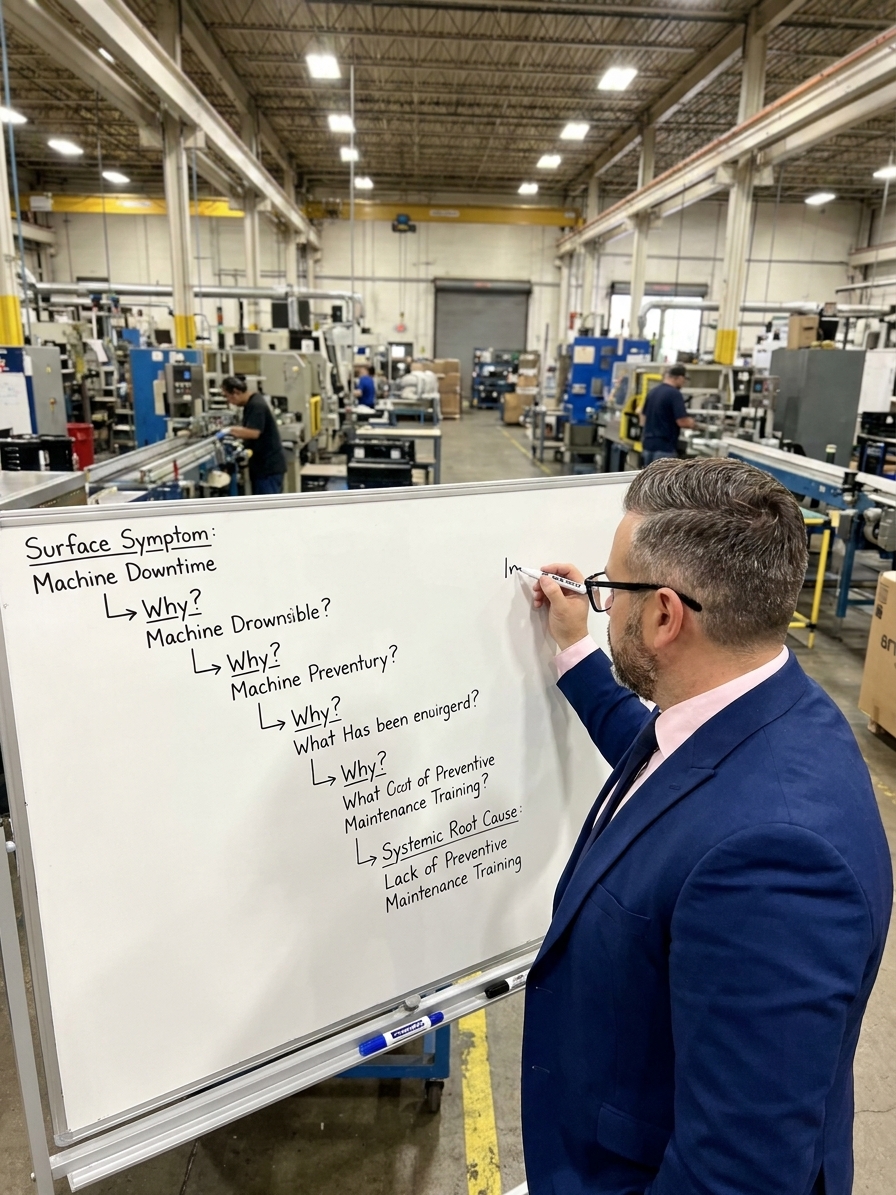
The 5 Whys is deceptively straightforward. You encounter a defect, ask 'why' five times, and supposedly drill down from a surface symptom to a systemic root cause. Developed by Sakichi Toyoda in the 1930s, it became the cornerstone of the Toyota Production System. The architect of TPS, Taiichi Ohno, described it as the basis of Toyota's scientific approach. By repeating why five times, the nature of the problem and its solution are supposed to become clear.
No statistical software is required. There are no specialised training courses or belt-coloured credentials. You only need a question that most toddlers have already mastered. Yet despite this simplicity, the 5 Whys fails in organisations across every industry, every day. This failure has nothing to do with the tool itself and everything to do with how human beings behave when pressured to produce answers quickly under audit deadlines.
I have audited plants that completed hundreds of 5 Whys analyses annually, yet saw their internal scrap rates remain completely static. The disconnect is always the same. Teams treat a thinking tool as a compliance exercise, filling in five rows to close a corrective action. They get exactly what they design for: a completed form, not a solved problem.
The Mechanics of a Proper Linear Investigation
Consider the classic Toyota example. A welding robot stops mid-production. Why one: a circuit breaker tripped, cutting power. Why two: the bearing on the welding arm seized, causing a current overload. Why three: the bearing ran out of lubricant. Why four: the oil nozzle supplying the lubricant was clogged with metal shavings. Why five: there is no filter installed on the oil supply line to trap contaminants. The solution is to install a filter and establish a preventive maintenance schedule.
Notice the progression. The first answer addresses the immediate symptom of power loss. The second addresses the component failure of the bearing seizure. The third addresses the physical condition of lubrication. The fourth addresses the mechanical failure of the clogged nozzle. The fifth uncovers the systemic gap: a missing engineering control that guarantees the problem will recur with every new bearing if left unaddressed.
Each level of inquiry moves the investigation deeper, from symptom to component to condition to mechanism to system. The solution at the fifth level is fundamentally different from what you would implement if you stopped earlier. If you stop at the tripped breaker, you reset it and resume production until the bearing seizes again next week. If you stop at the seized bearing, you replace it, only for the new bearing to run dry and fail the following month.
The Operator Error Trap
In the real world, a defect is discovered and a customer complaint lands in the quality manager's inbox. An IATF 16949 or AS9100 audit finding requires a corrective action response within forty-eight hours. Somebody opens the 5 Whys template in the CAPA system and starts typing. Why did the part fail inspection? The default answer: 'The operator didn't follow the work instruction.' The investigation is already off the rails, and nobody in the room has noticed.
Operator error is a human performance observation, not a root cause. It is a convenient terminal node that locates the problem in an individual rather than in a system. It implies a solution—retrain the operator, issue a discipline notice, add a sign-off step—that requires no changes to the process, the equipment, or the engineering controls. The subsequent questions follow the path of least resistance, inevitably ending at a vague training deficiency or procedural gap.
Because nobody stopped to verify if the work instruction was even accessible, the entire chain of reasoning is built on sand. Nobody questioned whether the process was capable of producing conforming parts. Nobody checked whether the Cpk was stable or if the measurement system was reliable. If the first answer is wrong, incomplete, or biased, the entire logical structure that follows is invalid.
Fundamental Attribution Error in Quality
Human cognition has a well-documented bias toward causal explanations that are simple, proximate, and attributable to individual action. Psychologists call this the fundamental attribution error. When we observe a negative outcome, we attribute it to the character or competence of the person closest to the event, rather than to the situational factors that shaped their behaviour.
In manufacturing quality, every 5 Whys that starts with human action will almost always end at a training deficiency. The investigation will never reach equipment design, material properties, or management policy, because those causes are unreachable through a chain that begins with operator error. The first answer does not just influence the final conclusion. It determines the entire domain in which the conclusion will be found.
A linear 5 Whys requires no evidence, no data, and no verification at each step, making it a tool for storytelling rather than investigation.
This is why skilled facilitators insist on generating multiple hypotheses at each level before selecting a path. The Toyota Production System actually encourages a branching investigation that explores several causes and uses evidence to select the most probable route. Most organisations skip this entirely, treating the exercise as a linear fill-in-the-blank form.
Verification: The Step Nobody Does
At each level of a genuine investigation, you must point to physical evidence that confirms the causal link. Not opinion. Not consensus. Not 'that is what usually happens.' If you claim a bearing seized because it ran out of lubricant, you must inspect the bearing and find evidence of dry running: discoloration, metal transfer, elevated friction wear patterns.
If you claim the oil nozzle was clogged with metal shavings, you must show the clogged nozzle. You must identify the shavings, their material, their source, and the machining operation that generated them. Each 'why' should generate a verification activity: a go-and-see observation, a dimensional measurement, a material test, or a document review. Without verification, you are performing speculation in a structured format.
The Japanese term for this verification step is genchi genbutsu, meaning 'go and see for yourself.' It is one of the most frequently cited principles of TPS and one of the most consistently ignored. Most investigations are conducted in conference rooms based on what people remember or assume. Even when someone walks to the line, the verification is often performative—a manager glances at the equipment, nods, and returns to confirm a chain drafted before anyone left their chair.
Applying Structure to Complex Problems
The 5 Whys is designed for single-cause linear problems. Modern manufacturing defects are rarely single-cause events. Consider a dimensional nonconformance on a CNC-machined part. The possible contributing factors include material hardness variation, cutting tool degradation between scheduled changes, and thermal expansion of the workpiece during processing.
Add to that fixture clamping force inconsistency, machine slide way wear, gauge calibration drift, and ambient temperature swings affecting coolant performance. A linear 5 Whys investigation cannot capture this complexity. It will pick the most obvious factor, follow it to a single root cause, and implement a corrective action that addresses one contributor while leaving the others untouched. The problem appears to improve but does not disappear.
| Problem Type | Appropriate Tool | Expected Output |
|---|---|---|
| Single-cause linear failure | Verified 5 Whys | Specific system or engineering gap |
| Multi-factor dimensional issue | Ishikawa + Design of Experiments | Weighted contributions of variables |
| Complex system or safety event | Fault Tree Analysis (FTA) | Mapped logical pathways and cut sets |
Building Real Investigative Capability
To make root cause analysis work, four conditions must be in place. First, trained facilitators who resist premature convergence. The facilitator must generate alternative hypotheses, challenge answers that blame individuals, and insist on physical evidence at each step. None of this is intuitive. It requires deliberate practice and feedback.
Second, time and access. A genuine investigation requires time to gather evidence, visit the actual location, and talk to operators. If your CAPA system requires a completed 5 Whys within forty-eight hours of problem detection, you are doing paperwork, not engineering. Real investigations take days or weeks, depending on the complexity of the failure.
Third, a culture that rewards honesty. If finding a systemic root cause results in blame or an unbearable documentation burden, people will guide the investigation toward safe conclusions. They will identify causes that are already known and implement actions that require no new investment. The CAPA will close, the audit will pass, and the defect will recur because the actual cause was never in play.
The Verified Root Cause Loop
- 01Define the symptomState the exact failure mode and isolate it from generalities.
- 02Branch hypothesesGenerate multiple possible causes across machine, method, material, and human factors.
- 03Verify with evidenceGo to the floor, inspect parts, and measure data to eliminate invalid branches.
- 04Implement actionExecute the corrective action only after confirming the verified systemic gap.
- 05Monitor recurrenceTrack the process metrics for months, not days, to validate the fix.
Fourth, follow-through verification. After a corrective action is implemented, someone must verify that it eliminated the problem over a defined period. Track recurrence rates and confirm the root cause identified was actually correct. Without this closing loop, there is no feedback mechanism to improve future investigations. Teams will keep making the same reasoning errors and wondering why their corrective actions never hold.