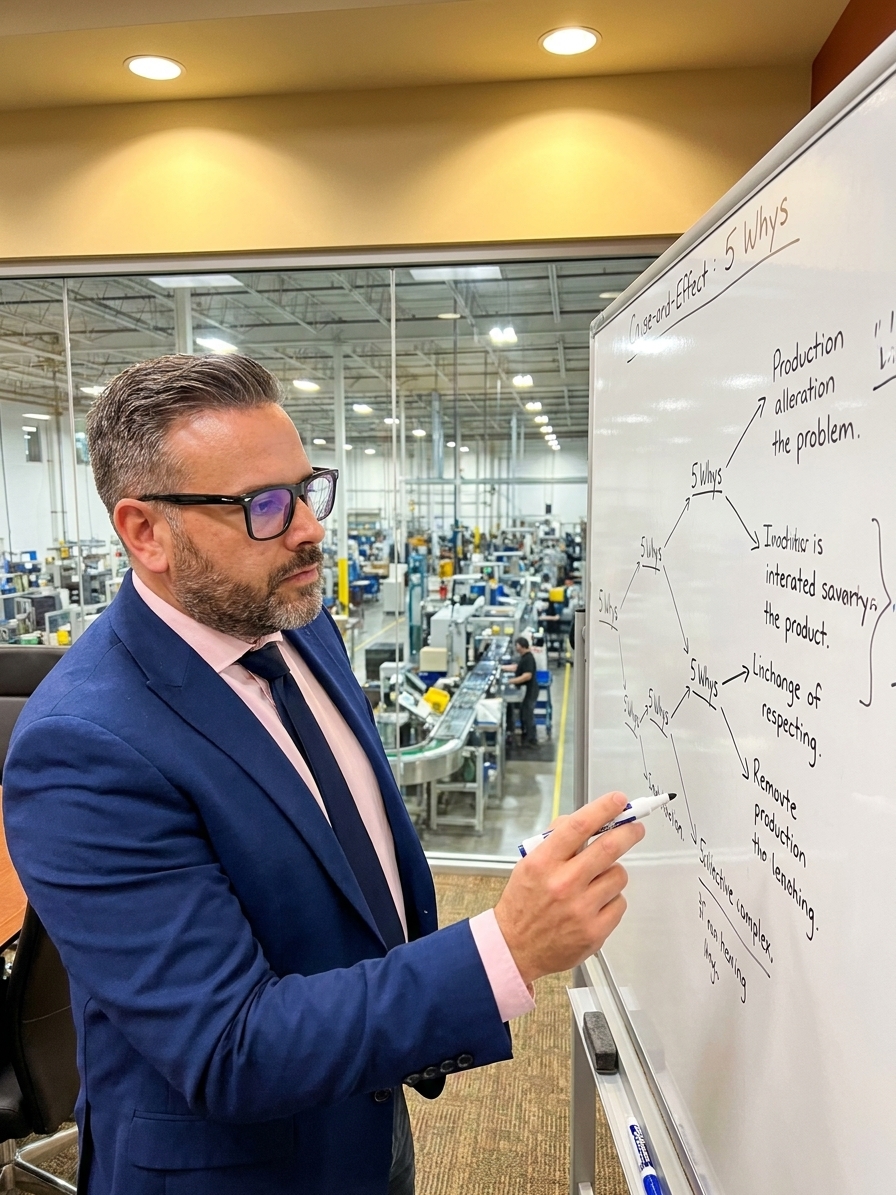
A defect appears. A customer complaint lands. A production line stops. The team gathers around a whiteboard, someone grabs a marker, and the facilitator says, "Let's do a 5 Whys." Five questions later, everyone nods, the root cause is declared, a corrective action is assigned, and the meeting ends. Three months later, the same defect returns. The same customer complains. The same line stops.
Nobody asks why the previous root cause analysis failed. Asking that question would reveal the uncomfortable truth: the exercise was never about finding causes. It was about finding closure. The 5 Whys technique is arguably the most misunderstood tool in the quality engineering toolkit. It appears simple enough that anyone believes they can execute it without training, and it looks fast enough that managers treat it as a shortcut around more rigorous methods like Ishikawa or fault tree analysis.
Sakichi Toyoda developed the technique at Toyota in the 1930s, and Taiichi Ohno institutionalized it as a cornerstone of problem-solving culture. The premise is elegant: ask "why" successively to move past symptoms and surface the underlying cause. Each answer becomes the basis for the next question, creating a chain of logic that should terminate at a systemic failure within the organization's control. The result across modern industry is a widespread pattern of shallow investigations that produce confident answers instead of real solutions.
Where 5 Whys Investigations Go Wrong
Having facilitated and reviewed hundreds of root cause analyses across automotive and aerospace manufacturing, I have identified five recurring failure modes. Each one is preventable, but only if the facilitator recognizes it happening in real time. These failures share a common origin: teams adopt the form of the technique without its substance, stripping away the rigor that made it effective at Toyota.
The most common problem is that investigators inadvertently branch into parallel cause chains without realizing it. The first question might have three legitimate answers, and the team picks one. Usually, they select the answer that is easiest to address or the one that aligns with someone's preexisting agenda. By the time they reach the fifth question, they have traced a genuine causal path, but it leads to a root cause that is peripheral to the actual problem.
Few facilitators enforce the discipline of exploring multiple branches. Toyota's original methodology explicitly acknowledges that a single problem may have multiple root causes, each requiring its own chain of inquiry. In practice, most teams pursue a single linear path and declare victory when they hit five questions. Before accepting any answer, the facilitator must ask the group: "Is this the only possible answer?" If not, document all plausible answers and pursue each one. A well-executed 5 Whys on a non-trivial problem looks like a tree, not a straight line.
The False Target of Five Questions
The number five is a guideline, not a law. Some root causes are reached in three questions. Others require seven or eight. The danger is that teams calibrate to the count rather than to the quality of the analysis. They stop at five even if the last answer is still a symptom, or they stop at three because they have an answer they like. Conversely, some teams pad their chains to reach five even when the genuine root cause was identified earlier.
The stopping criterion is not the count. It is the point at which the answer describes a system, process, or policy failure that the organization can change. If you reach that point in three questions, stop. If you have not reached it in six, keep going. A root cause is typically a breakdown in a management system, not an individual action. When the chain reaches an individual action, the real investigation is just beginning.
This brings us to the most pervasive failure: blame disguised as root cause. Human error is not a root cause. It is a symptom of a system that allowed the error to occur and failed to catch it. Yet a significant percentage of 5 Whys chains terminate at "the operator made a mistake" or "the engineer did not follow the procedure." These are convenient stopping points that absolve the system of responsibility. Ban the phrase "human error" as a root cause in your organization.
Verification and the Conference Room Trap
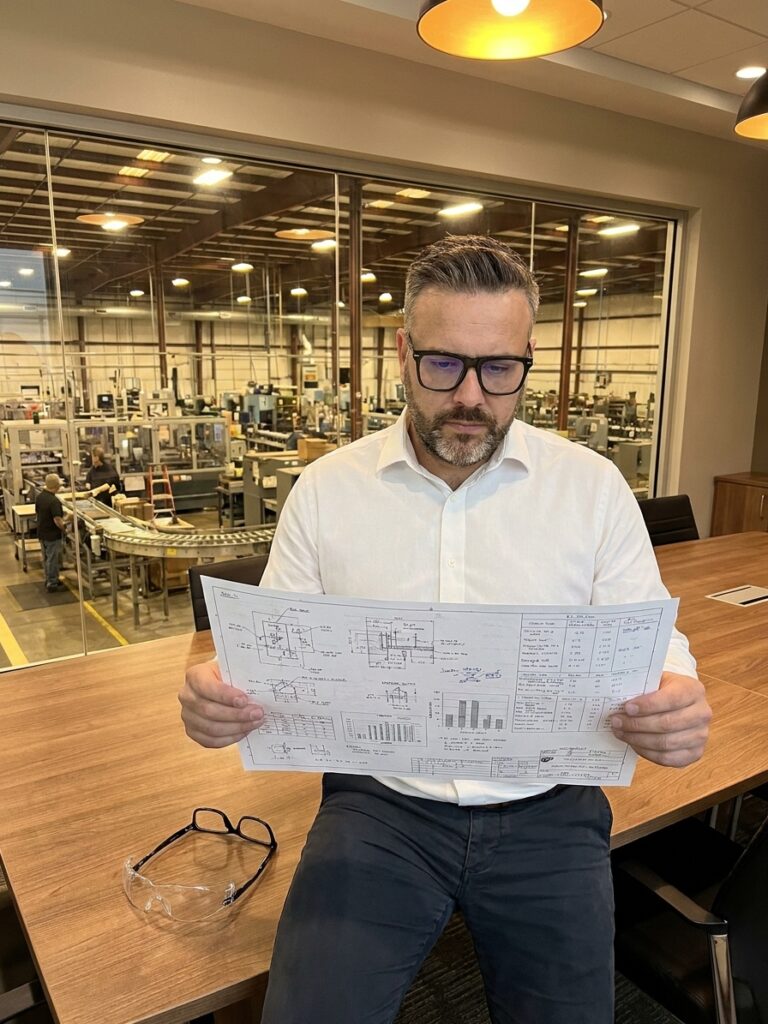
A 5 Whys chain is a hypothesis. Each link represents a proposed causal relationship. Yet most teams never verify those relationships. They accept them based on logic, experience, or consensus. Consensus in a meeting room is a notoriously unreliable substitute for evidence. If you claim the defect occurred because the fixture was misaligned, you must go to the line and confirm that a misaligned fixture produces that specific defect.
At Toyota, the expectation is genchi genbutsu: go to the actual place where the work happens and verify each link through direct observation and data. If you claim the fixture was misaligned because maintenance was skipped, check the maintenance records. In most organizations, the entire investigation happens in a conference room. Nobody goes to the floor. Nobody collects data. The result is a plausible-sounding narrative that usually does not reflect reality.
For each link in the chain, the facilitator must ask: "What evidence confirms this causal relationship?" If the answer is "we all agree," the link is unverified. Require at least one piece of objective evidence, whether that is process data, direct observation, test results, or documented records, before accepting the chain as valid. This single discipline will transform the quality of your 8D and corrective action outputs overnight.
The Verified 5 Whys Branching Method
- 01Define the ProblemState the specific failure with evidence: data, shift, part number, and defect rate.
- 02Identify Multiple CausesDo not accept the first answer. Brainstorm all plausible immediate causes.
- 03Branch the InvestigationPursue each valid cause down its own separate why-chain.
- 04Verify at the GembaConfirm every causal link with physical observation, records, or testing.
- 05Reach Systemic Root CauseStop when you hit a management system, policy, or process failure you can control.
Corrective Actions Disconnected from Reality
Even when the root cause is correctly identified, organizations frequently assign corrective actions that have no logical connection to it. A root cause of "inadequate preventive maintenance schedule" produces a corrective action of "add a visual indicator to the machine." A root cause of "supplier quality management system is ineffective" produces a corrective action of "increase incoming inspection sampling." These mismatches occur because the action is chosen based on available resources and organizational politics.
The test for a corrective action is simple: if the root cause is X, does the corrective action eliminate or control X? If not, the action is wrong, regardless of how practical or popular it is. Write the ideal corrective action immediately after the root cause, before any discussion of feasibility. This forces the team to confront the actual solution required to prevent recurrence.
If the ideal corrective action is not immediately possible, document what would be needed to make it possible and implement an interim control. But never substitute a convenient action for a correct one without acknowledging the gap. If your PPAP or corrective action report contains a mismatched root cause and solution, the auditor or customer will eventually notice when the defect returns.
A 5 Whys chain without verified evidence is a creative writing exercise, not root cause analysis.
Building a 5 Whys Culture That Actually Works
Fixing individual investigations is necessary but insufficient. The goal is to build an organizational capability where root cause analysis is done rigorously and consistently. The 5 Whys is a skill, not a meeting format. Facilitators need training in logic, causal reasoning, cognitive biases, and questioning techniques. They need to know when to push for deeper analysis, when to challenge an answer, and when to escalate to a more rigorous method.
The technique should never exist in isolation. It should be part of an A3 report, embedded in an 8D process, or feeding into a corrective action tracking system. When connected to a larger framework, the output becomes actionable. Root causes lead to countermeasures, countermeasures lead to verification, verification leads to standardization. When it exists in isolation, the output is a completed form that gets filed and forgotten.
Maintain a database of completed 5 Whys analyses and review them quarterly. Which ones held? Which ones failed, meaning the problem recurred? What does the pattern of failures tell you about your investigation quality? This meta-analysis is where organizational learning happens. Without it, every investigation starts from scratch and the same systemic mistakes are repeated indefinitely across different product lines.
Superficial vs. Rigorous 5 Whys Application
Superficial Investigation
- Single linear chain, often blaming the operator
- Stops at exactly five questions or whenever convenient
- Conducted entirely in a conference room
- Corrective action is retraining or adding a warning label
Rigorous Investigation
- Branches into multiple verified causal paths
- Stops at a systemic process or policy failure
- Verified through direct observation and data at the gemba
- Corrective action redesigns the system or process
When to Escalate Beyond 5 Whys
The 5 Whys is not the right tool for every problem. Complex issues with multiple interacting causes, chronic problems that have resisted multiple corrective actions, safety incidents with serious consequences, and problems involving complex technical systems all warrant more powerful analytical methods. The mark of a mature quality organization is not that it uses the 5 Whys for everything, but that it knows when to escalate.
Fault tree analysis provides a top-down, quantifiable approach to cause identification. Failure mode and effects analysis offers a structured way to evaluate potential failure modes before they occur. Design of experiments allows you to test causal hypotheses under controlled conditions. If your 5 Whys chain has more than three branches, or if the corrective action requires a capital expenditure, you probably should have started with a more rigorous method.
That is not a failure of the 5 Whys. It is the technique doing its job, telling you that this problem is bigger than a five-question chain can handle. Organizations measure many things related to root cause analysis: number of investigations completed, time to closure, percentage of corrective actions implemented on time. These are activity metrics. They measure whether the process is running, not whether it is working.
The only metric that ultimately matters is recurrence rate. If your recurrence rate remains stubbornly high, your investigations are producing answers, not causes. Your corrective actions are addressing symptoms, not systems. And your 5 Whys has become exactly what Ohno feared: a ritual that creates the illusion of problem-solving while leaving the actual problems untouched. The difference between success and failure is the discipline to verify the evidence.