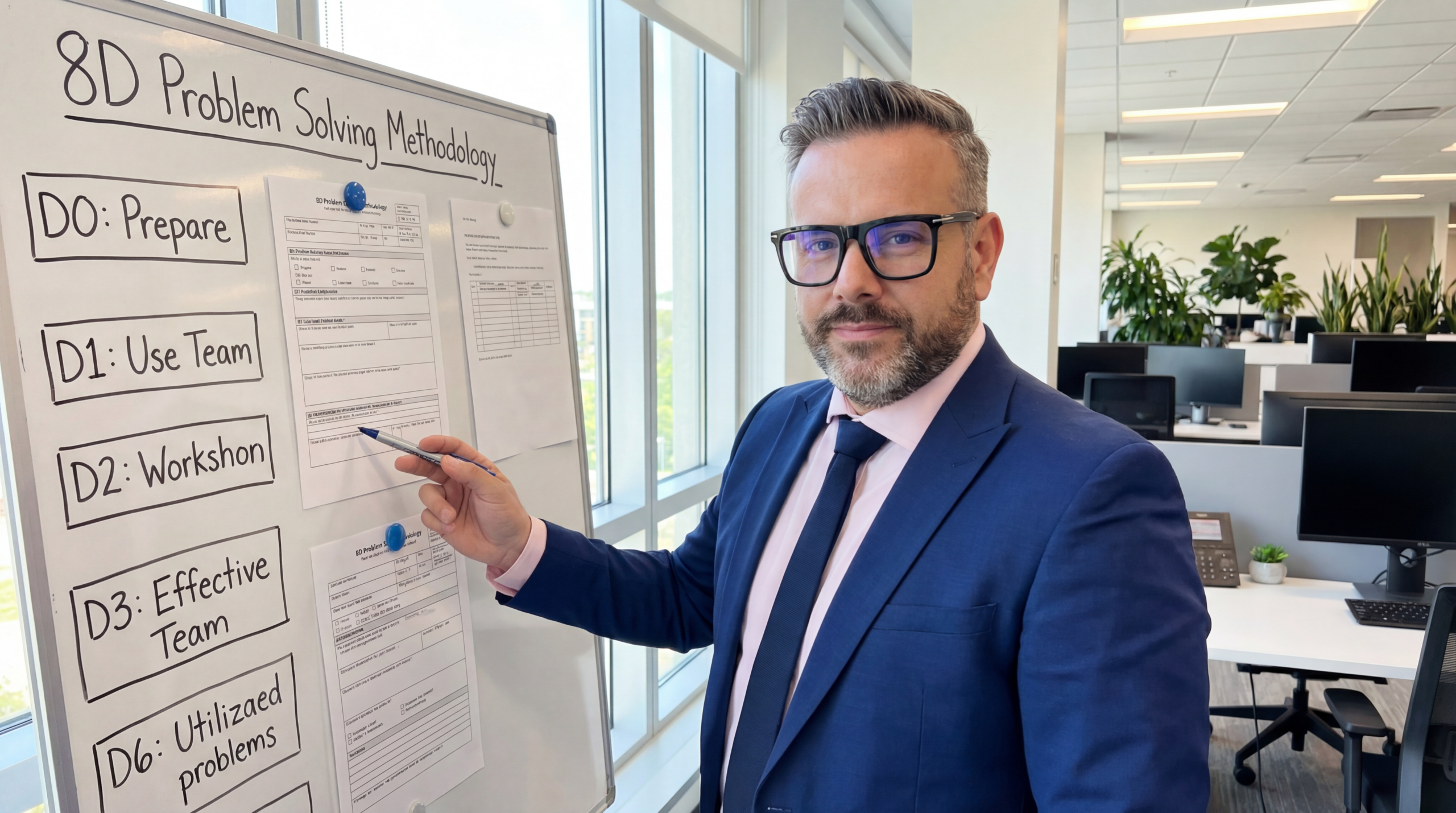
In automotive and aerospace quality management, reacting to nonconformities with unstructured firefighting guarantees recurrence. When a critical defect emerges on a production line, the immediate priority is containment, but the long-term objective is elimination. The 8D methodology provides the framework to achieve both.
Originally developed by Ford Motor Company, 8D is now an explicit requirement of IATF 16949 for handling customer complaints and field failures. OEMs like Volkswagen, BMW, and a major aerospace manufacturer mandate it because it forces suppliers to move beyond symptom treatment and deliver verified root cause analysis.
Having implemented and transitioned ISO 9001 and IATF systems across automotive and aerospace plants, I have audited hundreds of 8D reports. The failures are always the same: teams skip containment, guess at root causes, or substitute 100% sorting for permanent process fixes. The methodology only works when every discipline is executed with rigour.
Structuring the Team and Defining the Problem
D1 requires a multidisciplinary team with the authority to implement changes. A quality engineer writing an 8D report alone in an office will fail because they lack the operational reality of the production floor. You need process engineers, operators, and purchasing involved from the first hour, with a defined team leader who controls the timeline.
D2 demands a quantified problem description using the 5W2H method: What, Who, Where, When, Why, How, and How many. A statement like "the brake system failed" is useless. A valid D2 reads: "Pressure regulator unresponsive at final inspection, Assembly Line 3, 15 January, 0.03% defect rate (3 units of 10,000)." Precision here dictates the accuracy of the root cause analysis later.
Vague problem definitions lead to vague investigations. If the team cannot agree on exactly what failed, where it failed, and how many parts are affected, the subsequent steps will target the wrong failure mode. Lock down the 5W2H before moving to containment.
The 8D Problem-Solving Sequence
- 01D1-D2: Team and DefinitionAssemble cross-functional experts and quantify the defect using 5W2H.
- 02D3: Interim ContainmentIsolate the customer from suspect product via sorting, holding, or 100% inspection.
- 03D4: Root Cause IdentificationUse 5 Whys and Ishikawa diagrams to trace the failure to its origin.
- 04D5-D6: Verify and ImplementPilot the corrective action, confirm it works, then deploy it in production.
- 05D7-D8: Prevent and CloseUpdate PFMEA and control plans, then formally dissolve the team.
Containment: Protecting the Customer First
D3 is about isolation, not resolution. The goal is to prevent any defective part from reaching the customer while the investigation proceeds. Common containment actions include 100% outgoing inspection, adding extra test steps, segregating suspect batches, and placing holds on shipping.
The most frequent failure in 8D execution is treating D3 containment as a permanent fix. Running 100% sorting indefinitely destroys throughput and OEE, and it does not eliminate the defect. Containment buys time for root cause analysis. It must have a defined end date tied to the implementation of permanent corrective actions in D6.
Containment measures must be verified for effectiveness. If you implement a visual check, you must confirm that inspectors can actually catch the defect. I have seen plants where 100% inspection missed 40% of defective parts because the inspection method itself was flawed.
Root Cause Analysis: The Core Discipline
D4 is where most 8D reports succeed or fail. You must identify both the root cause of the defect and the root cause of the escape. The defect occurred in the process; the escape happened because your quality system failed to detect it.
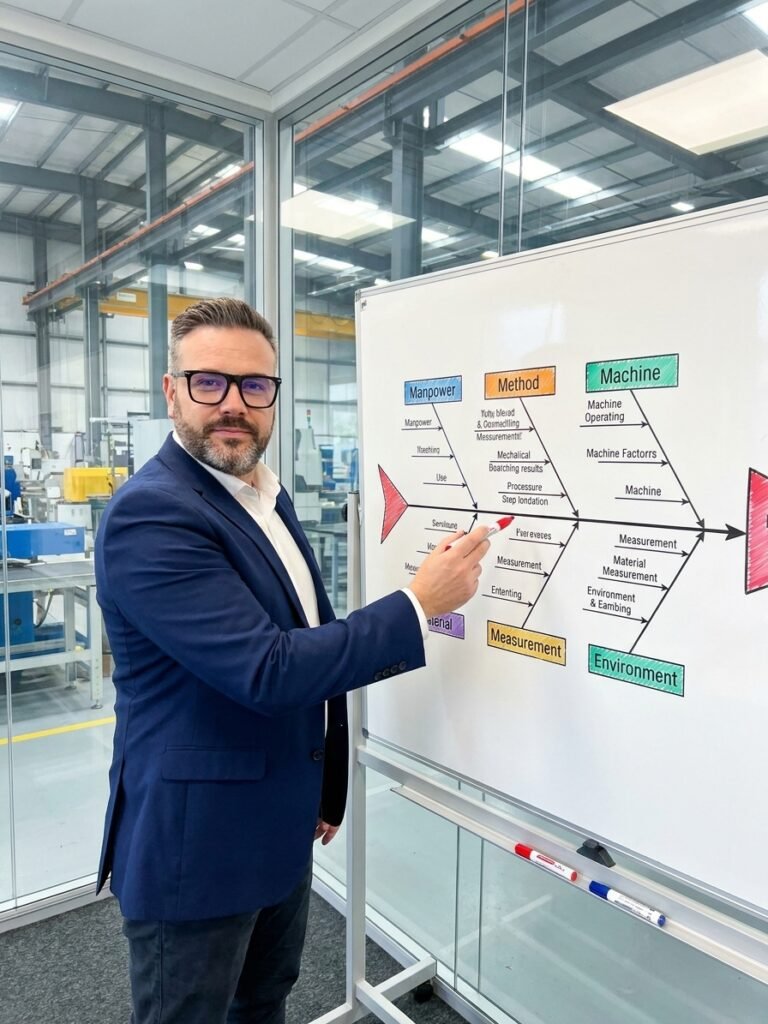
The primary tools are 5 Whys, Ishikawa (fishbone) diagrams, and PFMEA review. The 5 Whys technique forces sequential logic. Consider a pressure regulator failure: the regulator is unresponsive, the sensor is damaged, the sensor was overloaded, the process allows overloading, and the root cause is missing sensor protection in the design.
Teams often stop at the symptom level, stating "operator error" as a root cause. This is never a valid root cause. If an operator can make an error that reaches the customer undetected, the root cause lies in the process design, the poka-yake system, or the control plan.
Symptom Treatment vs Root Cause Elimination
Symptom Treatment
- Add 100% sorting to catch defects
- Retrain the operator and document it
- State 'operator error' as the root cause
- Leave the process parameters unchanged
Root Cause Elimination
- Redesign the fixture to prevent misloading
- Install torque wrenches with automatic cutoff
- Trace failure to process design or tooling
- Update PFMEA and control plan with new controls
Selecting, Verifying, and Implementing Corrective Actions
D5 requires selecting permanent corrective actions that eliminate the verified root cause. The solution must be tested before full implementation. A corrective action that fixes one failure mode but introduces a new one is not a solution. You must verify effectiveness through pilot runs, capability studies, or MSA where appropriate.
D6 is the deployment phase. Implementation targets three areas: product design, manufacturing process, and supplier process. If the root cause is a design flaw, engineering must release a drawing change. If it is a process parameter, manufacturing engineering updates the work instruction. If it is a supplier issue, purchasing enforces the corrective action through the SCAR process.
Implementation requires a timeline with named owners. Without accountability, corrective actions stall in procurement or engineering for weeks while containment costs accumulate. The team leader must track implementation against committed dates and escalate delays immediately.
If an operator can make an error that reaches the customer undetected, the root cause lies in the process design, not the operator.
Prevention of Recurrence and Team Closure
D7 addresses systemic prevention. If a root cause exists in one process, it likely exists in similar processes across the plant. Teams must update PFMEA documents, revise control plans, and verify that parallel production lines do not share the same vulnerability.
Prevention also means updating work standards and training matrices. Every lesson learned from the 8D must be codified into the quality management system. If the PFMEA still lists the old failure mode without the new controls, the system has not learned. Auditors will flag this immediately during IATF 16949 surveillance audits.
D8 closes the loop. The team documents all actions, verifies that the corrective action achieved the target defect rate of zero, and formally disbands. Recognition matters: teams that solve critical problems need visibility. A closed 8D report becomes a database entry for future problem prevention across the organisation.
Key Thresholds for 8D Validation
When to Deploy 8D and When Not To
8D is resource-intensive. Deploying a multidisciplinary team costs engineering hours and production time. Reserve 8D for customer complaints, safety-critical defects, internal rejects above defined thresholds, and recurring systemic problems. IATF 16949 customer-specific requirements from OEMs often dictate mandatory 8D reporting for any PPM deviation.
Do not use 8D for minor deviations that an operator can correct immediately at the source. Simple problems need simple tools: 5 Whys for straightforward issues, PDCA for continuous improvement cycles, A3 for concise reporting, and DMAIC for data-driven Six Sigma projects requiring statistical validation.
The decision criteria are risk and recurrence. If the defect has reached the customer, involves a safety or regulatory concern, or is likely to repeat without systemic intervention, it requires 8D. If it is an isolated internal deviation caught and corrected within the cell, a standard nonconformance report is sufficient.
| Methodology | Best Application | Key Differentiator |
|---|---|---|
| 8D | Customer complaints, critical defects, IATF 16949 requirements | Multidisciplinary team, documented audit trail, mandatory containment |
| 5 Whys | Simple, single-cause problems on the shop floor | Fast and direct, but lacks containment and verification steps |
| A3 | Concise problem solving within Toyota Production System environments | Visual single-page format, strong for communication and alignment |
| DMAIC | Complex problems requiring statistical analysis and process optimisation | Data-driven Six Sigma structure with defined statistical gates |