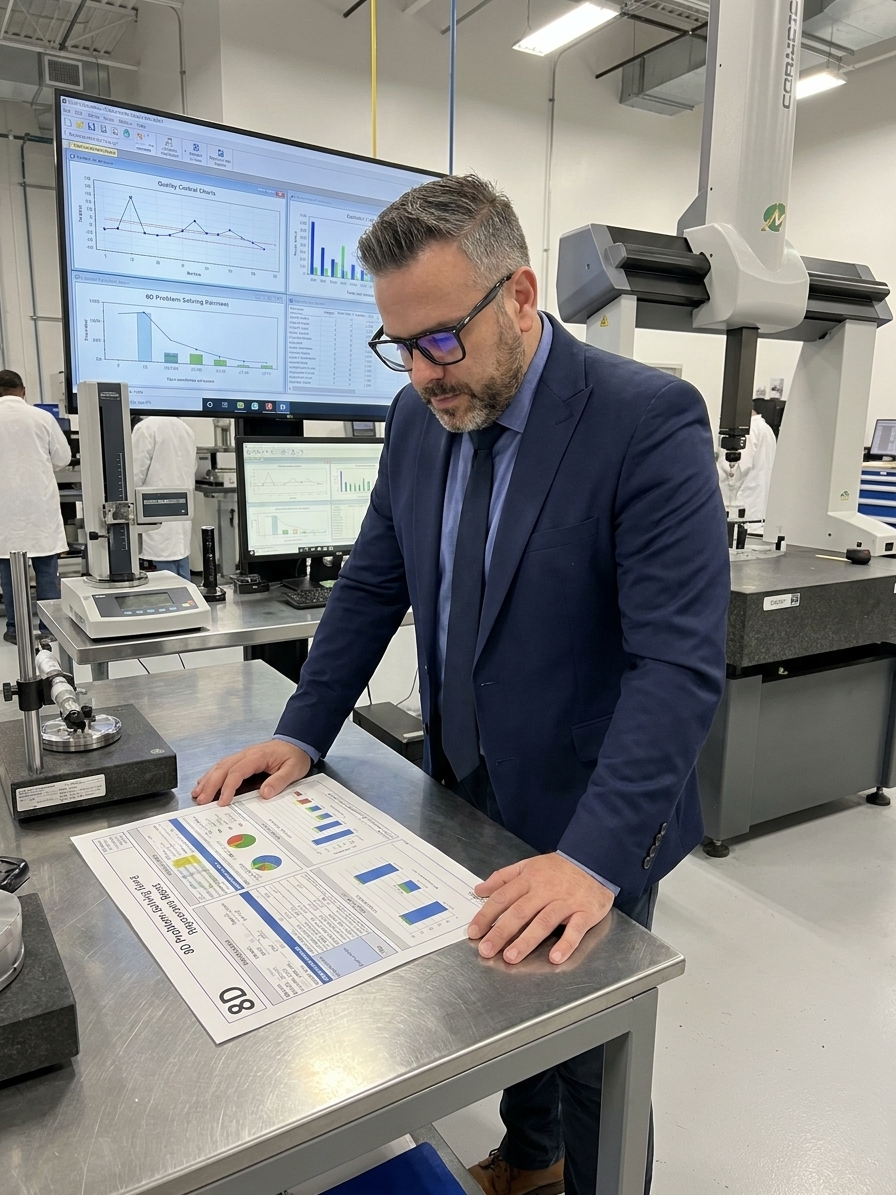
A customer reports a defect. An entire shipment goes on hold. Within hours, a cross-functional team gathers in a conference room, a corrective action report is opened, and a deadline is set. By the end of the week, the immediate symptom has been addressed, a containment action is in place, and the customer receives a professionally formatted 8D report.
Six weeks later, the exact same defect escapes to the customer again. This scenario plays out in manufacturing plants globally, every single day. Organizations do not repeat these failures because they lack problem-solving tools. They repeat them because they confuse containing a problem with solving it.
The Eight Disciplines (8D) methodology was built to prevent this exact loop. Originally developed during the Second World War and formalized by Ford in the 1980s, 8D is embedded in IATF 16949 and required by automotive OEMs globally. It remains the backbone of corrective action systems in aerospace, medical device, and heavy industry. Yet, most organizations execute it poorly.
Teams treat 8D like a form to complete rather than an investigation to conduct. They plug the first plausible explanation into the root cause field, describe their containment actions as permanent fixes, and list 'retraining the operator' as a preventive action. This checkbox approach satisfies a customer portal, but it completely misses the mechanics of the failure. 8D is not a form. It is a structured, evidence-based discipline.
D0 and D1: Triage and Team Composition
Before launching a full investigation, you must decide whether the problem warrants the resources. Not every minor cosmetic defect requires a multi-disciplinary 8D. However, if a failure impacts safety, triggers customer line downs, or shows recurrence, it demands a rigorous approach. Triage requires experienced judgment, not an automated ticketing threshold.
Once triggered, the quality of your investigation depends entirely on team composition. Three quality engineers locked in a room will only examine the failure through the lens of inspection and specification. You need a setup operator, a maintenance technician, and a process engineer. The operator knows the machine's sounds when it drifts and which material lots feel different.
I have reviewed hundreds of 8D reports across automotive and aerospace plants, and the most effective teams share three traits. They include the operator who runs the process daily. They have a champion with the authority to pull people off production to investigate. Finally, they include someone entirely unconnected to the failure who can ask the uncomfortable, obvious questions.
Excluding the operator from the investigation guarantees a blind spot. The informal workarounds operators develop to keep OEE high are often the exact variables that caused the defect. Without their input, your 5 Whys analysis will stall at the process documentation instead of uncovering the reality of the shop floor.

D2 and D3: Problem Description and Containment
The most common failure mode in 8D investigations is a rushed problem statement. 'Customer reported dimension X out of specification' is a symptom, not a problem description. It tells you what failed, but completely misses the boundaries of the failure.
A rigorous D2 uses the 5W2H framework to establish exact parameters. You need time boundaries, equipment specificity, prevalence data, and comparison conditions. A proper description does half the investigative work before you even look for causes. Without this specificity, your containment actions will be equally vague.
Effective D2 Problem Definition
- 01SymptomCustomer reported bore diameter out of specification on part Y.
- 02Quantify47 units (13.8%) rejected at final inspection.
- 03BoundProduced on Line 7, Station 3, between 02:15 and 04:30 on March 12.
- 04CompareLines 5 and 6 running the same part and tooling remained within specification.
Containment (D3) is not a solution. It is a tourniquet applied to stop the bleeding. Containment must be immediate and verified. If defective product can still reach the customer, your containment has failed. Just as critically, containment must be temporary by design. If you cannot give me an expiration date for the additional 100% sorting inspection, it is a permanent workaround, not a bridge to a corrective action.
D4: Root Cause Analysis vs. Satisficing
Root cause analysis is where most 8D reports fail completely. Human brains are wired for cognitive efficiency. We find an explanation that fits the immediate evidence and stop looking. This cognitive bias, known as satisficing, is the enemy of thorough root cause analysis. We accept the first plausible cause rather than the actual cause.
The second failure is confusing a contributing factor with the root cause. Most manufacturing failures require multiple conditions to align. The root cause is the intersection of several variables—tool wear, material hardness, machine drift—that individually would not cause a defect, but together create nonconforming product. Isolating those variables takes time.
Writing 'human error' as a root cause is choosing to blame a person instead of fixing a system.
Writing 'operator error' in an 8D report is a systemic failure. Human error is a symptom of a poorly designed process. The question 8D demands is: why did it make sense for the operator to deviate? Was the work instruction physically impossible to follow at cycle time? Was the training inadequate? Did a pressing production target force a shortcut?
Effective D4 analysis relies on tools like Ishikawa diagrams, fault tree analysis, and Design of Experiments. The specific tool matters less than the discipline of keeping asking questions until you reach a mechanism you can engineer out of the process. If your root cause does not point to a specific system or process failure, you have not gone deep enough.
D5 and D6: Validating the Permanent Fix
Once you identify the true root cause, you must develop and select the best permanent corrective action. Not the cheapest solution, not the fastest implementation, and not the path of least resistance. The best corrective action eliminates the root cause and makes the defect physically or systematically impossible to recreate.
This is where cross-functional input pays off. A quality engineer might propose tightened inspection, but a process engineer will propose a machine modification. An operator might suggest a simple poka-yoke fixture that makes the error physically impossible. You test these options before full rollout. You run a pilot. You collect data under real production conditions.
Statistical Validation Gates (D6)
Implementation means rolling out the change, updating the PFMEA, and revising the control plan. But validation means proving with statistical evidence that the corrective action eliminated the root cause. 'We haven't seen the defect since the change' is not validation. Actual data, analyzed with appropriate statistical methods over a meaningful production run, is the only acceptable proof.
Removing the D3 containment actions is the ultimate validation step. If the defect rate remains at zero after the 100% sort is lifted, you have evidence the permanent corrective action is functioning as designed. If the defect returns, your D4 root cause analysis was wrong, and you must reopen the investigation.
D7: Systemic Prevention and Closure
Most organizations treat D7 as an afterthought. They add a brief paragraph about updating a work instruction or adding a training module. But D7 is where you address the systemic conditions that allowed the root cause to exist in the first place. If a worn tool caused the defect, D7 asks why your tool wear monitoring system failed to catch it.
D7 is where you update your PPAP documentation, revise your preventive maintenance schedule, and modify your process validation protocols. The best organizations feed these D7 learnings back into their design reviews, APQP procedures, and supplier quality requirements. The 8D fixes one specific problem, but D7 makes the entire quality management system smarter.
I have audited plants that consistently produce excellent 8D reports, and they all share one trait: they formalize the dissemination of lessons learned. When an 8D reveals a vulnerability in a fixture design, that knowledge is pushed to the engineering standards committee. When a supplier defect reveals a gap in incoming inspection, the supplier quality manual is updated globally.
D8—recognizing the team—closes the loop. Problem-solving is difficult, cross-functional work that takes time away from daily production targets. If the only outcome of a rigorous investigation is more work for the team, you train your organization to accept superficial root causes. Formal recognition signals that evidence-based problem solving, not rapid closure, is the organizational standard.
Discipline Over Documentation
The 8D methodology is necessary but not sufficient. You can fill in every field in the template and still produce a completely useless investigation. The real value of 8D is not in the documentation. It lies in the willingness to keep asking questions when the production manager demands an immediate answer. It requires the courage to tell a customer you do not have the root cause yet.
8D works because it forces a structured, evidence-based approach to a process that humans naturally want to shortcut. We are wired for quick closure. We want to move on to the next production run. 8D acts as an organizational guardrail against our own cognitive biases, forcing us to gather evidence when assumptions feel so much faster.
Organizations that yield the highest returns from 8D treat it as an investigation discipline. They staff teams properly, demand evidence over assumption, and close the loop between corrective actions and systemic engineering improvements. They recognize that every escaped defect is a signal that the management system failed, and they refuse to treat it as merely an operator mistake.
The next time a defect escapes and your plant manager demands to know what happened, the first question must not be about who is responsible. The operational question is whether you intend to simply contain the issue for the customer, or whether you intend to engineer it out of your system permanently. The first option buys you a few weeks of peace. The second ensures you never pay for the same failure twice.