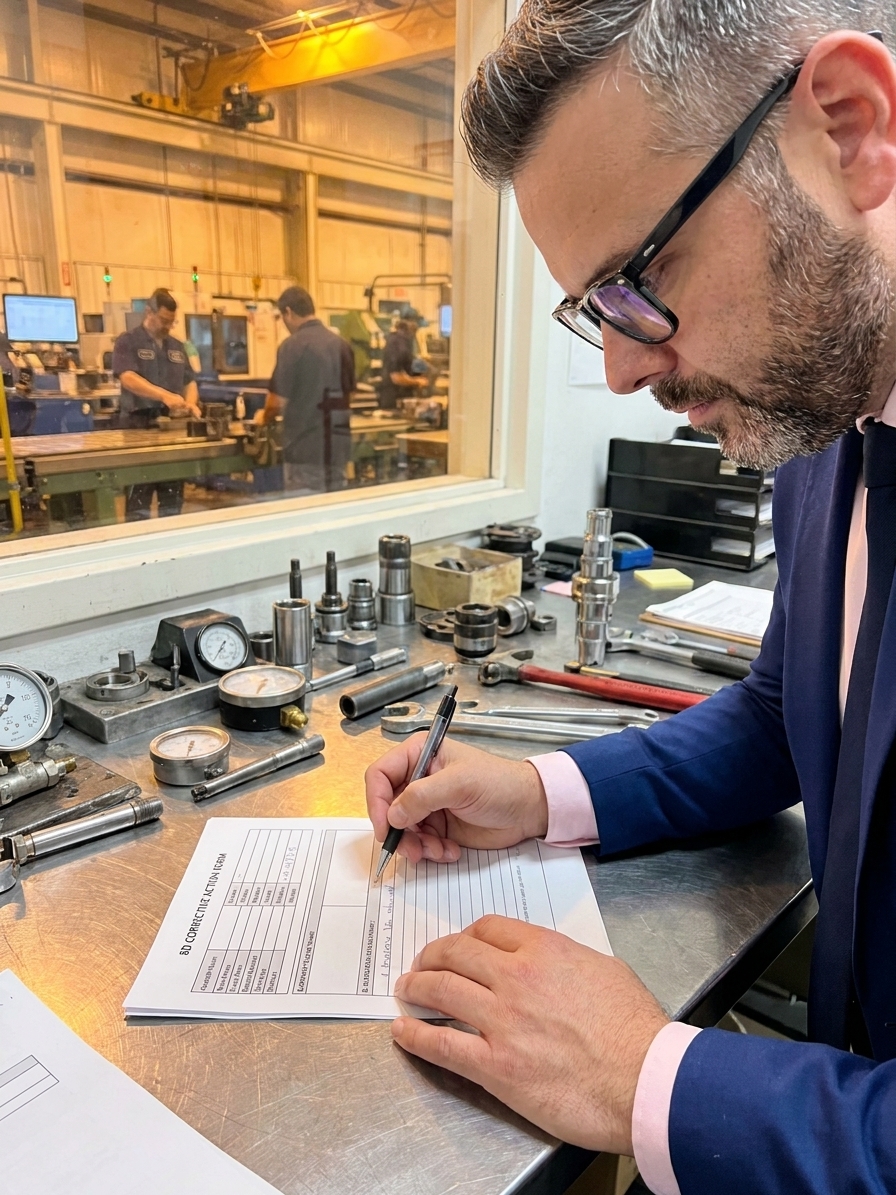
A customer complaint arrives. A quality engineer receives the 8D form, fills in the boxes, identifies a plausible root cause, and submits the report. The customer accepts it. Six months later, the same defect returns from the same line, wearing a different date stamp.
This is the natural endpoint of 8D problem solving in most manufacturing organisations: a documentation exercise that produces impressive reports but prevents nothing. The framework, originally developed at Ford, remains one of the most powerful structured methodologies in quality engineering. But power without discipline is administrative noise.
I have audited plants that run hundreds of 8Ds a year while their internal scrap rates remain completely flat. The reports are technically complete. The investigations are practically useless. Here is where the methodology breaks down, discipline by discipline, and what quality engineering leaders must enforce to fix it.
D1 and D2: Team Formation and Problem Definition
The first failure is structural. A quality engineer gets assigned the 8D as a solo project with a deadline. They send emails to the production floor, receiving secondhand accounts from operators who were too busy running the line to observe the failure mode carefully. The investigation is conducted by someone who was not at the crime scene.
A functional 8D team requires four to six people with defined roles and protected time. If plant management will not pull operators and engineers off the line to investigate, management does not care about solving the problem. They care about closing the report.
This leads directly to D2: vague problem description. Most reports open with statements like 'Customer reported surface defects on incoming parts.' There is no defect specification, no measurement data, and no identification of the specific cavity, shift, or machine involved.
Precision forces accountability. A proper description quantifies the defect rate, isolates the location, and defines the baseline. 'Between March 3 and 17, 47 of 1,200 housing assemblies exhibited crack initiation at the rib-to-wall transition, cavity 3 only' narrows the investigation before root cause analysis even begins.
D3: The Containment Action That Becomes Permanent
Discipline three calls for temporary containment to protect the customer. This means sorting inventory, adding inspection steps, or quarantining suspect material. The action is supposed to have an expiration date, existing only to buy time for the real investigation.

I have visited plants where the 'temporary' 100% sorting operation has been running for three years. When I ask why, the answer is always a variation of 'we never found the root cause, so we cannot remove the sorting.' This is a direct admission that the 8D failed, normalised as a permanent operational cost.
Every containment action must have documented removal criteria and a target date. If that date passes without a verified root cause, the 8D must be escalated to plant management. Instead, organisations quietly shelve the investigation while the sorting continues indefinitely.
Permanent containment destroys manufacturing margins. It absorbs labour, masks process instability, and signals to the production team that the defect is simply an accepted feature of the process rather than a failure to be eliminated.
D4: Root Cause Analysis Built on Consensus
This is where most 8D processes seal their fate. The fourth discipline requires identifying the actual mechanism that produced the defect. The standard tools—Ishikawa diagrams, 5 Why analysis, fault tree analysis, and design of experiments—are meant to drive investigators past symptoms to physical causes.
Instead, teams stop at the first plausible answer. They reach a conclusion that sounds reasonable in a meeting room and close the investigation without verification. No testing. No comparison between the defective condition and the good condition. The root cause is identified by consensus, not by evidence.
The most common failure here is 'operator error.' If an operator can make a mistake that produces a defect, the process is not mistake-proofed. If the procedure is ambiguous, the procedure is the problem. 'Operator error' is a symptom of a system failure, and writing it as a root cause guarantees the defect will return because the system remains unchanged.
Good root cause analysis also asks the inverse question. It asks why the defect did not occur on the adjacent line, the previous shift, or the similar product. The differences between where the defect occurs and where it does not are often more revealing than the defect characteristics themselves.
The Root Cause Identification Gap
What teams do
- Stop at the first plausible explanation
- Accept 'operator error' as a root cause
- Identify cause by meeting consensus
- Confuse correlation with verified causation
What works
- Verify the cause experimentally or analytically
- Trace the failure to an uncontrolled system parameter
- Prove the mechanism by reproducing the defect
- Ask why the failure did not happen on similar lines
D5 and D6: Corrective Actions Without Validation
Once the root cause is verified, discipline five requires corrective actions that directly address it. The key word is directly. Often, teams apply the kitchen sink approach, proposing twelve actions and hoping one works. When the defect rate drops, nobody knows which action actually drove the improvement.
Another common failure is proposing an action that addresses a different root cause. If the investigation identifies excessive temperature variation in the mould, but the corrective action is adding an extra inspection step, you have not fixed the variation. You have simply added a filter to catch the defects that variation produces. That is containment, not correction.
Discipline six is where the methodology dies completely. The team writes a single sentence in the report: 'Corrective actions implemented. No further customer complaints received.' That is not validation. That is hoping. Proper validation requires running enough production to generate statistically meaningful data and comparing post-implementation defect rates to the baseline.
If you close an 8D without statistical evidence that the defect rate has dropped and stabilised, you do not know if your corrective actions worked. You only know that you implemented them. Those are entirely different claims.
D7: Preventing Recurrence Across the Organisation
Discipline seven is where systemic prevention happens. It takes what was learned from one failure and applies it broadly enough that the same mechanism cannot activate elsewhere. This means updating procedures, modifying process designs, adding mistake-proofing, and revising PFMEAs.
Most organisations treat D7 as an afterthought. The customer is satisfied, the immediate fire is out, and nobody allocates the budget to do the broader engineering work. The same root cause therefore sits quietly in adjacent production lines, waiting for its turn to produce a defect.
If your 8D investigation does not feed verified failure modes back into your PFMEA, your risk documentation is theater.
Preventing recurrence is where the actual return on investment lives. Solving one problem on one line costs money. Preventing that problem across ten lines saves ten times that amount. But because prevention eliminates failures that have not happened yet, it rarely receives the attention or budget that the original crisis commanded.
An 8D investigation generates specific, verified knowledge about failure modes, causes, and controls. If this knowledge does not make it back into the PFMEA within 30 days of closure, the document is merely a revision-control exercise maintained for IATF 16949 or AS9100 auditors, not a functional engineering tool.
Systemic Change: Measuring Prevention Over Closure
The compounding cost of defective 8Ds is not just scrap or warranty claims. It is organisational learning failure. When the process produces reports instead of solutions, engineers learn to write documents that will be accepted rather than investigations that will be thorough. Managers learn to measure closure rates instead of prevention rates.
Metrics for a Functional 8D System
Organisations that extract real value from 8D share specific traits. They protect investigation time, meaning the team receives uninterrupted hours to dig into the process. They require evidence, not opinions, and they enforce a hard ban on accepting 'operator error' as a terminal root cause.
They validate corrective actions with data, refusing to close an 8D without statistical proof of improvement. They measure prevention rather than closure, tracking how many investigations eliminated failure modes across the plant rather than how many forms were processed.
8D is not a form. It is a disciplined methodology for transforming failures into organisational knowledge. If you are using it as a documentation exercise, you are spending engineering resources to produce paperwork while your actual process problems go unsolved.