There is a specific failure mode in manufacturing quality: the same defect appears on the same line for the fourth time in a quarter, and each occurrence was already closed with a beautifully formatted 8D report. The containment action was documented. A plausible root cause was written down. The word 'considered' appeared in the preventive action section. Yet the nonconformance persists.
This is how Eight Disciplines problem solving—one of the most effective methodologies in modern manufacturing—gets hollowed out into a template. Teams fill it out because IATF 16949 or AS9100 customer demands require it, not because anyone believes it will stop the defect. The methodology Ford developed to eliminate recurring quality issues becomes a reporting format that documents failures with increasing precision while doing nothing to prevent them.
The core issue is not a lack of templates. It is a fundamental misunderstanding of the 8D process. When I audit plants that fail to close recurrent corrective actions, the failure almost always starts at D1. If you do not assemble the right people, every subsequent step—root cause analysis, verification, prevention—collapses into guesswork dressed up in professional formatting.
D1 and D2: The Collapse of Team Formation and Problem Definition
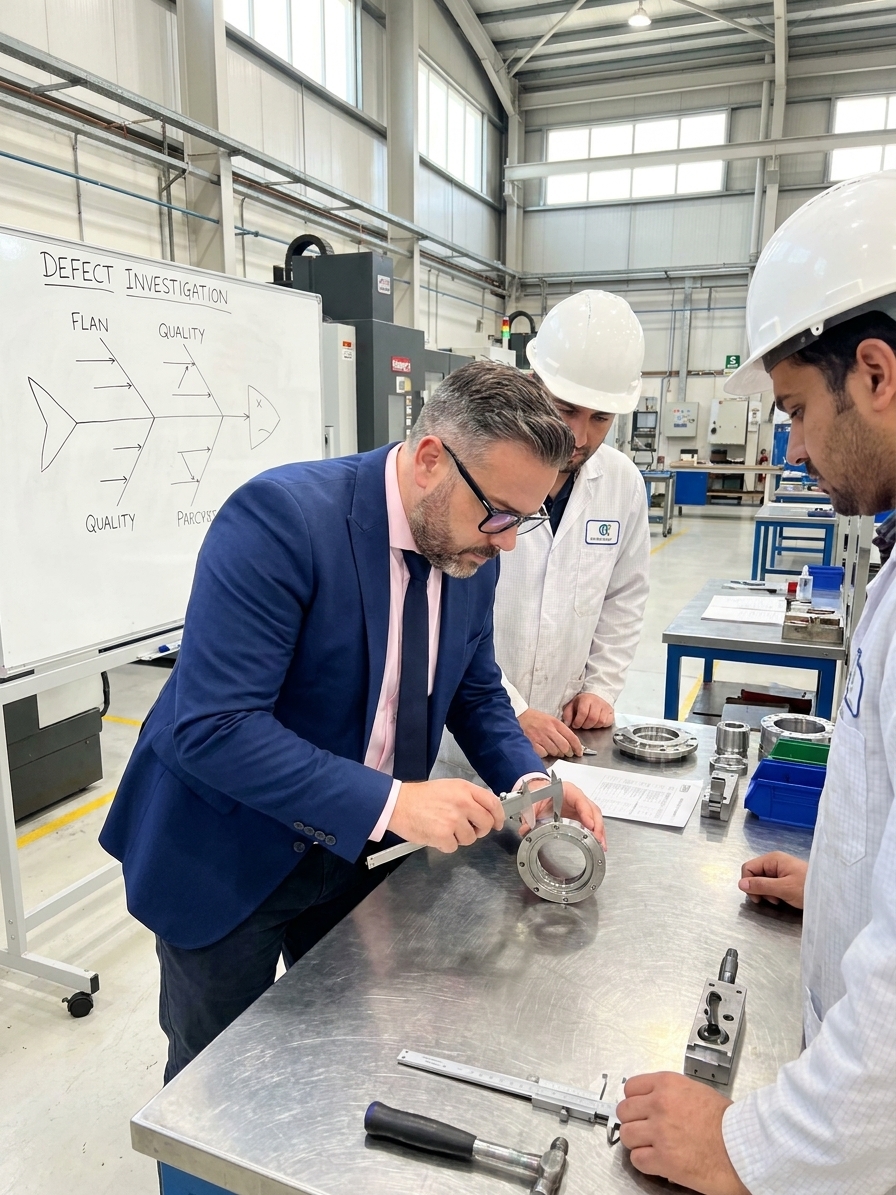
The first discipline calls for a cross-functional team with firsthand knowledge of the process. You need the machine operator who noticed the defect, the process engineer who designed the line, and the maintenance technician who services the equipment. What actually happens is a quality engineer is assigned to 'do the 8D' alone at a desk.
Without a real team, the investigation reflects one person's understanding of the problem—and that person is usually far from the production floor. The operator who has watched the defect occur for three weeks is never consulted. The maintenance tech who noted an unusual vibration pattern is never asked. Eliminating cross-functionality at step one guarantees the root cause identified in step four will be incomplete, convenient, or simply wrong.
This isolation directly impacts D2. The methodology calls for a precise, data-driven problem statement using the 5W2H approach (What, Where, When, Who, Why, How, How many). Instead, most 8D reports contain symptom descriptions so vague they could apply to any line. 'Parts failed final inspection' tells you nothing about the nature, scope, or pattern of the nonconformance.
A proper problem statement defines the defect, the specific workstation, the timestamp, and the magnitude. Compare 'bore diameter out of spec' to '0.15mm deviation detected on CNC Station 4 during the second-shift audit, exceeding the upper specification limit of 12.07mm across 7 of 50 sampled parts.' If you cannot describe the problem precisely, you cannot find its cause. Garbage in, garbage out—except here the garbage is dressed in a template that satisfies customer documentation requirements.
The 8D Execution Gap
What teams typically do
- Assign a single quality engineer to fill out the form
- Write vague symptoms like 'dimensional nonconformance'
- Accept 'operator error' or 'tool wear' as root causes
- Leave containment inspections in place indefinitely
What actually works
- Form a cross-functional team with production staff
- Use 5W2H and hard measurement data to define scope
- Push through to system failures using 5 Whys and fault trees
- Set hard end-dates and cost limits on sorting actions
D3: When Interim Containment Becomes Permanent Infrastructure
Interim containment is supposed to be a temporary bridge to protect the customer while the team investigates. You sort inventory, add a gauging station, and quarantine suspect material. These measures are expensive, labour-intensive, and unsustainable. The word 'interim' communicates that this is a bandage, not a cure.

In practice, interim containment frequently becomes the de facto permanent solution. The 100% sorting inspection that was supposed to run for two weeks is still running six months later. The additional gauging station has become a permanent fixture on the line. The cost of this containment is buried in the quality department's operating budget rather than highlighted as an extraordinary expense.
This is one of the most expensive failures in 8D implementation. Containment works just well enough to remove the urgency from the problem. The customer stops complaining, and the quality manager stops getting early-morning phone calls. With the immediate pressure gone, the investigation stalls at D4. The team is reassigned to the next fire, the containment becomes infrastructure, and the permanent corrective action is never developed.
Organizations that allow this pattern end up with quality systems weighed down by layers of accumulated inspection. Each layer adds cost, cycle time, and complexity. The factory becomes a museum of past failures, each preserved as an inspection step that nobody dares remove because nobody remembers why it was added or whether the original problem was ever actually fixed.
D4: The Difference Between a Cause and a Category
This is where 8D most commonly fails. The root cause analysis in most reports is not an analysis at all—it is an assertion. The isolated quality engineer writes down what they believe caused the problem: 'Operator error,' 'Tool wear,' or 'Material variation.' These are not root causes. They are lazy categories of cause.
'Operator error' is a symptom of a system that allows or requires an operator to make an error. Why was the process designed in a way that human inattention could produce a defective product? Was there a poka-yoke that should have prevented it? Was the work instruction ambiguous? 'Tool wear' describes a mechanism, not a root cause. The root cause is why your management system allowed worn tools to remain in production in the first place.
The hallmark of a genuine root cause is that when you eliminate it, the problem disappears completely. If your stated root cause is 'tool wear' and you replace the tool, and the defect recurs three weeks later, tool wear was not the root cause. It was a contributing factor. The true root cause is a management system failure, a maintenance system failure, or a process design flaw.
Real root cause analysis requires tools: 5 Whys, fishbone diagrams, fault tree analysis, and design of experiments. It requires going to the gemba, watching the process, and talking to operators without defending the current system. It requires time—sometimes days or weeks. That time is rarely allocated because the customer wants the 8D report closed in 72 hours.
D5 and D6: Skipping Verification to Hit the Deadline
If the root cause is wrong, the permanent corrective action will be wrong. If you believe the root cause is operator error, your corrective action is retraining. If the actual root cause is an ambiguous work instruction that causes even well-trained operators to make errors, retraining does nothing except give the operator one more pass through a confusing procedure. The defect will recur, and you will file another 8D.
Corrective Action Verification Process
- 01Define Success CriteriaEstablish the statistical threshold (e.g., zero defects at 95% confidence) the fix must achieve.
- 02Pilot RunProduce a batch under the new conditions with the fix in place.
- 03Data AnalysisDistinguish between 'we did not see the defect' and 'we proved the defect rate dropped'.
- 04Check for Unintended ConsequencesVerify the fix did not slow cycle time past takt or introduce a new failure mode.
- 05Implement in Production (D6)Roll out the verified fix, update the control plan, and remove interim containment.
Verification before implementation is the critical step that almost everyone skips. D5 asks you to run a pilot, produce a batch under new conditions, and prove the fix works before declaring victory. This step exists because corrective actions frequently have unintended consequences. The process change that eliminates one defect may slow cycle time past takt. The new tooling that solves the dimensional issue may create a surface finish problem.
In practice, D5 is usually a single sentence: 'Corrective action verified through process monitoring during implementation.' This is not verification. It is a hope dressed up as validation. Real verification means running the process with the fix in place under controlled conditions, with sufficient sample size to detect whether the defect rate has actually changed.
D7 and D8: The Breakdown of Organizational Memory
D7 is the most neglected discipline in the methodology. It asks what needs to change in systems, procedures, and management processes to ensure this problem never happens again—not just on this line, but anywhere in the organization. A properly executed D7 propagates lessons across the entire company.
A 8D report is a learning opportunity that could prevent future failures, and almost all are wasted because D7 is treated as a formality.
In reality, someone writes 'Updated work instruction and retrained operators' and moves on. The PFMEA is not updated because that requires a cross-functional review meeting nobody wants to schedule. The control plan is not revised because that triggers customer notification. The design standard is not modified because the design engineers were never on the 8D team. The same problem will appear on a different line in eighteen months.
The failure of D7 is the failure of organizational memory. It is why manufacturing companies make the same mistakes repeatedly across different product lines and facilities. Each 8D report could prevent future failures, but they are wasted because D7 is treated as a formality rather than the core of the methodology.
D8—recognizing the team—exists for a structural reason. Problem-solving in manufacturing is hard, unglamorous work. Teams that do it well spend weeks investigating, debating, and fighting organizational resistance. If that effort is met with a signed-off form and nothing else, no one will volunteer for the next investigation. Recognition means visibility: a mention in the quality review, a presentation to leadership, or a sincere thank-you from the plant manager.
Rebuilding 8D as an Internal Improvement Engine
The deepest problem with 8D implementation is the purpose for which the methodology is used. In many organizations, 8D reports exist to satisfy customers, not to solve problems. A customer issues a corrective action request. The supplier quality manual requires an 8D response within 72 hours. The quality engineer fills out the template. The customer accepts it. The documentation obligation is met.
This reduces 8D from a problem-solving methodology to a communication protocol. The report becomes a story told to an external audience, shaped by what the customer wants to hear rather than what actually happened. Customers want to see 'root cause identified.' Suppliers want to write those words. The transaction is completed, and the defect continues.
Breaking this cycle requires a structural shift. The organization must value 8D as an internal improvement tool, not an external reporting requirement. The customer-facing 8D report should be a summary of genuine internal investigation, not the investigation itself. The real work happens on the factory floor, with the team, over days and weeks.
When 8D is executed properly, the result is not just the elimination of one defect. It is the strengthening of the entire quality system. Each properly executed 8D makes the next problem less likely and the next investigation faster. Over time, the number of 8D reports decreases—not because problems are hidden, but because they are being prevented. That is the ultimate measure of 8D success: fewer reports, not more.