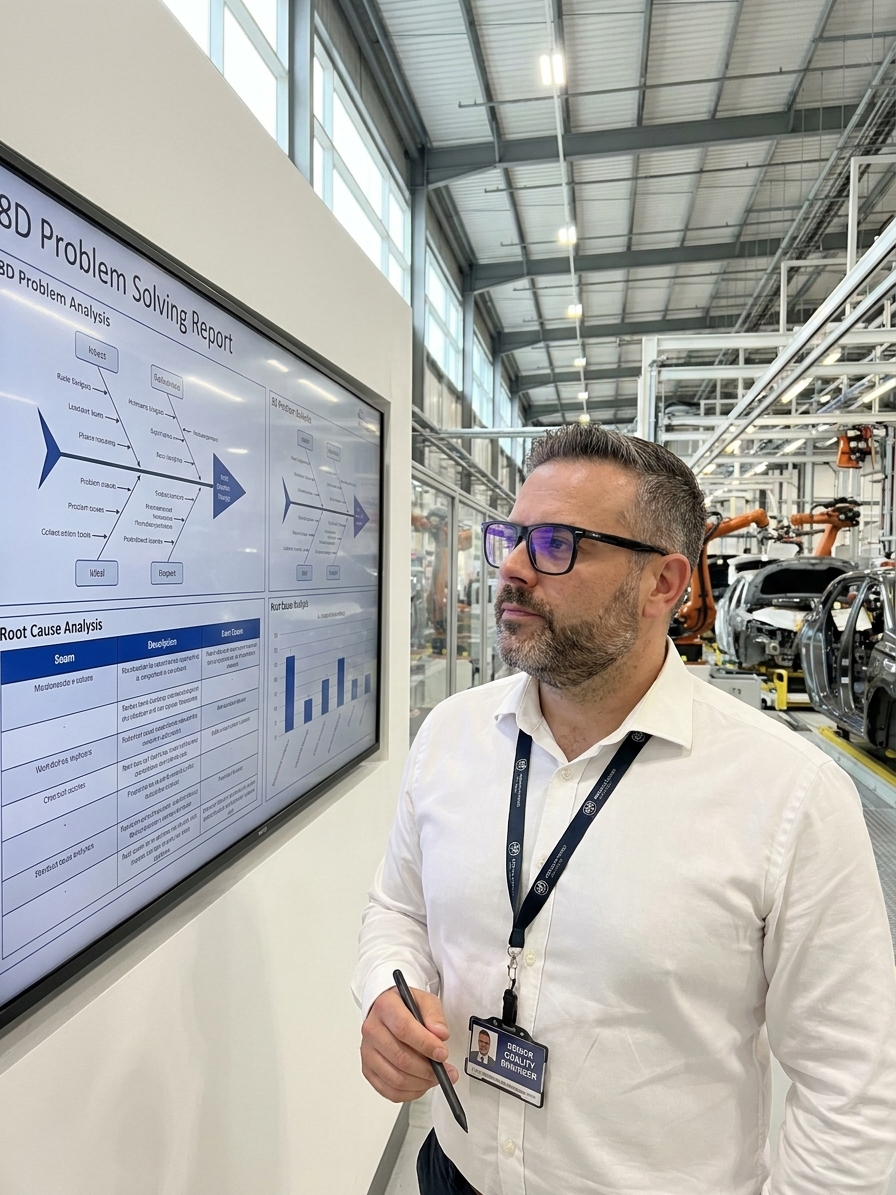
I have audited dozens of plants where a recurring defect escapes to the customer three times in eighteen months. The standard organisational response is predictable: replace the defective parts, send an apology letter, and add a 100% incoming inspection. When the defect inevitably returns, management stares at the nonconformance report feeling betrayed by the process.
This cycle happens because the organisation treated the symptom. Adding an inspection step is a band-aid that stops the bleeding but ignores the wound. What is needed is a methodology that hunts down every systemic condition allowing the defect to exist and eliminates them permanently.
8D Problem Solving, originally developed by Ford in the late 1980s, was built to force this exact discipline. It provides a rigorous framework that moves teams past assumptions to verifiable root causes. In quality engineering, three identical escapes are not a coincidence; they are proof your corrective action system is broken.
Mobilising the Investigation: D0 Through D3
The first half of the 8D process establishes urgency and stops the bleeding. D0 requires assessing severity to determine if a full investigation is warranted. A safety-critical failure demands immediate resources; a one-time cosmetic anomaly does not. Organisations routinely underestimate severity here, dismissing the first escape as a fluke and losing critical investigation time.
D1 mandates a cross-functional team. You need a champion with authority to allocate resources, a leader to drive the timeline, subject matter experts, and someone with fresh eyes to challenge groupthink. A team made entirely of quality engineers will only produce a quality-engineering answer. Include the operator, the maintenance technician, and the product designer to get the right answer.
D2 forces precise problem description using the 5W2H framework. Most problem statements are conclusions disguised as observations. Stating 'the supplier sent defective parts' is a conclusion. Stating 'three of fifty bracket assemblies exhibited fracture cracks at the weld seam' is a description. If your statement contains the word 'because', you have skipped directly to root causes.
D3 implements interim containment actions. You quarantine suspect lots, sort inventory, and modify processes temporarily to protect the customer. The trap is letting containment become permanent. Every extra inspection step that exists because 'we had that problem once' is a monument to an unfinished 8D.

The Heart of the Method: D4 Root Cause Analysis
Root cause analysis is where an investigation earns its keep. It is not a single tool, but a disciplined convergence of multiple techniques. The 5 Whys forces you past the first plausible answer to a cause you can act on. Ishikawa diagrams map causes across Man, Machine, Material, and Method to prevent fixating on one failure mode.
Comparative analysis and fault tree analysis provide further mechanistic depth. You compare good parts to bad parts to identify the exact variable that changed. This eliminates the organisational habit of treating a symptom as the root cause. The first answer is almost always superficial; the real systemic failure is two or three levels deeper.
The critical rule of D4 is verification. You must reproduce the defect under controlled conditions. You prove that when the identified cause is present, the defect occurs, and when it is eliminated, the defect stops. Without this verification step, any subsequent corrective action is mere guesswork disguised as engineering.
D4 Root Cause Verification Sequence
- 01Identify Potential CausesUse Ishikawa and 5 Whys to map failure modes across Man, Machine, Method.
- 02Compare Good vs BadAnalyse process data to isolate variables that differ between conforming and nonconforming output.
- 03Reproduce FailureTrigger the defect under controlled conditions to prove the causal mechanism.
- 04Verify EliminationRemove the variable and confirm the defect stops occurring.
Designing and Validating Systemic Corrective Actions
D5 develops the permanent corrective action. This solution must target the verified root cause, not just the symptom. It must be provable before full implementation and sustainable without heroic effort. Implementing the easiest corrective action instead of the most effective one is a common failure mode. If the fix does not eliminate the root cause, it is not a fix.
D6 requires rigorous validation. Immediate verification confirms the defect stops. Statistical confirmation proves process capability metrics improve and stabilise. Customer verification ensures the escape is genuinely resolved. This phase is where you remove the D3 containment actions; if you cannot remove the sorting operation without the defect returning, the corrective action failed.
Validation demands sustained performance data, typically monitored for 30 to 90 days. Declaring victory after one good production batch is a critical error. Without statistical proof of sustained capability, the organisation risks relapsing into firefighting the moment attention shifts.
Preventing Recurrence and Closing the Loop
D7 is what separates world-class organisations from the rest. The root cause found in D4 was the technical cause. D7 looks for the systemic cause. It asks what management decisions, procedural gaps, or training failures allowed the defect to exist in the first place.
Applying lessons broadly means updating PFMEAs, revising control plans, and modifying audit checklists. If the same latent conditions exist in similar processes, D7 demands you apply the corrective action there proactively. Skipping D7 solves the immediate problem but leaves ten identical vulnerabilities waiting to trigger.
D8 recognises the team. Problem-solving requires confronting uncomfortable organisational truths. If management skips recognition, people learn that thorough investigation is career-limiting while superficial band-aids are rewarded. A formal closure meeting signals that genuine root cause analysis is a core operational value.
The first answer in root cause analysis is almost always a symptom; the real cause is buried under systemic habits.
Organisational Maturity and the 8D Curve
Organisations do not master 8D overnight. Where a plant sits on the maturity curve dictates its quality culture. Most manufacturing facilities sit between compliance-driven and procedure-driven, performing 8D merely to satisfy customer mandates rather than to learn.
Compliance-driven plants fill templates with generic language. Root cause analysis stops at 'operator error' and corrective actions default to 'retrain operator'. Procedure-driven plants follow the steps technically but focus on closing the report. Problems recur because the focus is on paperwork, not systemic learning.
The leap to a learning-driven culture requires confronting ugly truths. It demands management hold people accountable not for having problems, but for failing to solve them properly. A prevention-driven plant embeds this thinking into daily work, investigating potential failures with 8D rigour before they ever escape to the customer.
8D Organisational Maturity Levels
- Level 1: Compliance-DrivenReports are templates. Root cause defaults to 'operator error'. Nothing changes.
- Level 2: Procedure-DrivenTools are used correctly, but the goal is closing the 8D, not systemic learning.
- Level 3: Learning-DrivenTeams dig deep, challenge assumptions, and share lessons across the plant.
- Level 4: Prevention-Driven8D rigour is applied proactively to potential failures before they occur.
The True Cost of Shortcutting the Methodology
Consider a real-world failure where an engineering design decision created a stress concentration at a weld joint. This latent flaw only surfaced under specific loading conditions in the customer's actual use environment, conditions never captured in the original design requirements. The defect escaped three times over eighteen months.
The first occurrence cost roughly 15,000 USD in scrap and emergency freight. The second occurrence triggered an ongoing 45,000 USD annual cost for incoming inspection. The third occurrence stopped production for four hours, wiping out nearly 50,000 USD in throughput and triggering a customer audit.
The total direct cost of those three escapes exceeded 180,000 USD. A proper 8D investigation after the first occurrence would have cost roughly 25,000 USD and prevented both subsequent failures. The organisation did not save money by shortcutting the investigation; it multiplied the cost by a factor of seven.
The Economics of Recurring Defects
Building an 8D Culture in Practice
Implementing the forms is straightforward; building the discipline is difficult. It requires visible management commitment. If leadership demands quick closures and penalises teams for taking time to investigate thoroughly, 8D becomes theatre. Reports will look excellent for auditors while the factory floor continues degrading.
Real capability requires training beyond a one-hour overview. Teams need hands-on practice with actual problems and coaching through the difficult steps. Early efforts benefit immensely from experienced facilitators who have led dozens of investigations and can guide teams past the trap of accepting the first plausible answer.
Every completed 8D must be reviewed by someone outside the team. Fresh eyes catch verification gaps that invested eyes miss. The root causes and systemic fixes must feed into a searchable database, transforming isolated problem-solving into institutional knowledge that prevents the next failure before it starts.
Track the right metrics. Measure recurrence rates, time-to-close, and the technical quality of the investigation. A fast 8D that produces a recurring defect is a failure. The goal is verified elimination, not rapid paperwork. 8D is a commitment to the rigorous work of making sure things never fail the same way twice.