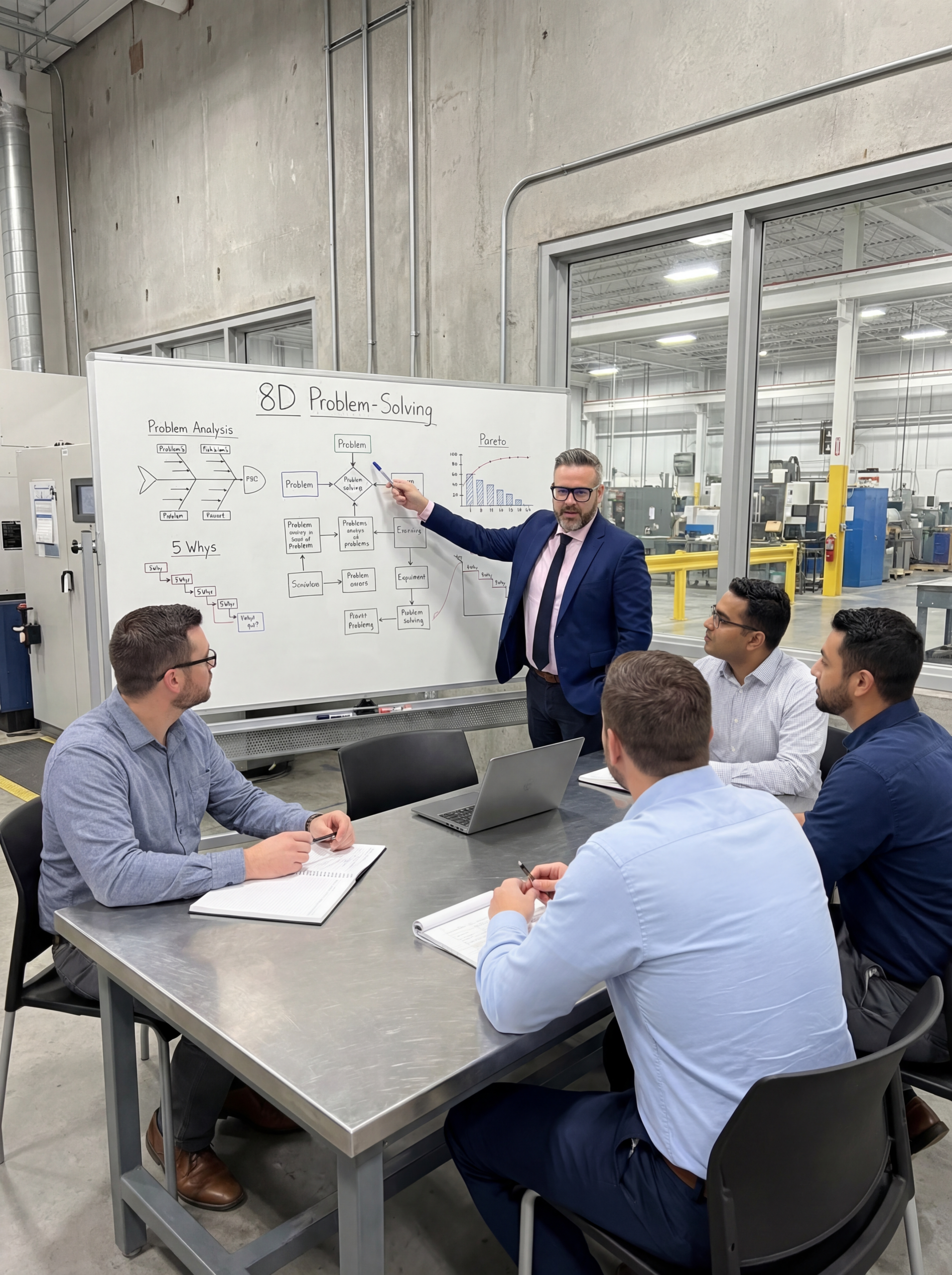
The 8D methodology is the automotive and aerospace standard for eliminating complex, systemic quality failures. Originally developed at Ford, it provides a rigid structure that prevents engineering teams from treating symptoms. In environments governed by IATF 16949 and AS9100, a structured 8D process is frequently the required response to significant field failures and customer complaints.
I encountered the critical need for 8D at an electronics plant supplying General Motors. Customer complaints spiked to twelve units in a single week due to a random electronic control unit reset occurring once every 500 hours of operation. The engineering team had spent five weeks blindly updating firmware, inspecting hardware, and tweaking production lines without making any progress. We were applying disjointed fixes instead of following a verified sequence.
The failure was not a lack of engineering effort, but a lack of systematic problem-solving. Implementing 8D forced the team to stop guessing, contain the defective hardware immediately, and systematically isolate the true root cause. We shifted from random troubleshooting to evidence-based verification.
Knowing When to Deploy 8D
8D is designed for complex, systemic issues where the root cause is unknown. It is the correct tool for recurring customer complaints, unexpected field failures, and defects involving multiple interacting variables. Deploying it signals to the customer that you are applying maximum organisational discipline to their problem.
Applying 8D to simple, one-time errors or obvious training gaps wastes valuable engineering resources. If an operator misses a step and the solution is a documented work instruction update, a full 8D is the wrong tool. Match the methodology to the complexity of the failure.
Choosing the right tool is a fundamental quality engineering skill. Using PDCA or Kaizen for minor process adjustments keeps the 8D system reserved for critical supplier-customer escalations where comprehensive documentation and permanent corrective actions are contractually mandated.
Escalation Thresholds for Problem Solving
Team Formation and Containment (D1-D3)
Demand a multidisciplinary team of three to seven members who have the authority to make immediate decisions. A quality engineer, process engineer, production operator, and customer representative must be dedicated to the task. If team members treat 8D as secondary to their daily routines, the investigation will stall.
In the ECU failure, defining the problem using 5W2H shifted our perspective entirely. The vague claim of random resets became a specific, measurable failure: a reset occurring once every 500 operational hours across all product variants, without warning, resulting in a vehicle stall. Precise definition dictated exactly what data we needed to extract from the field.
Containment must be absolute and immediate to protect the customer while the investigation proceeds. For the ECU issue, we extended the end-of-line functional test from 24 to 48 hours, placed all current stock on hold, and formally notified General Motors. Containment is not a corrective action; it is a temporary shield that must have a clearly defined exit plan.

Isolating and Verifying the Root Cause (D4)
D4 is the core of the 8D methodology. If you identify a symptom rather than a root cause, the problem will return. We used the 5 Whys method to drill down from the observable defect to the fundamental mechanism, supported by Ishikawa diagrams to ensure we were not ignoring other potential variables.
Our 5 Whys analysis traced the ECU reset from a software memory error, to corrupted memory during a write operation, to voltage drops during high-priority tasks, and finally to a race condition in the power management firmware. The language shifted from a hardware defect to a specific software architecture flaw.
Verification is what separates engineering from guessing. We reproduced the race condition in the laboratory. The simulated environment generated the reset in 90% of test cases, confirming we had isolated the true failure mechanism before proposing any corrective actions.
Selecting and Implementing Corrective Actions (D5-D6)
With the root cause verified, D5 requires selecting a permanent corrective action that eliminates the mechanism. We evaluated three options: refactoring the firmware, adding a redundant power supply, or increasing memory protection. The selection criteria were based on which action permanently removed the race condition while remaining technically feasible and cost-effective.
Refactoring the power management firmware was selected. Before touching the production line, we verified the solution in a controlled test environment. The updated firmware ran through 10,000 simulated operational cycles with zero resets. Validation must occur before implementation, never after.
Implementation in D6 requires rigorous change management. We processed a formal change request, updated the technical specifications, retrained the production test engineers, and deployed the firmware over a weekend. Post-deployment verification confirmed that 100% of manufactured units operated on the corrected architecture.
A corrective action without documented prevention is just a temporary fix with a longer shelf life.
Preventing Recurrence and Closing the Loop (D7-D8)
D7 forces the organisation to look beyond the single solved problem. We systematically audited all other firmware modules for similar race conditions, updated the development standards to require race condition analysis, and modified the Product FMEA and Control Plan to include specific screening tests.
Effective prevention updates the quality management system. If your PFMEA and Control Plan remain unchanged after an 8D, you have failed to institutionalise the learning. The documentation must reflect the new reality to protect future product iterations.
D8 formalises team recognition and monitors the results. The ECU investigation dropped customer complaints from twelve per week to zero over the next quarter. Recognising the cross-functional effort ensures engineers remain committed to applying the rigorous 8D methodology the next time a systemic crisis emerges.
Avoiding the Most Common 8D Failures
The most frequent failure I audit is skipping D1 and assigning the investigation to a single quality engineer. A lone engineer lacks the full process context and authority to drive systemic changes. Without a dedicated, multidisciplinary team, the 8D degrades into a paperwork exercise.
Another critical error is implementing corrective actions before verifying them in D4. Pushing an unverified fix into serial production creates new failure modes. Engineering teams must prove the fix eliminates the defect in a simulated environment before submitting a change request for the production line.
The Verification Sequence in D4
- 01Identify mechanismTrace the defect from symptom to fundamental failure using 5 Whys.
- 02Simulate in labReproduce the exact failure conditions in a controlled environment.
- 03Confirm root causeProve the mechanism generates the defect at a statistically significant rate.
- 04Propose solutionDesign a corrective action that breaks the verified failure mechanism.
Finally, neglecting D7 leaves the system vulnerable to parallel failures. Fixing one specific race condition does not prevent the same software architecture flaw from triggering failures in adjacent modules. Systematic prevention requires updating the standardised engineering rules across the entire product portfolio.