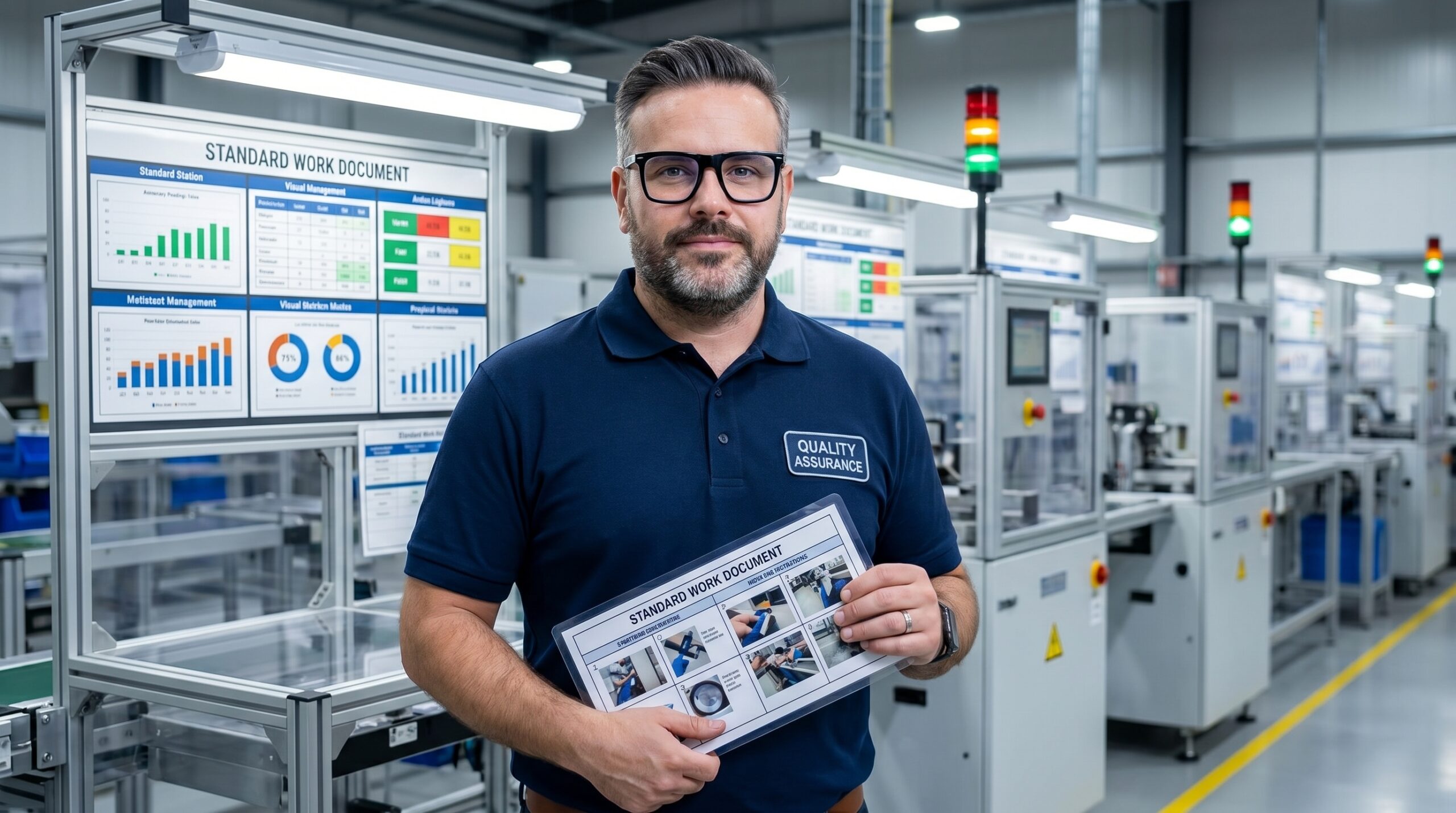
Quality Standard Work: When Your Best Day Becomes Your Every Day — and the Gap Between Your Top Performer and Your Newest Hire Disappears

Uncategorized

Quality Standard Work: When Your Best Day Becomes Your Every Day — and the Gap Between Your Top Performer and Your Newest Hire Disappears

\n

The Day Everything Changed on Line 7

\n

It was a Tuesday morning in a mid-sized automotive parts plant somewhere in the American Midwest. The quality manager — let’s call her Elena — was standing at the end of Line 7, staring at a control chart that made no sense. Monday’s production run had produced 47 nonconforming parts. Friday’s run on the same line, same product, same machines? Three.

\n

Same process. Same specifications. Same raw materials. But fifteen times more defects.

\n

She walked the line twice. Checked the gauges. Reviewed the incoming material certificates. Everything checked out. Then she did something she’d never done before: she watched six different operators perform the same operation, one after another, without intervening.

\n

Operator One loaded the part, pushed the green button, waited for the cycle light, removed the part, checked it visually, placed it in the outgoing rack. Thirty-two seconds.

\n

Operator Two loaded the part, adjusted the fixture with two light taps from a rubber mallet, pushed the green button, watched the pressure gauge climb, waited for the cycle light, removed the part, checked two dimensions with a caliper, logged the result on a sheet, placed it in the outgoing rack. Fifty-one seconds.

\n

Operator Three skipped the visual check entirely. Operator Four used a different clamping sequence. Operator Five — the senior operator, twenty-three years on this line — did something with the coolant flow that nobody had documented and nobody else did. His parts were always perfect.

\n

Elena saw it in that moment. The process wasn’t the process. There were six processes running on one line, and the quality system assumed there was one. The standard didn’t exist. Not really. There was a document called a “Standard Operating Procedure” sitting in a binder on the wall. It hadn’t been updated in four years. Nobody had read it in three. It described a sequence that none of the six operators actually followed.

\n

That Tuesday changed everything for that plant. Because Elena didn’t just fix Line 7. She asked a question that most organizations never think to ask: What is the actual best way to do this work — and how do we make sure every single person does it that way, every single time?

\n

That question is the heart of Quality Standard Work. And the answer is more powerful than most quality professionals realize.

\n


\n

What Standard Work Actually Is — and What It Isn’t

\n

Let’s clear something up immediately. Standard Work is not a rigid, bureaucratic procedure designed to turn human beings into robots. That’s the caricature, and it’s wrong.

\n

Standard Work is the documented current best practice for performing a specific task — captured at a level of detail that allows anyone with the required training to reproduce it consistently. It’s the recipe. Not a suggestion. Not a guideline. The recipe.

\n

Think about it this way: a Michelin-starred restaurant doesn’t achieve consistency by hiring genius chefs and letting them improvise. It achieves consistency by documenting every technique, every temperature, every timing with obsessive precision — and then training every cook to execute that standard until it becomes muscle memory. The standard doesn’t kill creativity. The standard creates the baseline of excellence that makes creativity possible.

\n

In quality terms, Standard Work serves three critical functions:

\n

First, it’s a stabilizer. It reduces the variation that comes from individual interpretation. When ten operators perform a task ten different ways, you get ten different quality outcomes. Standard Work collapses that distribution into one tight, predictable curve.

\n

Second, it’s a baseline for improvement. You cannot improve what you haven’t defined. If there’s no standard, there’s no starting point. Every improvement becomes someone’s opinion about what’s better, with no way to measure whether it actually is. Standard Work gives you the “before” that makes the “after” meaningful.

\n

Third, it’s a training tool. When your best operator retires, takes vacation, or calls in sick, their knowledge shouldn’t leave with them. Standard Work captures that expertise and makes it transferable. It’s the difference between “watch how I do it” and “here’s exactly how it’s done, step by step, with every critical detail documented.”

\n

Toyota understood this from the beginning. Standard Work is one of the foundational elements of the Toyota Production System — not as a constraint, but as the platform upon which kaizen (continuous improvement) is built. At Toyota, the standard is the worst acceptable way to do the job today, and the starting point for finding a better way tomorrow.

\n


\n

The Anatomy of Effective Standard Work

\n

Not all Standard Work is created equal. I’ve seen organizations that confuse a three-page text document with Standard Work. I’ve seen others that think a training video is sufficient. These are ingredients, but they’re not the meal.

\n

Effective Standard Work has several non-negotiable components:

\n

The Task Breakdown

\n

Every task must be broken down into its constituent elements — not at a vague, high level, but at the level of specific physical actions. Not “assemble the bracket.” But “pick up the bracket with your left hand, align the left bolt hole with the fixture pin, lower the bracket until it seats flush, confirm seating with tactile feedback.” This level of detail eliminates ambiguity. It removes the “I thought you meant…” conversations that produce defects.

\n

Key Quality Points

\n

Within each step, there are critical points where quality is determined. These must be explicitly identified. “At this point, verify that the gap between the bracket and the base plate is between 0.5mm and 1.0mm. Use feeler gauge 0.5. If the gauge slides freely, proceed. If it binds, adjust the bracket position before continuing.” These quality checkpoints are the DNA of your standard — they encode the decisions that separate conforming from nonconforming output.

\n

Time Elements

\n

Standard Work includes timing. Not to pressure workers, but to establish rhythm and predictability. When a step takes significantly longer or shorter than the standard time, it’s a signal. Something has changed — the material, the tool condition, the operator’s understanding, or the process itself. Time deviation is a leading indicator of quality deviation.

\n

Visual Aids

\n

Photos, diagrams, color-coded references, physical samples of acceptable and unacceptable output. The best Standard Work documents I’ve seen are heavily visual. They show you what right looks like — and what wrong looks like. They don’t rely on the operator’s ability to interpret text. They put the standard in front of their eyes in a form that’s impossible to misunderstand.

\n

The Reason Why

\n

This is the element most organizations skip — and it’s perhaps the most important. For each critical step, the Standard Work should explain why it matters. Not “check the torque” but “check the torque because insufficient torque allows vibration loosening in the field, which has caused two warranty claims in the last quarter totaling $14,000.” When people understand the reason behind the requirement, compliance stops being obedience and starts being ownership.

\n


\n

The Standard Work Cycle: Document, Train, Audit, Improve

\n

Creating Standard Work is not a one-time event. It’s a living cycle with four phases.

\n

Phase 1: Document

\n

Start by observing your best performer. Not your average performer — your best. Watch them perform the task multiple times. Ask them to narrate what they’re doing and why. Record everything. Then observe a second strong performer. And a third. Look for the common elements that produce consistently excellent results. The standard is the synthesis of the best practices from your best people.

\n

Document using the simplest format possible. A single page with photos and numbered steps beats a ten-page text document every time. The standard should be readable at a glance by someone standing at the workstation with their hands busy.

\n

Phase 2: Train

\n

Training is not handing someone the document and saying “read this.” Training is demonstration, practice, and verification. The trainer performs the task to the standard while the trainee watches. Then the trainee performs the task while the trainer watches. Then the trainer verifies that every critical quality point was executed correctly. Only when the trainee can reproduce the standard consistently — not once, but repeatedly — are they certified on that operation.

\n

This is where most organizations cut corners. They “show them once” and assume competence. The result is the situation Elena discovered on Line 7: six operators, six processes, no standard.

\n

Phase 3: Audit

\n

Standard Work must be audited regularly. Not as a policing exercise, but as a support mechanism. The audit answers one question: “Is the standard being followed, and is it producing the expected results?” If the answer is yes, reinforce it. If the answer is no, investigate why. Is the standard unclear? Is there a physical barrier to following it? Does the operator need retraining? Or has someone discovered a better way — in which case, the standard needs to be updated?

\n

Layered Process Audits (LPAs) are an excellent vehicle for this. Multiple levels of the organization — operators, team leaders, supervisors, managers — each audit Standard Work compliance on a regular schedule. The frequency decreases as you go up the hierarchy, but the visibility increases. Everyone knows that someone is watching. And more importantly, everyone knows why someone is watching.

\n

Phase 4: Improve

\n

Here’s where Standard Work becomes truly powerful. When an operator discovers a better way to perform a task — faster, more reliably, with fewer defects — the standard is updated. Not discarded. Not overridden. Updated. The old standard becomes the baseline. The new standard becomes the target. And the improvement is documented, shared, and deployed across every workstation performing that task.

\n

This is kaizen in its purest form: small, incremental improvements, grounded in a defined standard, validated through measurement, and sustained through documentation. Standard Work isn’t the enemy of improvement. It’s the enabler of improvement. Without it, every improvement is someone’s personal trick that disappears when they do.

\n


\n

The Hidden Costs of Not Having Standard Work

\n

Organizations that operate without effective Standard Work pay a tax they can’t see on any financial statement. Let me describe what that tax looks like.

\n

The Variation Tax: Every operator who performs a task differently introduces variation. Some of that variation produces defects. Some produces rework. Some produces inconsistency that shows up downstream in assembly, testing, or — worst case — at the customer. You can’t control what you haven’t standardized.

\n

The Expert Dependency Tax: When critical knowledge lives in one person’s head, your quality system has a single point of failure. That person gets sick, and quality drops. That person retires, and quality collapses. That person has a bad day, and you ship nonconforming product. Standard Work distributes that knowledge across your entire workforce.

\n

The Training Tax: Without Standard Work, training is ad hoc, inconsistent, and slow. New hires learn from whoever happens to be available, which means they inherit that person’s habits — good and bad. Ramp-up time stretches from days to weeks to months. Quality during the learning period is unpredictable. And the cost of every new hire’s learning curve is absorbed directly into your defect rate.

\n

The Improvement Tax: Without a standard baseline, you can’t measure improvement. You can’t replicate it. You can’t sustain it. Every improvement initiative becomes a project that produces a temporary spike in performance followed by a slow regression to the mean. The organization spends enormous energy running in place.

\n

Add these up over a year — the defects, the rework, the extended training, the failed improvements, the customer complaints, the warranty costs — and the Standard Work tax can easily run into six figures for a mid-sized manufacturing operation. And most organizations don’t even know they’re paying it.

\n


\n

Standard Work in the Digital Age

\n

The principles of Standard Work haven’t changed since Toyota formalized them decades ago. But the tools for implementing and sustaining them have evolved dramatically.

\n

Digital work instructions displayed on tablets at each workstation allow for rich visual content — photos, videos, 3D models — that paper documents can’t match. They can be updated in real time, ensuring that every operator always has the current standard. They can include embedded checks and confirmations that create a digital record of compliance.

\n

Augmented reality is beginning to appear in manufacturing environments, projecting step-by-step instructions directly onto the workpiece. The operator sees the standard overlaid on reality — where to place the part, which bolt to tighten first, what the correct alignment looks like. It’s Standard Work made visceral and immediate.

\n

AI-powered observation systems can monitor whether operators are following the standard without human auditors. Computer vision can detect deviations from the specified sequence, timing, or technique in real time, providing immediate feedback and correction before a defect is produced.

\n

But here’s the critical point: technology amplifies Standard Work, but it doesn’t replace the fundamentals. A beautifully designed digital work instruction that documents the wrong process is worse than a handwritten note that documents the right one. The technology is the delivery mechanism. The content — the careful, observed, validated, best-practice documentation of how the work should be done — is the substance. And that requires human intelligence, human observation, and human judgment.

\n


\n

Implementing Standard Work: A Practical Roadmap

\n

If you’re reading this and recognizing your own organization in the story of Line 7, here’s a practical approach to getting started.

\n

Start small. Pick one critical operation — something with a history of quality issues, something that involves multiple operators, something where you suspect inconsistency. Don’t try to standardize your entire factory at once. One operation. One standard. One success story.

\n

Observe before you write. Spend time at the gemba. Watch the work. Talk to the operators. Understand what they actually do — not what the procedure says they do. The gap between the documented procedure and reality is where your defects live.

\n

Involve the operators. Standard Work imposed from above is resented. Standard Work developed with the people who do the work is owned. The operators know things about the process that no engineer sitting in an office ever will. Tap that knowledge. Make them co-authors of the standard.

\n

Keep it simple. The best Standard Work document is the one that actually gets used. A single laminated page with photos and numbered steps, mounted at eye level at the workstation, beats a beautifully bound manual sitting in a rack across the room.

\n

Audit and sustain. The standard is only as good as its last verification. Build audit schedules, assign owners, and make compliance visible. When deviations occur, treat them as learning opportunities, not punishable offenses. You want people to follow the standard because they understand its value, not because they’re afraid of getting caught.

\n

Improve relentlessly. Every standard should have a revision date and an owner responsible for keeping it current. When someone finds a better way, celebrate it, document it, and share it. The standard should evolve continuously — always getting better, always reflecting the current best knowledge of the organization.

\n


\n

The Deeper Truth

\n

Let me return to Elena and Line 7. What she discovered that Tuesday morning wasn’t really about Standard Work. It was about something deeper: the relationship between variation and quality.

\n

Quality, at its core, is the absence of unwanted variation. We design products with specifications that define acceptable variation. We build processes with controls that limit variation. We inspect to catch the variation that escapes our controls. Everything we do in quality management is fundamentally about managing variation.

\n

And the single largest source of variation in most manufacturing processes is not the machines, not the materials, not the environment — it’s the method. The way the work is performed. When ten people perform the same task ten different ways, you’ve introduced a source of variation that no amount of machine calibration or incoming inspection can compensate for.

\n

Standard Work eliminates method variation. Not by making humans into machines, but by capturing and deploying the collective intelligence of your best performers so that everyone benefits from it. It takes the best possible outcome and makes it the expected outcome. It takes your best day and makes it your every day.

\n

That’s not bureaucracy. That’s wisdom.

\n

After Elena implemented Standard Work on Line 7, the defect rate dropped from an average of 28 nonconformances per shift to four. Not zero — Standard Work isn’t magic. But it was predictable. And predictable quality is the foundation upon which you can build everything else: improvement, innovation, customer trust, market reputation.

\n

The operators on Line 7 didn’t feel like robots. They felt like experts. Because they had a document that captured the best of what they collectively knew, and they could execute it with confidence, knowing that every person on the line was doing it the same way — the best way they’d found so far.

\n

And when one of them discovered a small improvement — a slightly better grip, a faster verification technique, a reordering of steps that saved three seconds without sacrificing quality — they didn’t keep it to themselves. They shared it. Because the standard belonged to all of them.

\n

That’s what Standard Work really is. Not a constraint. A shared commitment to excellence, documented, sustained, and continuously improved.

\n

Your best day. Every day. For everyone.

\n


\n

Peter Stasko is a Quality Architect with 25+ years of experience transforming manufacturing organizations from reactive fire-fighting to systematic excellence. He specializes in building quality systems that don’t just comply with standards — they set them. His approach combines deep technical expertise with practical, shop-floor-tested methods that work in the real world, not just in textbooks.

Scroll top