
I have audited dozens of plants holding IATF 16949 and AS9100 certifications that still cannot hold a Cpk of 1.33 on critical characteristics. The paperwork is pristine. The PFMEA binders are updated. The nonconformance reports are filed on time. Yet the scrap rate fluctuates wildly, customer complaints persist, and 8D investigations repeatedly identify operator error as the root cause.
The failure is rarely the standard. The failure is the disconnect between the management system and the shop floor. When quality relies entirely on a final inspector catching defects, you have built an expensive sorting operation. When quality is driven by the operator at the process, you achieve first-time-through capability.
Transforming quality performance requires transforming operator behaviour. This means engineering a culture where reporting a defect is rewarded, not punished, and where shift leaders make decisions based on data rather than output pressure. Culture is not an abstract HR concept. It is the measurable difference between a process that drifts out of control and one that self-corrects.
From Blame to Process Control
In fear-driven environments, operators hide deviations to avoid reprimand. This guarantees that systemic defects remain invisible until they reach the customer. During my work building a greenfield QA/QC department for a 900+ employee plant at SNOP, the first hurdle was establishing psychological safety. Operators had to trust that pulling the andon cord or stopping the line would trigger support, not disciplinary action.
We replaced blame with process control. When a dimension drifted, the reaction plan dictated the response, not the shift supervisor's mood. This is where PPAP and Control Plan requirements intersect with human behaviour. If the Control Plan says to check a feature every 25 pieces, the culture must make it socially unacceptable to skip that check to hit a production target.
The consequence of this shift is immediate. Escapes drop because deviations are caught at the source. Internal rework costs fall because problems are contained before they multiply. The quality department stops acting as a police force and starts functioning as a process engineering resource.
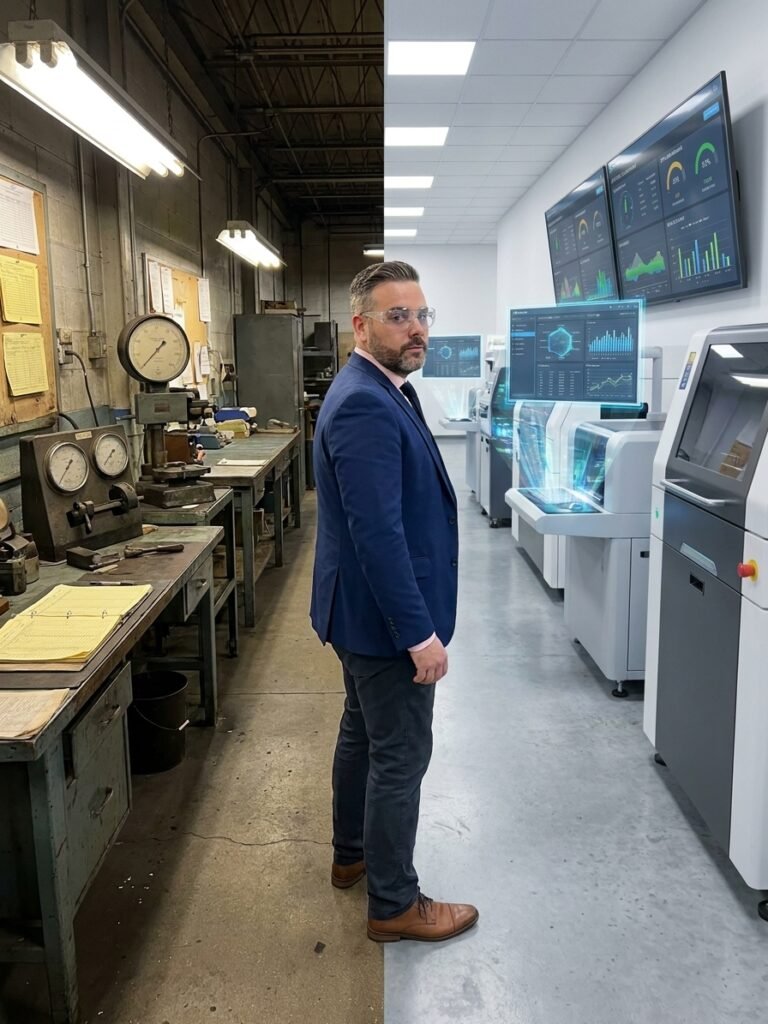
Engineering Ownership on the Shop Floor
Ownership cannot be mandated in a morning briefing. It must be built through structured competence and clear authority. I introduced Routing Verification KPIs at a major aerospace manufacturer specifically to push verification authority upstream. By giving operators the responsibility to verify routing and quality at their own stations, we cut internal lead time by 97%.
This requires precise role definition. The operator owns the process output. The quality engineer owns the measurement system analysis (MSA) and capability studies. The shift leader owns resource allocation and escalation. When these boundaries blur, ownership evaporates, and quality becomes nobody's job.
To make ownership measurable, track the rate of operator-initiated stops and improvement suggestions. A floor that reports zero near-misses is not a safe floor; it is a silent floor. High-performing lines log interventions because operators are actively monitoring variation against the control plan limits.
The Mechanisms of Open Communication
Open communication in quality management requires specific mechanisms, not just encouragement. Tiered daily management meetings are the most effective structure. Shift start-up meetings review the previous shift's quality issues, open 8D actions, and highlight specific risks for the current shift.
These meetings must be driven by visual management. A board displaying OEE, scrap trends, and open corrective actions forces the conversation. If the data is invisible, the problems remain anecdotal. The goal is to move problem-solving from the back office to the Gemba.
Problem-Solving Culture Shift
Reactive Blame Culture
- Operators hide deviations to hit output targets
- Quality acts as a sorting filter at the end of the line
- 8D root causes default to operator error
- High variability and recurring customer escapes
Data-Driven Ownership
- Operators stop the line when variation exceeds limits
- Quality engineers focus on process capability and MSA
- Root cause analysis targets system and process failures
- Stable processes with predictable Cpk and low scrap
Sustaining the Transformation Through Measurement
A cultural shift will regress without continuous measurement. Standard quality metrics like PPM, scrap rate, and on-time delivery are lagging indicators. To measure the health of the culture itself, you need leading indicators tied to engagement and system usage.
Track the closure rate of corrective actions, the frequency of MSA studies, and the percentage of shifts hitting first-time-through targets. If these numbers trend downward, the culture is slipping, regardless of what the final monthly PPM report says.
The standard only defines the framework. The operators define the reality of the process.
Link engagement to process capability. When a team adopts a new SMED technique or integrates a new poka-yoke device, measure the resulting OEE and setup time reduction. Quantifying the output of behavioural change proves to the organisation that the cultural shift has tangible financial value, converting sceptics into advocates.
Indicators of Cultural Health
Building Resilience Against Production Pressure
The most fragile moment for any quality culture is during a capacity surge or launch phase. Production managers are incentivised by volume, creating intense pressure to bypass standard work, skip MSA validations, or delay preventative maintenance. This is when the quality system must hold firm.
Leadership determines the outcome. If a plant manager tells a shift to ship a nonconforming part to hit a delivery target, the entire quality culture collapses. The operators learn instantly that the ISO 9001 certificate is theatre. Leadership must enforce the standard, even at the cost of a missed shipment.
I have seen technical improvements like automated inspection systems fail because the underlying culture valued output over accuracy. The technology catches the defect, but the culture dictates whether the part is actually quarantined or quietly pushed through. Resilience is built when leadership refuses to accept deviations, anchoring the standard firmly to daily operations.