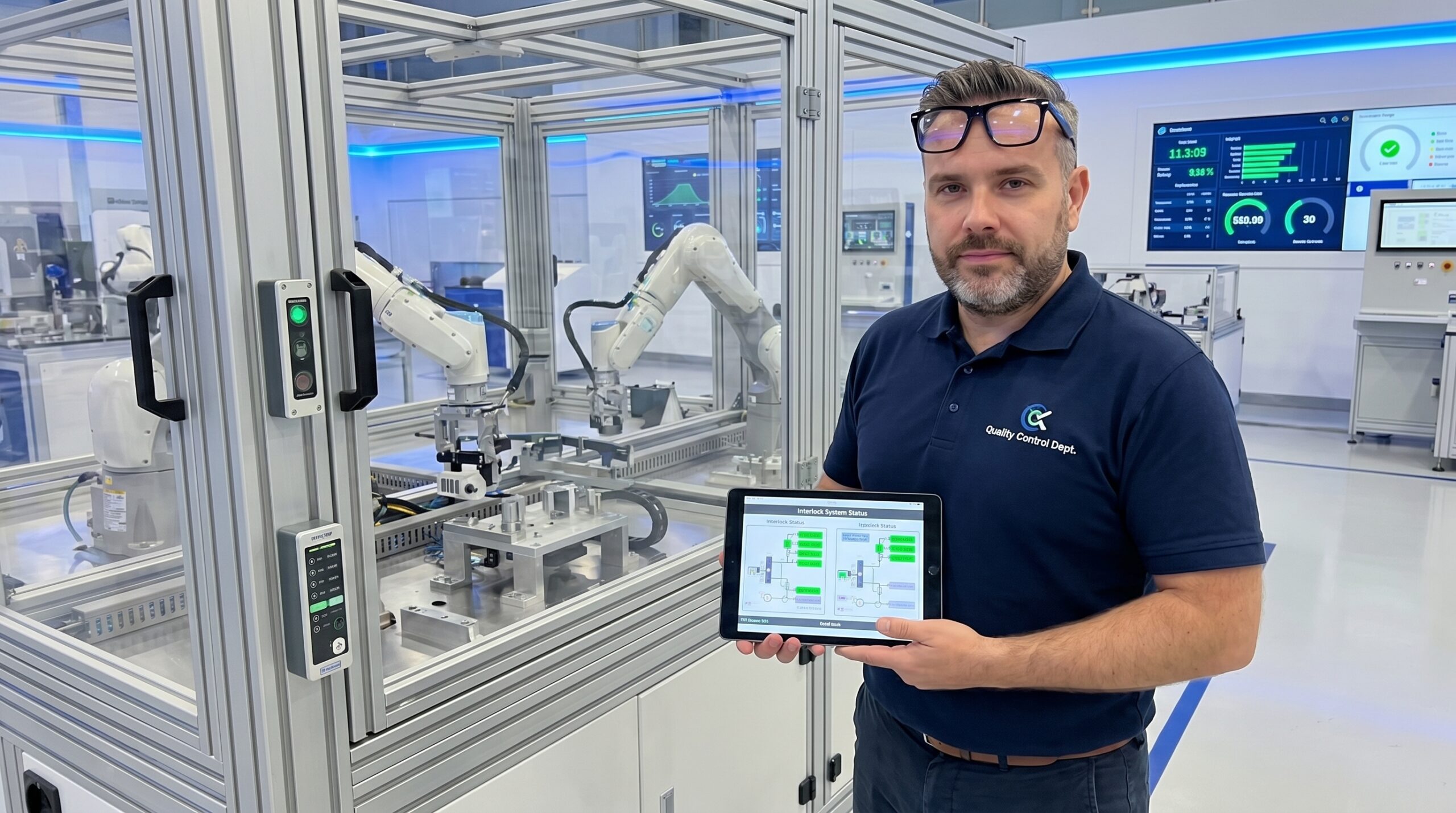
A high-speed automotive stamping line running at 14 strokes per minute relies on a robotic arm to feed a 600-ton press. Every cycle, a sensor verifies that the previous part has been ejected before the next blank loads. When that sensor fails, the press relies entirely on the operator hitting the emergency stop. An experienced operator might catch the half-second delay in the sound rhythm. But relying on human reflexes to prevent a double-stamp, die destruction, and a safety incident is not a quality strategy. It is a gamble.
The investigation following such an event typically praises the operator, issues a safety award, and documents the heroic save in the plant newsletter. The critical engineering question remains unasked: what happens when the operator is on a break? The failure to answer this leaves the process one bathroom break away from disaster. The correct response is a complete redesign of the interlock logic so the press is physically incapable of closing unless multiple independent verification systems confirm it is safe.
I have implemented and transitioned quality systems at a major aerospace manufacturer, SNOP, and WITTE Automotive. Across these sectors, I consistently see organizations relying on detection rather than prevention. A quality interlock is a built-in mechanism—mechanical, electrical, or software-based—that prevents a process from proceeding when conditions for producing conforming output are not met. Inspections catch defects after they occur. Interlocks ensure the conditions required to produce a bad part are engineered out of existence.
Distinguishing Poka-Yoke from Quality Interlocks
Quality interlocks apply the philosophy of machine safety to product quality. In safety engineering, you cannot open a machine guard while the spindle is spinning. You cannot start a laser cutter with the door open. These are mandatory, hard physical stops. Quality interlocks apply this same absolute logic to product conformity. The machine simply will not cycle if the parameters are wrong.
This concept is distinct from poka-yoke, though the two are related. Poka-yoke makes errors harder to commit. A poka-yoke fixture uses geometry to ensure a part only fits in the correct orientation. A quality interlock takes this further by physically preventing the machine from cycling. It requires a sensor to confirm the part is present, oriented correctly, and dimensionally accurate before the operation begins.
Poka-yoke prompts the operator to do the right thing. A quality interlock removes the operator from the equation. It locks the process. If the verification fails, the equipment does not run. This distinction is critical when designing PFMEA controls. A poka-yoke is a useful control, but an interlock is an absolute guarantee of process state.
The Five Levels of Interlock Maturity
Not all interlocks provide the same level of risk mitigation. Over 20 years of auditing and designing manufacturing systems, I have identified five distinct levels of interlock maturity. Most organizations operate at Level 2 or Level 3. World-class operations function at Level 4. Almost nobody has achieved true Level 5 capability.
Interlock System Maturity Matrix
- Level 1: ProceduralProcess relies on human discipline, work instructions, and checklists. Vulnerable to distraction and human error.
- Level 2: Detection-BasedSensors and alarms notify operators of issues, but the process continues running until manual intervention occurs.
- Level 3: Prevention-BasedThe process stops itself automatically when predefined conditions are not met. No human permission required.
- Level 4: AdaptiveSystem correlates multiple data streams in real time to stop processes before individual parameters breach specification.
- Level 5: Self-HealingSystem detects anomalies, automatically adjusts parameters to regain control, and verifies the correction.
Level 1 relies on human discipline. Work instructions say to verify temperature before starting the cycle. This works when people are alert and undistracted. Which is to say, it works inconsistently. Organizations at Level 1 experience periodic unexplained quality escapes that investigators blame on human error. Blaming human error is the organizational equivalent of blaming gravity for a plane crash. It was involved, but it is not the root cause.
Level 2 introduces sensors and alarms. If a parameter drifts, a light flashes. The system tells a human something is wrong and waits for a response. The process continues producing defects until the human acts. Detection systems assume the human is present, attentive, and empowered to stop production. Under manufacturing pressure, operators frequently acknowledge alarms and keep running.
Level 3 gives the machine authority to stop itself. The press will not cycle if the blank is absent. The dispensing valve will not open if the recipe is unloaded. This is where modern IATF 16949 and AS9100 systems aim. The machine refuses to continue until the condition is rectified. However, these interlocks are designed around known failure modes. Unanticipated failures can still slip through.
Level 4 systems correlate multiple data streams to detect anomalies before any single reading goes out of tolerance. An adaptive system might monitor the acoustic signature of a resistance spot welding operation alongside current draw and gas flow. It stops the process when the combination suggests a cold weld, even if individual readings pass. Level 5 takes this further by automatically adjusting parameters to bring the process back into control and verifying the adjustment.
Architecture: Designing for Failure Modes
Designing quality interlocks requires systematic thinking about verification pathways and reliability mathematics. Every interlock begins with a specific failure mode. If your Process FMEA has not identified what can go wrong concretely, you cannot design an interlock to prevent it. The PFMEA is the foundation of interlock design.
For every failure mode identified in the PFMEA, ask if an interlock can be engineered to prevent it. Not every failure mode can be interlocked. Visual inspection for cosmetic defects remains inherently human-dependent. However, mechanical and dimensional failures are highly receptive to interlocking. The engineering discipline lies in rigorously reviewing the FMEA for these opportunities.
A single sensor is a single point of failure. When the consequences of failure involve safety risk or catastrophic quality escape, the interlock system requires redundant verification. At least two independent systems must confirm a condition before the process proceeds. In the stamping line example, the redesigned architecture requires three independent verifications before the press cycles.
Multi-Sensor Redundant Verification Logic
- 01Photoelectric SensorDetects physical part presence and position within the die cavity.
- 02Limit SwitchMechanically confirms the ejection arm has completed its full stroke.
- 03Current MonitorVerifies the force profile of the ejection cylinder motion.
- 04PLC Logic GateRequires all three inputs to agree. If one disagrees, press stops. If two disagree, press locks out.
This is not over-engineering. It is risk-appropriate engineering aligned with the severity rating in the FMEA. A double-stamped structural component could cause a vehicle failure. The cost of three sensors is negligible compared to the cost of a recall. The architecture ensures that if one system fails silently, the other two prevent the defect.
The Danger of Silent Failures
An interlock that has failed silently is worse than no interlock at all. It provides false confidence. If a sensor breaks and the process runs anyway because the PLC assumes everything is fine, you have created the illusion of control. Interlock systems must be designed to detect their own hardware and software failures.
The most effective method is the normally-closed principle borrowed from machine safety engineering. Design interlocks so the default state is the safe state. When a sensor loses power, a wire breaks, or a PLC output fails, the circuit opens and the process stops. If the communication link is severed, the process stops. Failures must trigger safe shutdowns, not silent continuations.
More sophisticated systems include periodic self-tests. The PLC introduces known test signals and confirms the expected response from the interlock sensors. IATF 16949 and safety standards often require safety-critical interlocks to self-test at the start of every shift and after every cycle interruption. This catches sensor degradation before it allows a defect to pass.
A process that relies on human reflexes to prevent destruction is a gamble, not a quality strategy.
Managing Overrides and the Cultural Dimension
At some point, someone will need to override an interlock for maintenance or setup verification. When production is behind schedule, plant managers frequently demand bypasses. The question is not whether overrides will be requested, but whether your system manages them with the rigor they demand.
An effective override management system enforces strict authorization levels. Not everyone can bypass an interlock. Overrides must have time limits that force periodic reassessment. Every bypass must be logged—who authorized it, when, why, and for how long. Crucially, when an interlock is overridden, a documented compensating control must take its place. If there is no alternative verification, the override must be denied.
I have audited plants where interlock overrides are treated as an informal nuisance. Operators tape over sensors or jumper connections to keep cycle times low. Those plants always have unexplained quality escapes. The interlocks were signalling a systemic problem, and nobody was listening. Repeated overrides are an escalation trigger that something in the process design needs engineering attention, not a bypass code.
Technology alone does not create effective interlocks; culture does. In a healthy quality culture, when a machine stops itself, the first response is curiosity, not frustration. The operator does not feel blamed. The maintenance team investigates the root cause. When leadership treats interlock triggers as valuable data rather than inconvenient interruptions, the organization learns from its processes.
Validation, Common Failures, and Implementation
Engineers frequently design interlocks for the happy path. They anticipate that a blank is present or absent. They rarely account for the pathological case. What if the blank is present but damaged? What if the fixture is loaded with the wrong part that passes the presence check? Effective interlock design requires adversarial thinking. Assume the process is actively trying to defeat your interlocks and design for the worst-case scenario.
Interlocks are validated during PPAP and process launch. Then the process runs for years. New product variants are introduced. Software is updated. Worn components are replaced. A sensor aligned for a specific feature will not work for a new variant. Without periodic revalidation, your interlock system becomes a monument to launch engineering, disconnected from the running reality.
Best practice demands revalidating critical interlocks after every engineering change, every major maintenance event, and on a defined periodic basis. Quarterly validation is appropriate for safety-critical interlocks. Annual validation suits quality-critical controls. This ensures the architecture maintains its integrity over the lifecycle of the equipment.
Implementing this architecture requires a structured approach. Phase one is an assessment of existing controls mapped against FMEA failure modes. Phase two prioritises design for the highest severity gaps. Phase three implements the validated interlocks and trains operators on the new physical limitations. Phase four establishes ongoing validation schedules and monitors trigger rates to continuously tune detection thresholds.
A quality interlock is a philosophical statement. It states that we do not trust the process to always work correctly, and we do not trust humans to always be vigilant. We build quality into the system architecture so that conformity is the inevitable outcome of the process running as designed. When the process handles its own vigilance, human operators are liberated to focus on continuous improvement and innovation.