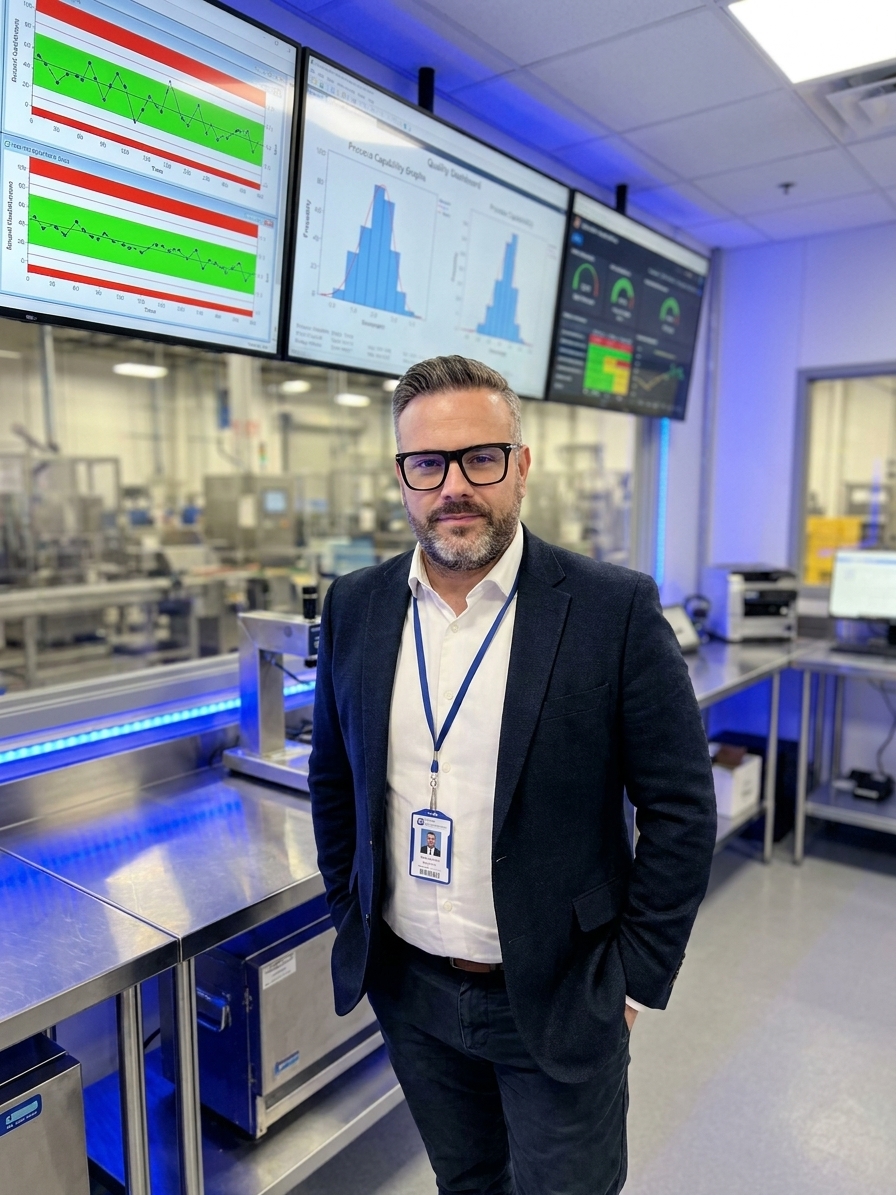
An audit was proceeding flawlessly. The plant manager walked the auditor past pristine workstations, referenced the latest Cpk numbers, and presented the visual management boards with the quiet confidence of someone who has done this dozens of times. The nonconformance rate sat well below target. The team knew their procedures. The auditor would find nothing, because there was nothing to find.
The auditor did find something. Not in the documentation or the metrics, but in a conversation with a line operator who casually mentioned skipping a cleaning step on the third shift for three months. The new product formulation did not seem to need it. Nobody had authorized the change, nobody had documented it, and nobody had asked whether it was acceptable. The results looked fine, and the operator genuinely believed they were doing the right thing. The plant manager had no idea.
That gap between the plant manager's confident belief that the process was running perfectly and the reality that a critical step had been silently abandoned is the overconfidence effect in action. It is one of the most dangerous, most invisible, and most widespread quality failures in manufacturing today. I have audited dozens of plants across automotive and aerospace, and the pattern is identical: the teams most certain of their quality are often the ones most blind to its erosion.
What the Overconfidence Effect Actually Is
The overconfidence effect is a cognitive bias where people systematically overestimate their own abilities, knowledge, and predictions. It is not arrogance or carelessness. It is a fundamental feature of how human cognition works. Decades of research show that when asked to estimate a range within which they are 90 percent certain the true value falls, people typically produce ranges that contain the correct answer only about 50 percent of the time.
This is not a character flaw. The brain optimizes for speed and decisiveness. In most situations, being roughly right quickly is more useful than being exactly right slowly. But in quality management, where the difference between roughly right and exactly right is measured in customer complaints, warranty claims, and regulatory citations, overconfidence becomes a precision instrument for producing exactly the kind of failure you were trying to prevent.
The bias operates differently from ignorance. An untrained operator knows they lack knowledge and will seek guidance. An overconfident expert has been right enough times that they have stopped questioning whether they might be wrong. They feel just as certain about things they are wrong about as they do about things they are right about. The internal experience is identical, which is why self-diagnosis is practically impossible.
How Overconfidence Shows Up in Quality Organisations
Overconfidence shows up everywhere in quality management. The problem is that it looks like competence. That is what makes it so dangerous. The team that says they have been running a process for fifteen years and know it inside out is probably right about their experience but wrong about their comprehension. Familiarity is not understanding.
The process confidence trap manifests when organisations stop monitoring processes they consider stable. If a process has been running well for months, the instinct is to redirect inspection resources to newer or more problematic areas. This is rational resource allocation on the surface. But stable processes do not stay stable on their own. Tooling wears, material lots change, and environmental conditions shift. The overconfident organisation does not notice because it stopped looking.

Experienced operators also begin making adjustments based on feel rather than data. They have seen the problem before and know what to do. Sometimes they are right. But sometimes they are treating a symptom while the root cause deepens, and by the time the feel-based adjustments stop working, the problem has compounded into something far larger than it needed to be. The confidence comes from pattern recognition, not from statistical evidence.
Supplier evaluation suffers the same distortion. An audit captures what a supplier wants you to see during the two days you are there. The overconfident organisation treats this snapshot as a comprehensive assessment and moves on. Meanwhile, the supplier's actual quality system, the one that operates when no one is watching, may look nothing like the version documented in the audit report.
The Capability Mirage and Risk Assessment Illusion
Statistical process capability is one of the most powerful tools in quality management. It is also one of the most frequently misinterpreted. A Cpk of 1.67 tells you that your process was capable during the period when the data was collected. It does not tell you that your process will remain capable, that your measurement system is adequate, or that the specification limits are correct. Overconfident organisations treat capability indices as proof of permanent excellence rather than temporary measurements requiring continuous validation.
Risk assessment tools like PFMEA and hazard analysis suffer the same distortion. When teams assess the likelihood of a failure mode, they are making predictions. Research on prediction shows that experts in a domain are often more overconfident than novices. The novice knows they do not know. The expert has stopped questioning whether they might be wrong. The people most qualified to conduct a risk assessment are also the people most likely to underestimate the risks they are assessing.
The False Certainty Gap in Expert Prediction
I once reviewed a PFMEA for a medical device assembly process where the team had rated every single failure mode as low or very low likelihood. When I asked whether they had considered the possibility that their ratings might be optimistic, the response was immediate and confident: we know this process, these ratings are accurate. Six months later, a failure mode they had rated as very low occurred three times in one week, triggering a product recall. The ratings had not been accurate. They had been overconfident.
The Cognitive Architecture of Overconfidence
Several interconnected cognitive mechanisms produce the overconfidence effect, and understanding them is the first step toward building defences. The better-than-average illusion is the tendency for most people to rate themselves as above average on desirable traits. In quality organisations, this shows up as every department believing it is performing better than the company average and every plant believing it is the best in the network. Statistically, this cannot all be true, but the belief persists because it feels true.
Hindsight bias transforms past uncertainties into apparent certainties. After a defect occurs, everyone can see the cause. It was obvious, the data was there, how did anyone miss it? This retrospective clarity is an illusion. Before the event, the cause was not obvious at all, the data was buried in noise, and reasonable people could disagree about what it meant. Hindsight bias convinces the organisation that the problem was predictable, which feeds overconfidence about predicting the next one.
Self-serving attribution completes the trap. When a process runs perfectly, it is because the team is excellent. When it produces a defect, it is because the material was bad, the machine acted up, or the customer was unreasonable. This pattern systematically inflates the organisation's assessment of its own competence while deflecting the evidence that would correct it. Each success is internalised as proof of skill, each failure is externalised as an anomaly.
Building Defences: What Actually Works
You cannot eliminate overconfidence. It is baked into human cognition. But you can build systems that compensate for it, detect it, and limit the damage it causes. The countermeasures are not exotic. They are disciplined practices that treat confidence as a hypothesis to be tested rather than a fact to be trusted.
Calibration Cycle for Quality Predictions
- 01PredictBefore an audit or process review, each team member states their confidence level for finding a major nonconformance.
- 02RecordCapture every prediction in writing with the associated probability estimate.
- 03CompareAfter the audit, measure actual findings against the stated confidence levels.
- 04AdjustReview the calibration gap and use it to recalibrate future risk assessments and FMEA ratings.
Calibration training is one of the most effective countermeasures and one of the least used in quality management. Before a process audit, have each team member estimate the probability of finding a major nonconformance. Record these estimates. After the audit, compare predictions to reality. Do this consistently, and the team will discover that their 90 percent confident predictions are correct only 70 percent of the time. Over repeated cycles, the act of tracking and comparing will naturally improve calibration.
Red teams are another proven defence. A red team is a designated group whose job is to challenge assumptions, find weaknesses, and argue the opposing case. In quality management, this means explicitly assigning someone to argue that the PFMEA is incomplete, that the capability study is flawed, or that the supplier audit missed something critical. The red team does not need to be right. They need to force the primary team to defend their conclusions with evidence rather than confidence.
Separating Belief From Evidence
Introduce a simple distinction in all quality discussions: things the team believes based on experience and things the team knows based on data. Both are valuable, but they should be labelled differently. Decisions based on belief should carry a different weight than decisions based on evidence. Walk into any quality review meeting and listen carefully. You will hear statements like that process is stable or we have never had a problem with that supplier. These are beliefs, not facts.
Overconfident organisations treat capability indices as proof of permanent excellence rather than temporary measurements requiring continuous validation.
The countermeasure is to actively seek disconfirming evidence. Instead of asking whether a process is capable, ask what evidence would convince the team that the process is not capable. Instead of asking whether a supplier is reliable, ask what a supplier failure would look like and whether any early signs are visible. This inversion forces the organisation to look for the cracks rather than admiring the surface. It also exposes assumptions that have never been tested.
Every quality system rests on assumptions. The key process inputs are what you think they are. The critical-to-quality dimensions are the ones you identified. The inspection frequency is adequate. These assumptions are necessary, but the overconfident organisation treats them as facts and never revisits them. The disciplined approach is to periodically test your most important assumptions against actual performance data and operator feedback from the floor.
The plant manager from the opening story learned this the hard way. After the audit finding, they implemented a practice they initially resisted: every month, a different operator from each shift was invited to tell management one thing that was different from the documented procedure. The first month, they found eleven deviations. The process had evolved in ways the documentation had not captured, and overconfident management had assumed that the documentation was reality. The gap was not between intention and execution. The gap was between belief and fact.
The organisations with the strongest quality performance are not the ones with the most confidence. They are the ones with the most calibrated confidence. They know what they know, they know what they do not know, and they have systems in place to continuously check whether the boundary between the two is where they think it is. This is not humility for its own sake. It is operational discipline that channels attention toward the gaps in knowledge rather than filling those gaps with unwarranted certainty.