Changeover time dictates batch size, inventory levels, and customer lead times. When a press or machining centre sits idle for four hours during a die change, the scheduling department compensates by running massive batches to amortise that downtime. This creates thousands of units of work-in-process inventory and destroys the plant's ability to respond to engineering changes or rush orders.
The solution is not running faster or adding technicians. It is rigorously separating the work that requires a stopped machine from the work that does not. Single-Minute Exchange of Die (SMED), developed by Shigeo Shingo, provides a framework to move external tasks offline and streamline the remaining internal operations.
I have observed plants where operators spent thirty minutes searching for specialised bolts and calibration tools after the line had already stopped. The assets were idle because the preparation was treated as an inline task rather than a prerequisite. Correcting this classification error typically cuts changeover duration in half before any engineering changes are made.
Separating Internal and External Setup
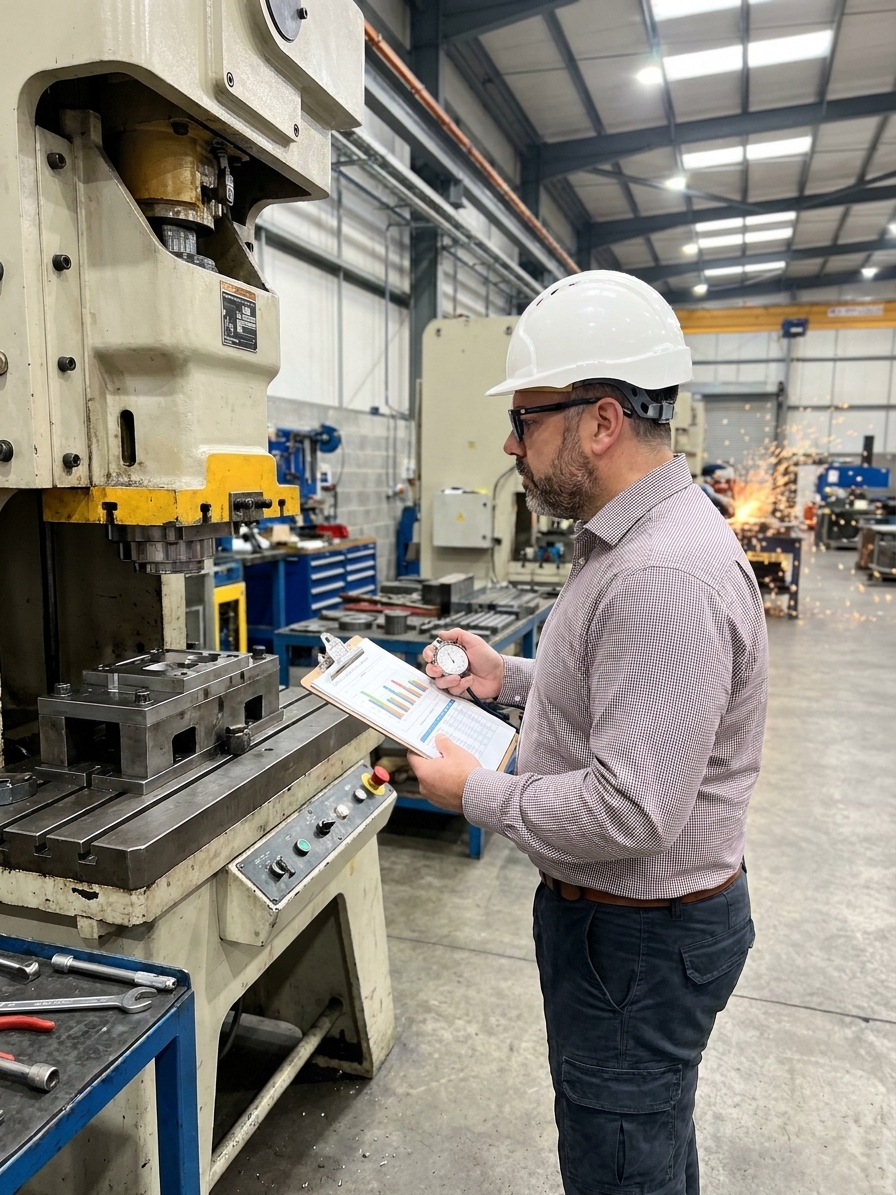
The foundational step in SMED is task classification. Film three complete changeovers on your critical constraint machine. Time every action from the last good part of the previous run to the first good part of the next run. For every task, ask one question: does this require the machine to be stopped?
If the answer is no, the task is external setup. This includes gathering tools, pre-positioning fixtures, transporting materials, and pre-calibrating measurement gauges. If the answer is yes, it is internal setup. This includes removing the outgoing die, positioning the new one, and executing the final mechanical clamping.
Most unexamined changeovers reveal that 60 to 70 percent of the downtime is external work being performed while the machine sits idle. Moving these tasks to the period before the line stops requires creating a setup preparation checklist, implementing shadow boards for tools, and pre-staging materials. This reorganisation alone typically reduces changeover time by up to fifty percent.
Converting Internal Conditions to External
Once external tasks are moved offline, the next stage is to engineer the remaining internal tasks so they no longer require a stopped machine. This requires mechanical redesign and process engineering. The objective is to eliminate the conditions that force a machine to sit idle during preparation.
Pre-heating is a primary conversion technique. If a die or mould must reach a specific operating temperature before it produces compliant parts, do not heat it on the press. Use an external pre-heating station while the previous job is still running. When the outgoing die is removed, the incoming die is already at production temperature.
Intermediate fixtures also reduce internal time. Instead of bolting a die directly to the press bed, attach it to a standardised adapter plate. The plate is pre-aligned and pre-bolted externally. During the changeover, the entire plate-and-die assembly drops into the press with a single hydraulic clamping motion, bypassing minutes of precise inline alignment.
The SMED Conversion Sequence
- 011. Observe and ClassifyFilm the changeover. Categorise every task as internal or external.
- 022. Externalise PreparationMove tools, materials, and gauges to the pre-setup phase.
- 033. Convert Internal TasksUse pre-heating and intermediate jigs to remove work from the stopped machine.
- 044. Streamline Remaining WorkEliminate adjustments via precision pins and one-point clamping mechanisms.
Streamlining the Remaining Internal Setup
After conversion, the remaining internal setup consists only of tasks that genuinely require a stopped machine. The focus shifts to making these tasks faster and more reliable. The goal is to eliminate adjustments entirely. Trial runs and iterative adjustments consume the majority of traditional changeover time.
Design the die and press interface so alignment is automatic. Use precision locating pins, guide rails, and physical stops. The die should drop into the correct position and lock immediately. When technicians align by eye and adjust by feel, variation is guaranteed. Mechanical Poka-Yoke features ensure the die cannot be installed incorrectly.
Replace threaded bolts with quick-action clamps. Shingo observed that bolts are frequently used to fix dies in position, but threading, tightening, and checking bolts is slow. One-point clamping mechanisms, toggle clamps, and hydraulic quick-lock systems secure a die in seconds. Every die must use the same clamping points and connection heights to standardise the motion for the operator.
The Economic Threshold of Batch Size Reduction
The primary value of SMED is not the recovered machine time; it is the destruction of the economic barrier to small batches. When a changeover costs four hours, schedulers must run large batches to spread the penalty across enough units. If a changeover costs two thousand dollars in lost time, a five-thousand-part batch amortises that cost to forty cents per unit.
When SMED reduces that changeover to eight minutes, the economic model inverts. The setup penalty drops to near zero. The plant can now run five-hundred-part batches or smaller without penalising unit cost. This collapses lead times and drains the work-in-process inventory from the shop floor.
The difference between a two-hour changeover and an eight-minute changeover is a difference of kind, not degree.
Quality performance also improves. Smaller batches mean defects are caught during first-article inspection after a few hundred parts rather than several thousand. If a die is misaligned, the defect batch is contained. The financial exposure of a quality escape drops by an order of magnitude.
The SMED Impact Index
Overcoming Resistance to Standardisation
The most significant obstacle to SMED is cultural. Changeovers are typically performed by the most experienced technicians on the floor. These operators have developed an intuitive feel for the process over years. They are often resistant to SMED because it externalises and standardises the tacit knowledge they hold.
This resistance must be addressed directly. SMED does not replace expert technicians; it elevates them. When the routine elements of clamping and alignment are standardised through mechanical design, the expert's attention is freed for the complex problem-solving that actually requires human judgment.
Another common failure mode is the "good enough" ceiling. Organisations implement Stage One, see a fifty percent reduction in setup time, declare victory, and stop. At two hours, the plant still runs large batches. If the implementation stops above the twenty-minute economic threshold, the organisation has captured easy operational gains but missed the strategic transformation.
Traditional Changeover vs SMED Changeover
Traditional Setup
- Tools fetched after machine stops
- Large batches amortise downtime
- Die alignment by trial and error
- High WIP and extended lead times
SMED Setup
- Materials staged in external phase
- Small batches match actual demand
- Precision pins eliminate adjustment
- Low WIP and responsive scheduling
Sustaining the Standard Work
The final stage of implementation is documentation and enforcement. The new changeover procedure must be codified into standard work. Create a visual setup checklist that the technician follows sequentially. Train every operator on the standardised clamping points, the pre-heating sequences, and the external preparation tasks.
Apply the methodology to every constraint machine in the plant. Review the changeover KPIs quarterly. If changeover time drifts upward, it indicates that external tasks are creeping back into the internal window. Re-film the process, reclassify the tasks, and reassert the standard.
SMED removes the fixed cost of changeovers. When the penalty for switching products approaches zero, the factory stops producing to forecast and starts producing to demand. The plant transitions from a rigid system optimised for machine utilisation into a responsive system optimised for customer delivery and quality control.