
When an auditor examines a manufacturing process, they look for a closed loop: a standard, a record proving compliance, and a corrective action when the record deviates. Predictive quality systems, particularly physics-based digital twins, disrupt this established audit trail. The algorithm flags part number 12,847 for verification because a sensor reported a melt-temperature excursion that the model predicts will cause a dimensional shift. The auditor must now ask how that prediction was validated before the containment action was triggered.
Across two decades in automotive and aerospace, I have seen plants present sophisticated data models as evidence of control. They display dashboards showing real-time OEE and Cpk calculations. However, when the auditor asks for the Gage R&R on the input sensors or the mathematical validation of the algorithm's predicted failure mode, the presentation collapses. The system detects anomalies, but it does not govern the quality decision within the approved framework.
A functional digital twin must be treated as a critical-to-quality process. It cannot remain an engineering tool sitting outside the AS9100 or IATF 16949 management system. If the model automatically sends a correction command to a PLC, it is making a process control decision. The audit evidence must prove that decision is mathematically sound, validated against physical outcomes, and governed by documented change control.
The Evidence Gap in Algorithmic Detection
Traditional Statistical Process Control (SPC) provides a clear evidence chain. The standard defines the sample frequency, the operator records the measurement, and the control chart triggers a reaction plan. Auditors know how to verify operator training, gauge calibration, and the 8D methodology used to address the resulting out-of-control condition. The trail is linear and heavily documented across the quality management system.
Digital twins break that linearity. A purely data-driven machine learning model can interpolate within its training data, but it struggles to extrapolate during novel ambient conditions. When the model predicts a defect that has never physically occurred on the line, the operator cannot rely on historical scrap data to verify it. The auditor looking at the resulting containment must see the physics-based simulation that proves the root cause, not just the algorithmic confidence score.
This creates the core evidence gap. Manufacturing teams present the dashboard showing the anomaly was detected and the part was quarantined. The auditor asks for the proof that the anomaly was actually a defect. Without a validated mathematical model linking the sensor variation to the dimensional shift, the containment action is a guess. The system must provide simulated evidence that isolates the variables physical experiments cannot.
What Teams Present vs What Satisfies a Quality Audit
What teams present
- Real-time dashboards showing live sensor deviations
- Algorithmic confidence scores flagging potential scrap
- Historical data queries correlating past failures
- Screenshots of automated containment triggers
What satisfies the audit
- Validated Gage R&R for all input sensors
- Physics-based extrapolation proving the failure mode
- Documented model validation against physical DOEs
- Change-controlled logic linking detection to PLC action
Validating the Input Data and Physics Architecture
Before accepting predictive output, an auditor must examine the input data infrastructure. Sensor miscalibration, inconsistent MES timestamps, and unacceptable measurement system analysis silently corrupt the simulation. The first evidence an organisation must provide is a comprehensive audit of this infrastructure. If the data feeding the twin is unreliable, the model will confidently predict nonsense, and any resulting process adjustments are invalid.
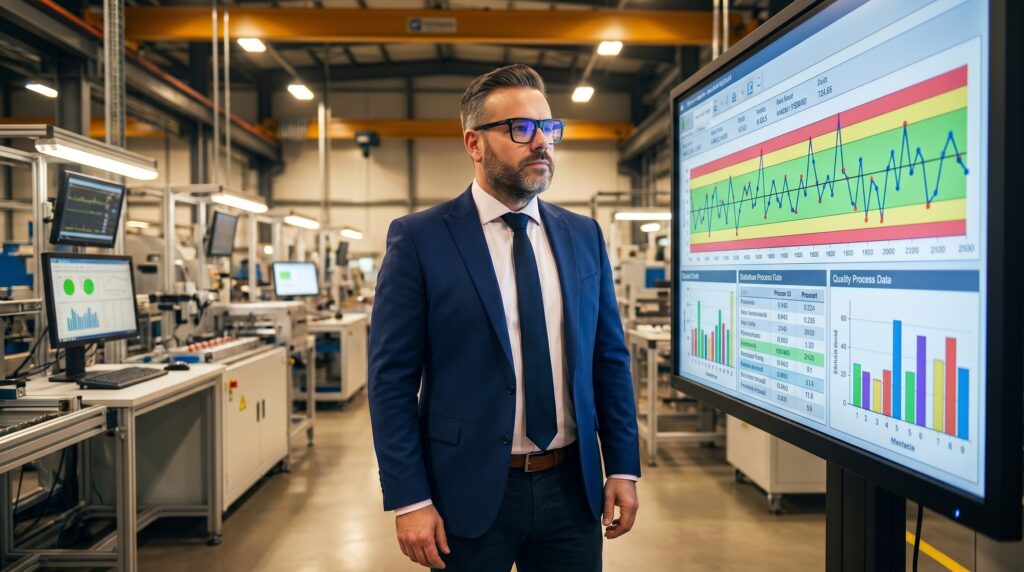
The architecture itself requires scrutiny. The most effective manufacturing models are rooted in first principles: thermodynamics, fluid dynamics, and structural mechanics. Machine learning fills the gaps in the data, but physics provides the backbone. When an organisation encounters a novel set of ambient conditions, a physics-based model extrapolates beyond its training data to provide a mathematically sound answer. A purely algorithmic model guesses.
Fidelity must be layered intelligently to generate auditable evidence. You do not need a high-fidelity simulation of every process step. Start with a coarse model of the entire line to identify where quality is most sensitive, then increase the simulation fidelity at those critical stations. This approach allows engineering teams to isolate variables and present specific, focused validation reports for the parameters that actively control the outcome.
Validating this architecture requires cross-functional expertise. A modelling engineer who understands finite element analysis but has never stood on a shop floor will build a simulation that misses operational reality. A quality engineer who knows every failure mode but cannot read code cannot validate the model. The audit evidence must demonstrate that these two domains collaborated to confirm the digital twin accurately reflects the physical machine.
Governing the Predictive Loop and Model Drift
Closing the control loop is the ultimate objective of a mature digital twin, but it introduces significant governance challenges. When the model detects an emerging quality issue, it sends adjustment commands directly to the PLC. This automated defect prevention bypasses the traditional operator sign-off process. The auditor must verify that robust validation was performed before the organisation handed the keys to an algorithm.
Model governance becomes the central audit focus. Who owns the model within the quality system? How do you handle model drift when predictions diverge from physical reality? Organisations must establish clear, documented protocols detailing exactly when the twin's logic overrides experienced operators. Without this governance framework, the model acts as an uncontrolled process change, violating the core requirements of ISO 9001.
The quality team must treat the algorithm as a controlled document. Any adjustment to the simulation parameters, the sensor weighting, or the reaction logic requires a formal engineering change order. The audit trail must show who authorised the change, what validation data supported it, and when the updated model was released to the production environment. This discipline ensures the predictive system remains stable and verifiable.
The Validated Predictive Control Loop
- 01Data IngestionAuditor checks sensor calibration records and MES timestamp integrity.
- 02Physics SimulationAuditor reviews finite element analysis validation against physical DOEs.
- 03Predictive AnalysisAuditor verifies the statistical threshold triggering the defect flag.
- 04Automated AdjustmentAuditor confirms the PLC change order and operator override protocol.
Demonstrating Measurable Quality Outcomes
A calibrated digital twin allows organisations to run thousands of virtual Design of Experiments (DOE) without disrupting the production line. Every physical DOE burns capacity and generates scrap. The audit evidence for process capability improvements must show how the twin simulated these experimental matrices first. This drastically reduces qualification lead times and physical confirmation costs while providing a documented rationale for the new process window.
Predictive quality enables a fundamental shift in inspection sampling. Traditional final inspection samples a fraction of production, checking one part in fifty. The twin predicts quality for every single part based on actual, real-time process conditions. When the system flags a specific component for verification due to a temperature excursion, the audit trail must capture the sensor data, the simulation result, and the physical measurement of the flagged part.
A purely data-driven model interpolates. A physics-based twin extrapolates. When conditions change, algorithms guess. Physics calculates.
Tooling and equipment life prediction provides another measurable outcome. Instead of replacing tools on a fixed preventive maintenance schedule, the twin tracks cumulative stress and recommends replacement when the quality risk curve crosses a defined threshold. The maintenance log must link the tool change directly to the model's risk calculation, proving that the action prevented downstream scrap rather than reacting to an unexpected failure.
Supply chain quality propagation is a critical use case that auditors increasingly examine. When incoming material properties vary, the twin simulates the downstream manufacturing impact before the material is committed to production. The system routes material characteristics to the process window most likely to produce conforming parts. The evidence of this action is the documented deviation from standard routing, supported by the simulation proving the yield optimisation.
Building the Audit File: Deployment Strategy
Organisations must avoid attempting to twin an entire factory on day one. The deployment strategy should target one critical process where quality failures are expensive, root causes are difficult to find, and reliable sensor data already exists. Success on a single high-risk process builds the necessary validation evidence and funds the expansion of the technology. This focused approach ensures the initial audit file is manageable and thoroughly documented.
The initial deployment can begin simply. A validated regression model predicting a critical-to-quality characteristic from three process variables is a functional digital twin. It may lack sophistication, but it establishes the validation workflow. Every prediction must be compared against actual physical outcomes. The resulting accuracy data, and the investigation of every discrepancy, forms the foundation of the audit file. This evidence proves the model is trustworthy.
Trust must be built gradually through documented evidence, not management mandates. Early adopters must demonstrate value on the shop floor by successfully predicting defects that operators would have missed. The system must publish its accuracy and log the resulting containment actions. Mandates build superficial compliance; published accuracy data builds operational conviction. The twin gets better over time, and the audit file grows richer with every validated correction.
The progression from passive data monitoring to automated process adjustment follows a strict maturity path. Most organisations begin with a digital shadow, merely receiving data for anomaly detection. They advance to predictive simulations and eventually to closed-loop systems that actively prevent defects. The audit requirements scale with each level, demanding stricter validation and tighter model governance as the system takes on more autonomous control.
Sustaining the System Through External Audit
Return on investment for a digital twin takes time. The first six months of a project feel like building infrastructure with nothing to show for it. The organisation is calibrating, validating, and building trust with the shop floor. The returns compound in the following months as scrap reduction, capacity recovery, and Cpk improvements hit the bottom line. The audit evidence captured during this foundation phase is what ultimately proves the system's reliability to an external auditor.
Sustaining the system requires continuous validation against physical reality. The quality team must routinely pull parts flagged by the model and verify them through traditional metrology. If the predicted defect rate does not match the physical scrap rate, the model requires recalibration. This ongoing verification activity must be scheduled, executed, and recorded as a mandatory element of the internal audit programme.
The future of quality engineering is not longer audit checklists. It is deeper process understanding driven by mathematical representation. The digital twin is a lens that exposes the complex, nonlinear, interconnected reality of the production line. By demanding rigorous evidence for every prediction and automated adjustment, the audit process ensures this technology delivers actual quality assurance, not just an expensive screensaver displaying confident predictions.