A field-rejection rate of 2.1% on a critical brake actuator sub-assembly forced a multi-site recall and an emergency supplier escalation across four regional manufacturing plants. The defect was severe dimensional distortion caused by residual casting stress, which manifested only after the product reached the customer's assembly line and thermally cycled. The cost of containment, sorting, and expedited replacement parts exceeded the entire annual quality budget within nine weeks.
The post-mortem revealed that the root cause was not a processing error at any single site. The failure was an engineering trade-off accepted years earlier during low-volume prototyping. The design team had balanced casting wall thickness for structural integrity against the cooling time required to relieve thermal stress. They compromised on a thinner wall that reduced cycle time but retained internal stress, adding a mandatory post-cast stress-relief annealing operation to the PFMEA to compensate.
When demand surged and the sub-assembly was cloned to three additional regional suppliers, that annealing operation became an uncontrolled variable. One facility shortened the cycle to meet takt time. Another lacked the exact furnace specification. The original compromise, safely managed at a single mature plant, scaled into a systemic defect. The organisation had not replicated a robust engineering process; it had replicated a fundamental contradiction.
The Anatomy of a Scaled Technical Contradiction
A technical contradiction exists when improving one engineering parameter inevitably degrades another. In this case, improving cycle time degraded the structural stability of the casting. Standard engineering practice handles this by finding an acceptable midpoint. The PFMEA documented the residual stress risk, assigned it a moderate severity, and listed the stress-relief annealing as a required control. At the original manufacturing site, this control functioned reliably for years.
The failure occurred because a process-level work-around cannot survive the variance introduced by geographical scaling. Multi-site manufacturing introduces different ambient humidity levels, varying operator training cadences, and alternative local equipment brands. The annealing oven at the primary site ran on natural gas; the new regional facilities used electric batch furnaces with different thermal ramp profiles. The documented control masked the contradiction, but it did not resolve it.
By the time the defect reached the customer, the parameter conflict was buried under layers of procedural documentation. The 8D investigation team initially focused on furnace calibration at the offending facility. The actual failure was a design architecture that required thermal stress relief at all. The contradiction between fast cycle times and geometric stability had simply outgrown its containment strategy.
Tracing the Failure to an Unresolved Parameter Conflict
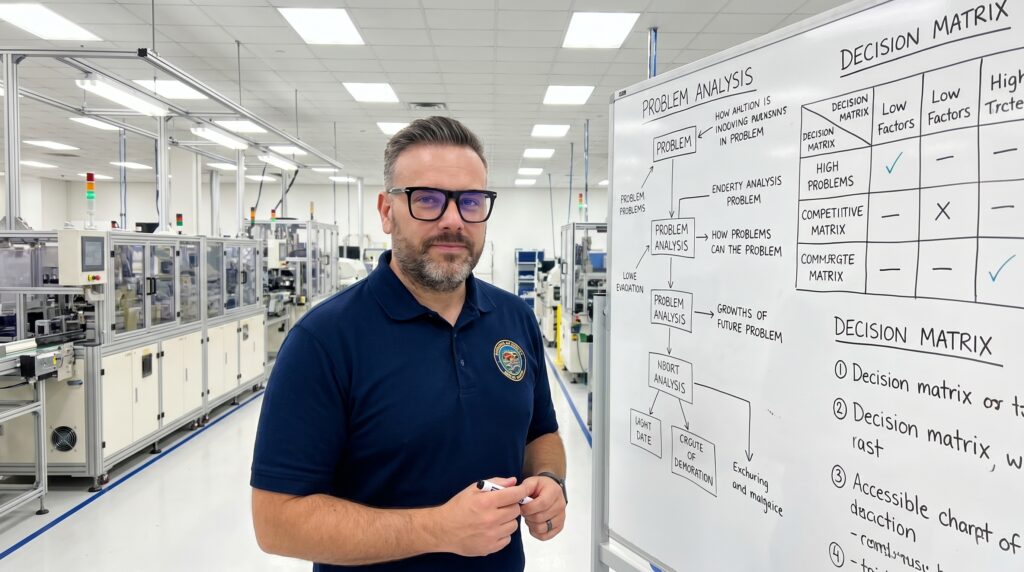
When standard root cause analysis (5-Whys, Ishikawa) encounters an engineering trade-off, it typically terminates at the process control failure. The team asks why the furnace profile was incorrect, not why the part required a furnace operation at all. This is the boundary where standard problem-solving tools fall short in a distributed manufacturing network. They fix the local execution failure while leaving the systemic design vulnerability intact.
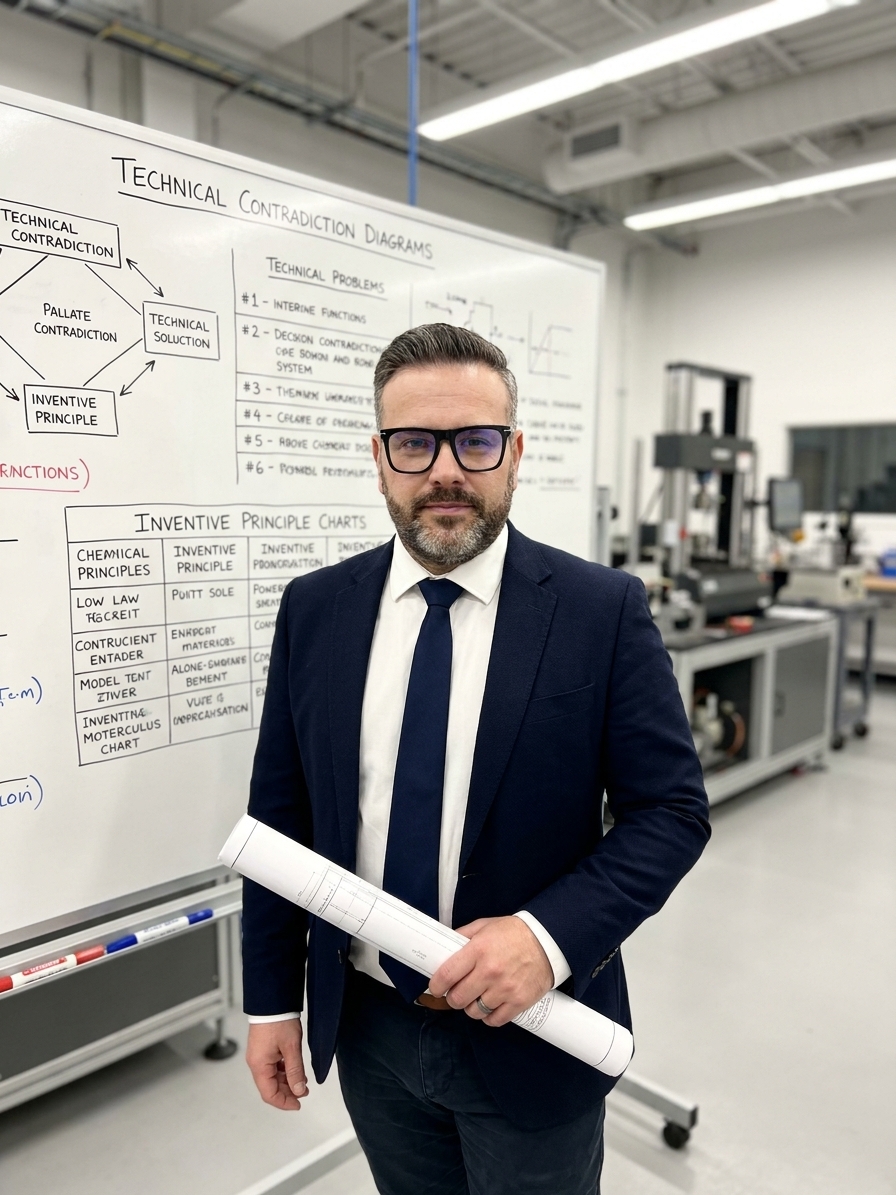
Genrich Altshuller's TRIZ methodology addresses this specific gap by forcing engineers to define the conflict in absolute terms using the contradiction matrix. Instead of optimising the annealing parameters, the matrix would map the conflict between 'Strength' (Parameter 14) and 'Temperature' (Parameter 17) or 'Loss of Time' (Parameter 25). This deterministic mapping pushes the engineering team away from containment and toward resolution.
If the original design team had applied the matrix, they would have been directed to inventive principles such as Principle 35 (Parameter Changes) or Principle 40 (Composite Materials). The trade-off between casting thickness and cooling time could have been addressed by altering the material matrix itself, rather than adding a secondary thermal processing step that would eventually fail under scale.
Failure Progression of a Scaled Engineering Trade-off
- 01Initial CompromiseDesign accepts shorter cooling time; adds mandatory stress-relief operation to manage residual geometric distortion.
- 02Local ValidationPrimary site establishes stable Cpk through controlled furnace timing; the work-around appears robust.
- 03Process CloningSub-assembly distributed to regional sites; thermal equipment, ambient conditions, and cycle pressures vary.
- 04Control CollapseVariance in secondary processing causes residual stress to escape; geometric distortion manifests at customer assembly.
The Cost of Scaling Containment Infrastructure
When a parameter conflict is unresolved, organisations do not merely scale a defect; they scale the infrastructure required to manage it. The brake actuator case required each of the four regional plants to install dedicated stress-relief furnaces, maintain specific thermal profiles, and employ certified furnace operators. The capital expenditure for this containment infrastructure was substantial, yet it was approved because the engineering trade-off was framed as an immutable law of physics.
This dynamic is visible across automotive and aerospace scaling projects. An interference fit that creates assembly difficulties at one site becomes a source of line stoppages, overtime authorization, and inconsistent torque verification across a global network. The tolerance stack-up was accepted during initial design because it functioned within the controlled environment of the original plant. Under multi-site variance, the accepted tolerance becomes a cost multiplier.
The quality system adapts to these trade-offs by adding layers of protection. Layered process audits (LPAs) are increased. Statistical Process Control (SPC) charts monitor the symptoms. Poka-yoke devices are installed to catch the defect before it ships. The cost of quality rises linearly with each new site, entirely because the engineering contradiction was never dismantled at its origin.
Optimisation accepts the boundary; resolution identifies the boundary itself as the defect.
Applying Inventive Principles to Dismantle the Conflict
If the brake actuator design team had utilised TRIZ, the resolution would have bypassed the secondary thermal operation entirely. Applying Principle 35 (Parameter Changes), the engineering team could have transitioned the casting alloy from a standard grade to one engineered with a modified silicon content, altering the solidification dynamics to eliminate the internal stress accumulation without a secondary heat treatment.
Alternatively, Principle 1 (Segmentation) offers a path to standardisation across high-mix variants. An automotive electronics supplier dealing with connector specification variance across global platforms used segmentation to design a modular base housing. The primary assembly process was standardised globally, while the specific connector interface was segmented into a locally sourced final sub-assembly. This eliminated the need for dedicated production lines at every facility and removed the underlying conflict from the scaling equation.
In the packaging sector, scaling corrugate crush defects during automated palletising often leads to purchasing heavier, more expensive materials across all distribution centres. Applying Principle 35, one operation altered the adhesive from a standard thermal cure to a rapid UV-activated cure. This changed the structural rigidity profile of the box at the precise moment of robotic placement, eliminating the crush defect across all sites without increasing material costs.
Managing Trade-offs vs. Resolving Contradictions at Scale
Scaling the Compromise
- Clones containment infrastructure to all regional facilities
- Multiplies scrap and rework rates across the supply chain
- Requires continuous inspection overhead to monitor defects
- Cost of quality increases linearly with production volume
Scaling the Resolution
- Eliminates the failure mode at the initial design source
- Removes secondary processing operations before expansion
- Reduces the PFMEA risk priority number to negligible levels
- Cost of quality decreases as volume amortises the fix
Integrating Resolution into APQP and Reactive Quality
The most effective place to prevent scaled trade-offs is during Advanced Product Quality Planning (APQP). When design teams identify a high-risk failure mode in the DFMEA and assign a severity rating of 9 or 10, they frequently accept it as an inherent design limitation. This is the exact moment the scaling problem originates. If the severity is not challenged, the organisation commits to building and maintaining containment infrastructure at every facility that will ever produce the part.
Integrating the TRIZ contradiction matrix into APQP design reviews allows quality leaders to challenge severity ratings with deterministic engineering. The matrix maps the specific parameter conflict against forty inventive principles derived from global patent analysis. Instead of documenting a containment plan, the team applies the suggested inventive principle to engineer the severity down to a manageable level before the process is ever established or cloned.
In reactive 8D problem-solving, the methodology prevents teams from defaulting to permanent containment actions. When root cause analysis identifies a parameter conflict, the inventive principles serve as a structured checklist. If a proposed corrective action fails to achieve the required 1.33 Cpk target because it merely manages the trade-off, the team maps the remaining conflict to the matrix and pursues a resolution rather than accepting a sub-optimal yield.
Defining the Ideal Final Result for Global Manufacturing
When a quality problem appears at a single site, engineers propose adding sensors, poka-yoke devices, or automated inspection stations. When that same problem exists across multiple sites, these additions represent massive capital expenditure and an increased maintenance load. The TRIZ concept of the Ideal Final Result (IFR) forces a different approach: the function must be performed perfectly, with zero added weight, zero maintenance, and zero harmful side effects.
The IFR demands that engineering teams eliminate the failure mode using resources already present in the standard process. I have audited plants where this pursuit transformed a scaling strategy. A precision manufacturer facing surface contamination during automated handling across three facilities avoided purchasing expensive robotic vision systems. By applying the IFR, they developed a non-contact Bernoulli-effect gripper powered by the plants' existing compressed air infrastructure. Contamination dropped to zero across all sites with zero new equipment cost.
Building a culture of resolution requires changing the focus of engineering reviews. Organisations fail to adopt systematic inventive problem-solving because their local statistical optimisation tools feel adequate. Teams attempt to solve only the problems their current tools can address. The chronic defects and accepted trade-offs remain untouched in the operational margins, growing into massive cost drains as the enterprise expands and the compromises multiply.
Measuring the Ideal Final Result at Scale
Stopping the Clone of Engineering Compromises
The post-mortem of any multi-site quality failure eventually reveals a moment where a compromise was accepted and then procedurally enshrined. The dimensional distortion in the brake actuator was not caused by poor execution at the regional facility; it was caused by a design architecture that required thermal stress relief. The organisation did not scale a robust process; it scaled a structural vulnerability that mutated under different conditions.
Manufacturing leaders must actively interrogate long-standing constraints. The trade-offs accepted during single-site development are not laws of physics; they are the boundaries of the engineering methodology used at the time. When a defect rate that is tolerable on one automated line is multiplied across a distributed network, the local compromise becomes an unsustainable systemic cost driver.
Start with one chronic quality problem documented across multiple production sites. Frame it explicitly as a technical or physical contradiction using the matrix. Apply the suggested inventive principles and pursue the solution that approaches the Ideal Final Result. The objective is to stop cloning trade-offs and start engineering contradictions out of the global manufacturing system entirely.