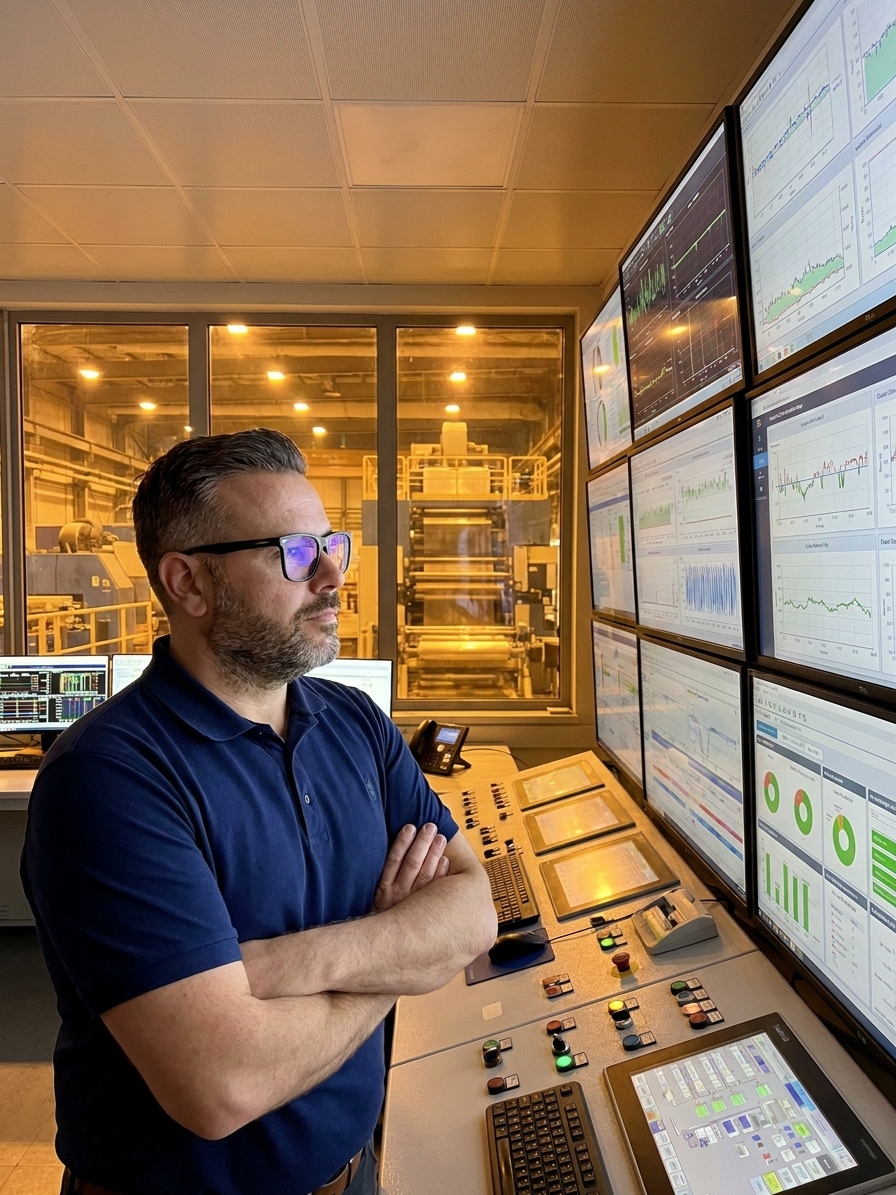
Every gauge is green. Every SPC chart hugs the centreline. Every KPI sits comfortably inside its target corridor. Yet three weeks later, a customer rejects a 12,000-unit shipment because a critical dimension drifted so far out of specification that assembly fails. The control charts showed nothing because the instruments were calibrated to the wrong reference standard. The system was not controlling the process; it was controlling the narrative the organisation told itself.
This is the Illusion of Control — the false belief that the existence of a procedure, a dashboard, or a checklist equates to genuine process management. In high-stakes manufacturing, where the consequences are measured in warranty claims and recalls, this cognitive bias does not simply lead to sub-optimal decisions. It systematically disarms the very safeguards designed to prevent catastrophic failures.
The psychology is well-documented. Ellen Langer coined the term in 1975 after experiments showing that people act as if they can influence objectively random outcomes. On the shop floor, this manifests when organisations confuse having a quality system with having control over their outputs. The ritual of maintaining documentation generates a comforting, authoritative permanence that frequently disconnects from operational reality.
The Ritual of Documentation vs Effective Control
Quality systems run on procedures, control plans, PFMEAs, and flow diagrams. The problem is not documentation itself, but what the act of documenting does to human vigilance. When a procedure is written, approved, and filed in a controlled system, it feels authoritative and permanent. A control plan written three years ago for a process that has since undergone three engineering changes is not a control mechanism. It is a historical artefact masquerading as active management.
I have audited facilities where the control plan explicitly mandated a specific dimensional check every two hours. The operator responsible had never been trained on the measurement instrument. The form was being filled out with fabricated data — not out of malice, but out of a desire to complete the paperwork. The system looked tightly controlled during the document review. On the shop floor, no actual verification was taking place.
This disconnect thrives on repetition. When an auditor signs off on a procedure, the organisation treats it as proof of effectiveness. ISO 9001 and IATF 16949 audits evaluate whether procedures exist, are followed, and generate records. They explicitly do not evaluate whether those procedures are effective at controlling process variation. A perfectly compliant quality management system can consistently produce defective parts, provided you follow your inadequate procedures rigorously.
Automation and the Zero-Detection Trap
Modern manufacturing technology amplifies the illusion. When a process runs inside a machine equipped with sensors, feedback loops, and digital displays, it inherently looks controlled. Numbers update in real time. Alarms trigger when statistical limits are exceeded. Charts populate automatically in management dashboards. The visual sophistication of the interface creates an assumption of operational reliability.

But the reliability of automated inspection depends entirely on its last validation. Sensors drift. Lighting modules degrade. Alarm thresholds are quietly widened to reduce nuisance alerts on the night shift. I worked with an automotive supplier that invested heavily in automated inline vision inspection. Their final inspection defect rate registered as zero for six consecutive months, a metric celebrated at every management review.
The vision system's lighting had degraded. The automation was rejecting good parts and passing defective ones. The celebrated zero-defect rate was actually a zero-detection rate. Nobody had verified that the feedback loop was actually feeding back to the right actuator, or that the sensors remained capable of catching the failure modes defined in the PFMEA.
Verifying Automated Inspection Integrity
- 01Challenge the baselineIntroduce a known master sample to verify the system still catches the defect.
- 02Audit the parametersCheck if alarm thresholds have been widened to suppress nuisance alerts.
- 03Verify the actuatorConfirm the feedback loop physically ejects the nonconforming part.
- 04Shadow with manual checksRun periodic human inspection in parallel to cross-validate the automation.
High-Risk Environments for Control Illusions
The Illusion of Control does not affect all processes equally. It concentrates in specific environments where the operational rhythm breeds complacency. High-volume, low-mix production is acutely vulnerable. When a line runs the same part continuously, the monotony of the schedule creates a false sense of process stability. But tooling wears, material lots drift, and ambient humidity changes regardless of the production schedule.
Post-audit periods are equally insidious. After surviving a rigorous customer or certification audit, organisations experience a psychological letdown. The intense vigilance that drove good behaviour during the audit lifts. Because the audit went well, management assumes the system is structurally sound. The illusion of the audit's success substitutes for the reality of ongoing, daily process control.
During these periods, escaped defects multiply. When you believe your process is controlled, you stop looking for evidence that it is not. Inspection frequencies get arbitrarily reduced. Investigation thresholds get raised. Customer complaints are categorised as isolated anomalies rather than systemic symptoms. Each individual decision is defensible in isolation; the cumulative effect is a quality system that has been systematically disarmed by the people who built it.
Separating Measurement from Control
Lord Kelvin's maxim states that if you cannot measure it, you cannot improve it. The dangerous corollary organisations implicitly adopt is: if we are measuring it, we must be controlling it. This conflation is the structural foundation of the illusion. A thermometer tells you the temperature; it does not control the temperature. An SPC chart indicates statistical stability; it exerts no force on the process.
When reviewing a control plan, quality engineers must classify every single entry. Ask explicitly: is this a measurement, or is this a control? If it is only a measurement, you must define the corresponding control mechanism. If there is no mechanism that acts on the process to keep it within limits, you have a monitoring point, not a control point. Someone must decide whether passive monitoring is adequate for the risk.
A perfectly compliant QMS can produce terrible quality, as long as you follow terrible procedures consistently.
I have reviewed facilities generating thousands of SPC data points daily with no reaction plan attached. The data was collected, stored, and ignored. The act of measurement was performing a ritual that made operators and management feel safe. Measuring a process is necessary but insufficient. Control requires an active intervention based on the data collected.
Validating Measurement Systems Beyond Calibration
Periodic calibration is the baseline expectation, but it is woefully inadequate for asserting real control. Calibration confirms that an instrument reads correctly against a master standard at a specific moment. It does not confirm that the measurement system is capable of tracking process variation in real operating conditions. To break the illusion, you must validate the entire system.
Conduct rigorous Measurement System Analyses (MSA) that examine bias, linearity, and stability over time. Repeatability and reproducibility at a single point are not enough. Furthermore, you must deliberately test your control limits. Introduce a small, known deviation into the process and measure how long it takes your system to detect and react. If your control system cannot catch a deliberate shift, it will not catch an accidental one.
Key Thresholds for Validating Real Control
Building Resilience Through Constructive Skepticism
The most robust quality systems do not rely on a single control mechanism. They layer multiple, independent controls so that when one fails — and eventually, one always does — others catch the deviation. This means combining automated inline inspection with manual shadow boards. It means combining statistical process control with periodic human judgement. Different control mechanisms have different failure modes, making a diverse system harder to fool.
This technical redundancy must be paired with cultural skepticism. The most powerful antidote to the Illusion of Control is an environment where asking 'How do we know?' is rewarded. When data shows a process is in control, the immediate follow-up must challenge the data's integrity. This requires training operators and supervisors to recognise the difference between feeling in control and genuinely being in control.
Instead of only reacting to defects, conduct process forensics. Periodically select a process that appears to be working perfectly and dissect it. Trace every control point, verify every measurement, and challenge every assumption. You will invariably find a gauge reading consistently high, or a control limit set using capability data from a decommissioned machine. Closing these hidden gaps is where actual continuous improvement happens.