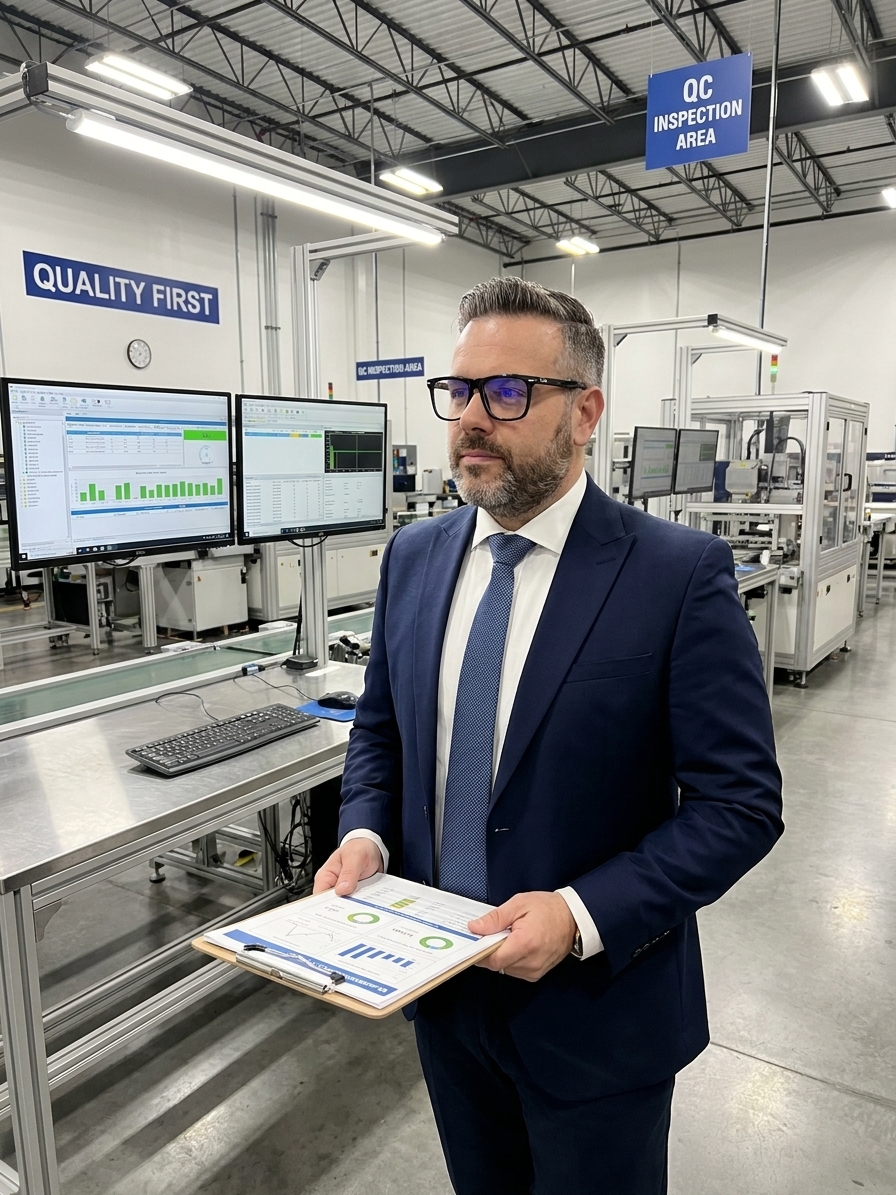
A line operator with a decade of experience detects process drift before the gauge registers it. Their reject rate is a fraction of the plant average. When the team lead retires, management does what it always does: they promote the operator. Six months later, the station they left behind is producing scrap at three times its previous rate, and the new supervisor is drowning in paperwork and conflict resolution they were never trained to handle.
The organisation didn't just lose a great operator. It created a struggling supervisor. The quality system paid for both losses simultaneously. This is the Peter Principle in action: in a hierarchy, employees tend to be promoted based on performance in their current role until they reach a position where they lack the competence to perform effectively.
In quality-critical environments, this structural failure does not merely create inefficient management. It generates defective products, delayed problem-solving, and compromised safety. When the person responsible for quality decisions lacks the competency to make them, the IATF 16949 or AS9100 system degrades from the point of promotion outward.
Why Manufacturing Promotion Paths Breed Incompetence
Manufacturing organisations face a unique vulnerability because of how they define competence at each tier. The skills that make an exceptional operator—manual precision, sustained focus, pattern recognition, and deep knowledge of a single process—are fundamentally different from the skills that make an effective supervisor: communication, data interpretation, systems thinking, and conflict resolution.
The standard advancement path moves from operator to team lead, then to supervisor, production manager, and plant manager. Each step requires a qualitatively different skill set. Yet the criteria for advancement at every step remain identical: how well did you perform at the level below? We evaluate candidates on skills that no longer matter rather than developing the skills that determine their future success.
In quality terms, this is like calibrating a measurement instrument for temperature when the characteristic you must control is pressure. The measurement is precise. It is also completely irrelevant. Using Cpk on the wrong characteristic guarantees you will ship nonconforming product.
The Competence Mismatch in Operator Promotions
Operator Competencies
- Manual precision and process control
- Tactile and visual pattern recognition
- Deep knowledge of a single station
- Sustained individual focus on output
Supervisor Competencies
- Cross-station systems thinking
- Data interpretation and root cause analysis
- Conflict resolution and coaching
- Resource allocation and decision-making
The Quality Ripple Effect of a Failed Promotion
When a Peter Principle promotion happens, the consequences cascade through the facility in predictable ways. First, the station left behind loses decades of tacit knowledge. That experiential knowledge—the feel of the material, the sound of the machine—was never documented because it was intuitive. The replacement operator will take months or years to develop equivalent capability, and defect rates will rise during that gap.

At the supervisory level, the new leader defaults to the only tool they have: telling people to be more careful. They understand their former operation deeply, but they now oversee six different stations. When a quality issue arises at a process they never worked at, they lack the technical depth to evaluate root causes during an 8D investigation.
Operators respect competence. When the new supervisor demonstrates unpreparedness, respect erodes. Operators stop bringing problems forward and begin working around the supervisor. Critical information that should flow upward gets trapped at the floor level, and the quality system goes blind. In my experience auditing plants, a breakdown in upward communication is the first visible symptom of a failed supervisory promotion.
Applying FMEA Logic to the Promotion Process
Quality professionals already possess the exact tool needed to fix this: Failure Mode and Effects Analysis (PFMEA). Treat a promotion as a process change and run it through the framework. The failure mode is that the promoted person cannot perform the new role effectively.
The effect is increased defect rates, team dysfunction, and quality system degradation. The severity is high because it impacts product conformity and safety. The occurrence is extremely high—this is one of the most common organisational failure modes in manufacturing. The detection is low, because organisations are notoriously slow to recognise and address failed promotions.
The resulting Risk Priority Number (RPN) is critically high. If a production process generated this RPN, you would immediately design prevention controls, implement detection safeguards, and monitor the process. You must apply the same rigour to your promotion process.
Mitigating Promotion Risk with Quality Controls
- 01Assess Leadership AptitudeEvaluate conflict resolution and systems thinking before offering the role.
- 02Implement MentorshipPair the candidate with an experienced supervisor during a transition period.
- 03Monitor Quality MetricsTrack team-level scrap and closure rates to detect early failure.
- 04Execute Response PlanProvide a structured, stigma-free return to a technical role if the fit is wrong.
Designing Dual Career Tracks for Technical Expertise
In most plants, the only way to significantly increase compensation and status is to move into management. You cannot pay an operator at a supervisor's level, even if that operator's contribution to quality is worth far more. So you promote them, losing the operator and gaining a mediocre supervisor. This reward structure actively harms your quality output.
Effective manufacturing organisations solve this by creating parallel advancement tracks. They establish a technical track and a leadership track. An operator who is exceptional at their craft advances to roles like master operator or quality technician, with compensation and status equivalent to supervisory positions. They continue doing what they do best, and the organisation retains the expertise exactly where it drives Cpk improvements.
These operators are given leadership opportunities that do not require them to abandon the floor. They mentor new hires, lead Kaizen events, and serve as subject matter experts during AS9100 or IATF 16949 audits. They become the backbone of the quality system because they are valued within it, not promoted out of it.
Building Structured Transition and Detection Controls
When promotion does happen, it must never be a cliff edge. The new supervisor should receive formal leadership training concurrent with their appointment. They must be paired with an experienced mentor. Their first three months should include protected time for development, not total immersion in the firefighting that typically consumes new leaders.
The competence that earned an operator their promotion often becomes invisible in a role that demands entirely different skills.
Create mechanisms for honest evaluation without stigma. If, after a structured trial period, it becomes clear that the person is not suited for the supervisory role, they should be able to return to their technical role with full respect and compensation. The alternative—leaving them in a role where they struggle indefinitely—harms the team, the quality system, and the individual.
Detection controls are equally vital. Implement regular performance reviews with specific leadership criteria, team feedback mechanisms, and quality metric tracking at the team level. Skip-level conversations are essential to surface problems early, before a struggling supervisor compounds the damage by making poor hiring decisions or resisting training that exposes their gaps.
Defining Competency Before You Need It
Define what good looks like in the supervisory role before you have a vacancy. What daily decisions does a supervisor make? What knowledge do those decisions require? What interpersonal skills are essential for resolving floor-level conflicts? What quality-related judgments will they face during a PPAP submission or a customer audit?
Use these criteria to evaluate candidates. Assess their aptitude through structured interviews, situational judgment tests, and supervised trial periods. Not everyone who excels at operating will excel at leading. Finding that out before the promotion is infinitely cheaper than discovering it after the scrap rate triples.
The Peter Principle is a design problem, not a destiny. You can redesign your promotion processes, build dual career tracks, and treat leadership development as seriously as you treat process control. Start with one question: the last time you promoted someone, what criteria did you actually use? If the answer is that they were good at their current job, your advancement criteria are calibrating for the wrong characteristic.
Your quality system deserves leaders selected for their ability to lead. Your operators deserve career paths that leverage their strengths. Your customers deserve products made by an organisation that understands the difference between excellence at one level and competence at the next.