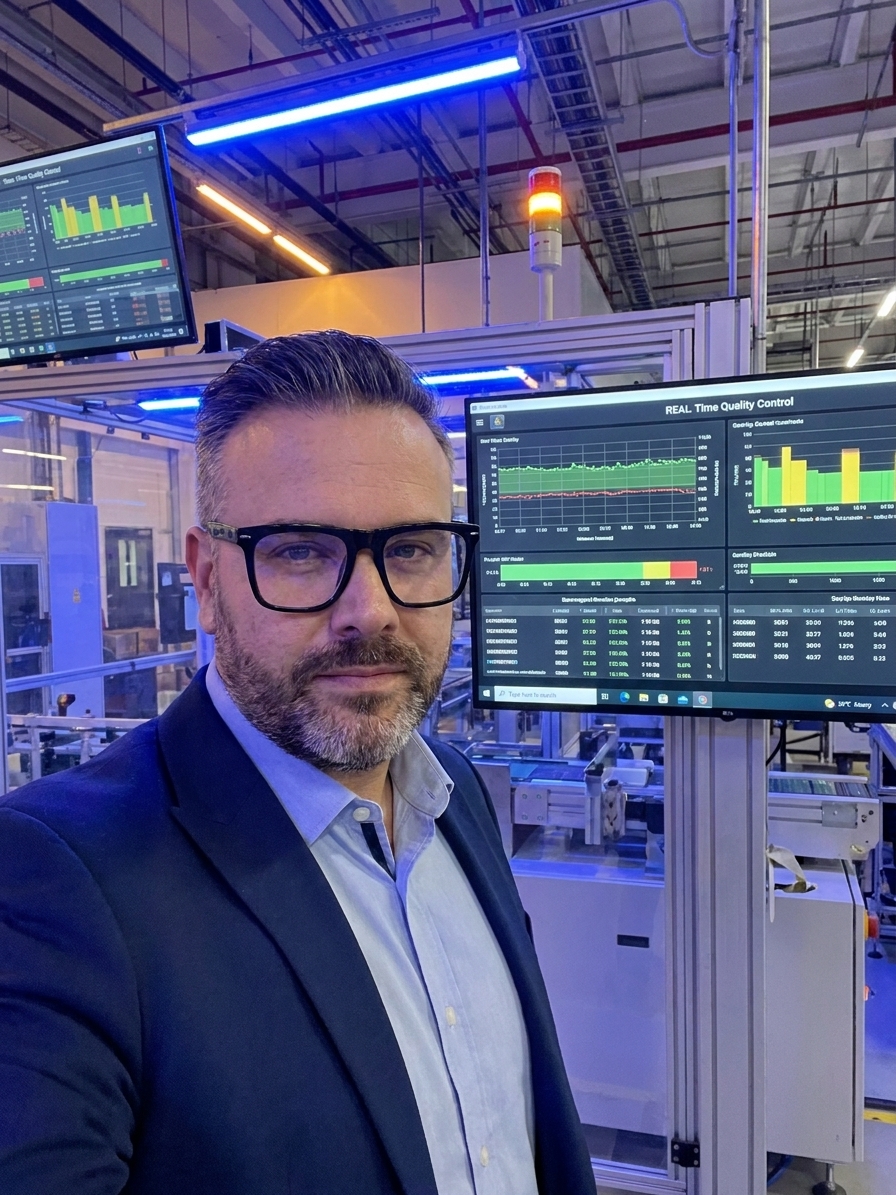
Standard quality tools are built for a linear world. Your FMEA evaluates failure modes individually or in small, predefined combinations. Your SPC charts monitor individual data streams for shifts beyond control limits. Your control plan measures discrete characteristics against engineering specifications. These tools are designed to catch defects, not to prevent cascades.
A defect is a discrete event: a part outside specification, a process drifting beyond its control limits. A cascade is a chain reaction where multiple small deviations, each individually harmless and well within tolerance, combine in ways that amplify rather than cancel each other. The distinction is critical because every tool in your quality arsenal can return a green light while the seeds of a catastrophic failure are already germinating across your process steps.
I have audited plants where teams meticulously tracked Cpk values above 1.33 on every critical-to-quality characteristic, yet still faced field failures that traced back to unmeasured interactions between compliant variables. The assumption underlying most quality management is that small variations are either linear and predictable, or harmless enough to ignore. When you treat your manufacturing process this way, you are betting your organisation's future on the assumption that no combination of minor deviations will ever intersect to produce a catastrophic outcome. Across thousands of parts produced over months of operation, that assumption breaks down.
When In-Spec Parts Cause Field Failures
Consider an automotive supplier that shipped a batch of seals with a dimensional deviation of 0.003 millimetres. The deviation fell well within the accepted tolerance band. Quality control signed off. The parts passed every inspection gate. Six months later, 2.4 million vehicles were recalled because the microscopic variation in seal thickness, combined with a specific thermal cycling pattern and a particular fuel additive used in certain markets, created a slow leak that accumulated over thousands of miles. The recall cost exceeded $400 million.
The root cause investigation traced the failure back through seventeen interconnected variables. The seal deviation alone would not have caused the leak. The thermal cycling alone would not have caused it. The fuel additive alone would not have caused it. But together, they formed a cascade that no one had modeled, tested for, or imagined. The FMEA had rated the seal deviation as low severity because, in isolation, it was inconsequential.
This pattern is far more common than most organisations are willing to admit. Modern manufacturing processes are webs of interconnected variables: material properties, machine settings, environmental conditions, operator behaviours, measurement uncertainties, tool wear patterns, and supplier variations. They interact in ways that are often invisible to standard process documentation. By the time the failure appears on your instruments, the forces have been building for months.

Three Conditions That Enable Quality Cascades
Not every small variation creates a cascade. Through studying quality failures across automotive, aerospace, medical devices, and electronics manufacturing, three conditions consistently emerge as precursors. When all three are present simultaneously, the probability of a cascading failure rises sharply — and your standard quality tools are least equipped to detect it.
The first condition is tight coupling between process steps. Lean manufacturing, just-in-time delivery, and reduced work-in-process inventory all increase coupling. This eliminates waste and improves flow, but it also removes the buffers that once absorbed small variations before they could cascade. In tightly coupled systems, variations propagate rather than dissipate. Every time you remove a safety buffer in the name of efficiency, you remove a dampening mechanism.
The second condition is the simultaneous occurrence of multiple small deviations. FMEA evaluates failure modes one at a time, and typically limits combination analysis to two or three variables. A catastrophic quality failure might involve the simultaneous interaction of seven, ten, or fifteen small deviations across multiple process steps, suppliers, and environmental conditions. The probability of any specific combination is vanishingly small, but the probability of some harmful combination occurring across millions of parts is far higher than your risk assessment suggests.
The third condition is time-delayed manifestation. The seal in the example above did not cause an instant failure. It took six months of thermal cycling, fuel exposure, and vibration for the cascade to reach its catastrophic conclusion. Time-delayed manifestation defeats your containment systems. Sorting activities, quarantine procedures, and stop-ship decisions all assume that if something is going to fail, it will fail soon enough to catch.
How Cascades Defeat Standard Quality Logic
What standard tools assume
- Variables act independently or in simple predefined pairs
- In-tolerance deviations are inherently safe and self-contained
- Significant failures manifest rapidly and within the containment window
- Tight coupling and zero buffers represent maximum efficiency with no hidden quality cost
What complex systems actually do
- Variables interact dynamically across multiple unrelated process steps
- Multiple compliant deviations converge and amplify at critical convergence nodes
- Cascades build silently over months of operational and environmental stress
- Removed dampening buffers allow small variations to propagate without absorption
Which Organisations Face the Highest Cascade Risk
Not every operation faces equal exposure. Three characteristics make a manufacturing organisation particularly vulnerable to cascading failures. If you carry all three, your quality system must be designed for complexity, not merely for IATF 16949 or AS9100 compliance.
High product complexity is the first vulnerability factor. A simple product with few components and few process steps has a limited combinatorial space. A complex product with hundreds of components, dozens of process steps, and multiple tiers of suppliers has an exponentially larger surface area for butterfly effects to emerge. Every additional variable adds combinatorial risk that standard tools do not account for.
Operating at the edge of process capability is the second factor. When your processes run comfortably within specification — when capability indices sit well above 1.33 — small variations have room to occur without approaching any critical boundary. When you are running at Cpk 1.0 or below, you are already near the cliff edge. Any small additional variation, even from an unexpected or unmonitored source, can push you over.
Long, opaque supply chains are the third factor. The more tiers of suppliers between you and the raw material, the more opportunities exist for small variations to be introduced, amplified, and propagated without your knowledge. Your supplier quality system might audit direct suppliers thoroughly, but sub-tier suppliers operate in a visibility shadow where cascades can quietly build momentum.
Mapping the Interaction Topology
Your process flowchart shows the sequence of operations. It does not show how variables influence each other across the process. Building an interaction topology means identifying which variables at each process step can affect which downstream variables, even indirectly. It requires mapping the flow of influence, not just the flow of material.
This is demanding work. It requires cross-functional teams who understand the physics, chemistry, and engineering of each step, and who can think beyond immediate inputs and outputs. But it reveals the pathways through which cascades travel — the connections that standard PFMEA documentation never captures. Once you have the topology, you can identify the nodes where variations from multiple sources converge.
Your quality system is designed to catch the earthquake. The Butterfly Effect is about the tectonic plates.
These convergence nodes are your cascade risk points. They deserve more monitoring, more analysis, and more contingency planning than your average process step. In my experience leading QA departments, the most valuable output of a cross-functional topology mapping session is not the map itself, but the specific convergence nodes the exercise uncovers — points where no one realised multiple upstream variables were meeting.
Once identified, these nodes dictate where you deploy strategic redundancy. Redundancy in a complex system is not waste; it is a damping mechanism. The key is distinguishing between redundancy that serves no purpose and redundancy that provides resilience against cascading failure at proven convergence points.
Strategic Redundancy and Combinatorial Modelling
Lean manufacturing has taught the industry to eliminate waste, and buffers of inventory, time, and inspection are often classified accordingly. But targeted buffers serve as damping mechanisms that prevent cascading failures at high-risk convergence nodes. Strategic redundancy means placing a small WIP buffer between tightly coupled steps, adding a verification checkpoint at a convergence node, or running periodic accelerated life testing on products that have passed all standard inspections to catch time-delayed failures.
Your PFMEA must also evolve to include a section on combinatorial risk: the risk that arises when multiple low-severity deviations occur simultaneously. This does not require modeling every possible combination. It requires identifying the combinations most likely to create resonance — scenarios where deviations in multiple variables push in the same direction, amplifying each other rather than cancelling out.
Cross-functional scenario planning sessions are one of the most effective tools for this. Bring together process engineers, operators, quality professionals, and key suppliers. Pose the question directly: if three or four things went slightly wrong at the same time, which combinations would be most dangerous? The insights that emerge from people who understand the process deeply but have never been asked to think about combinatorial failure will reshape your control plan.
Cascade Risk Thresholds for Process Capability
Early Warning Systems for Cascade Signatures
Cascading failures rarely happen instantly. Even when the time to catastrophic failure is short, there are early indicators: subtle shifts in process behaviour, minor increases in variation, small changes in the correlation patterns between variables. The problem is that these indicators fall below the detection threshold of standard SPC charts, which are designed to detect shifts in individual variables, not changes in the relationships between variables.
Multivariate statistical process control addresses this gap. By monitoring the relationships between variables rather than just the variables themselves, you can detect the early signs of cascade formation — the moments when variables begin to move together in unusual patterns. This is the statistical equivalent of watching for the atmospheric conditions that could amplify a minor deviation into a systemic failure.
The ultimate defence, however, is not a tool. It is a quality culture that thinks in systems rather than in parts. When your engineers, operators, and quality professionals understand that their process is a complex, interconnected system — that a small change here can have unpredictable effects there — they become your early warning network. They start asking questions that your tools cannot ask and seeing connections that your flowcharts do not show.
This mindset shift starts with how you frame quality problems during 8D investigations and daily floor management. Stop asking what went wrong with this part. Start asking what interactions produced this outcome. Stop looking for the single root cause and start looking for the cascade pathway. Stop treating small deviations as trivial and start treating them as potential cascade triggers that could find a resonance path tomorrow, or six months from now, or never.
You cannot eliminate cascading failures entirely. They are a fundamental property of complex systems. What you can do is design quality systems that are robust not because they prevent every possible failure, but because they can survive the failures they cannot prevent. The organisations that build for complexity rather than for compliance are the ones that navigate uncertainty without catastrophe. The ones that assume their standard tools have eliminated all risk are the ones that wake up to a recall they never saw coming, traced back to a deviation they never measured, in a process they never questioned.