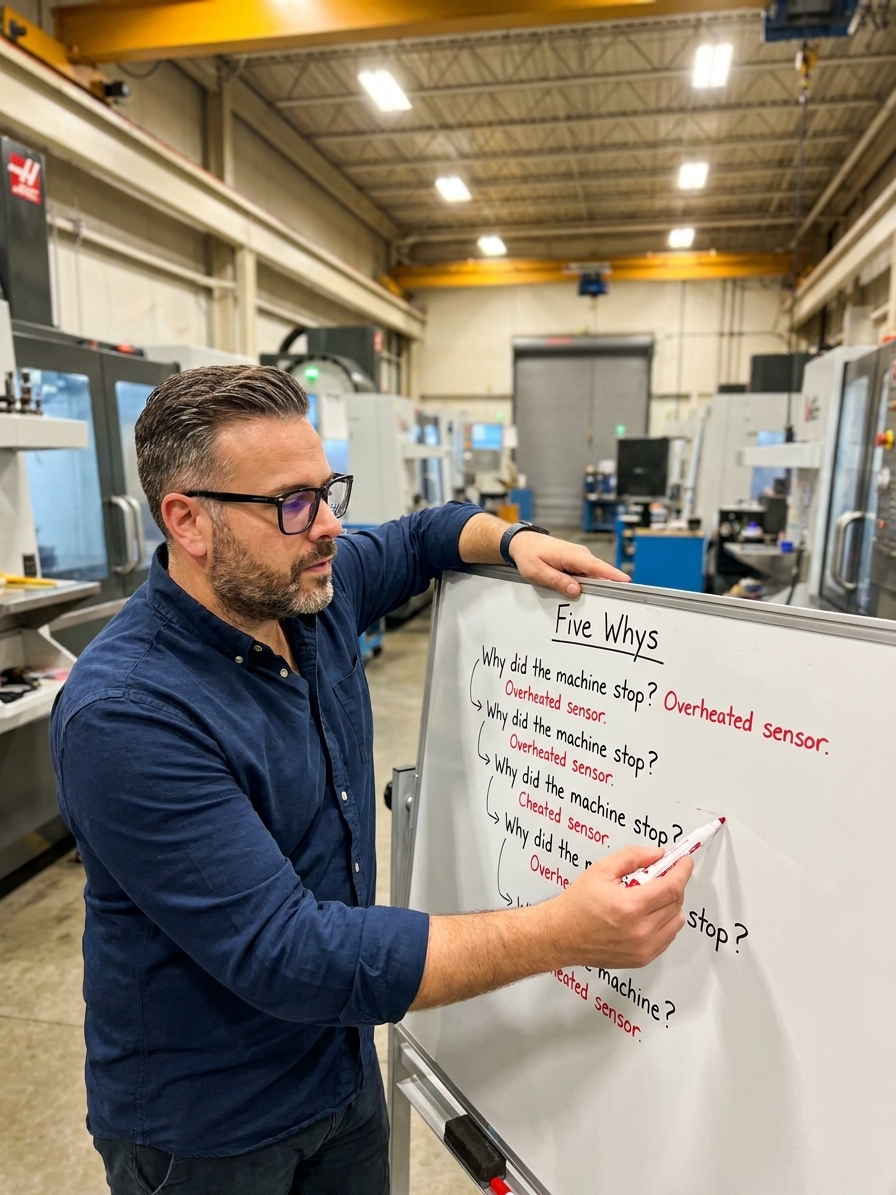
A defect appears. A customer escalates a complaint. Within minutes, your team identifies the cause: operator error. The corrective action is swift. You retrain the operator, document the 8D report, and close the finding in your CAPA system. Problem solved.
Except it is not solved. Three weeks later, the same defect returns. Different operator, identical failure mode. You retrain again. It comes back. You add another in-process inspection step. It still comes back. At this point, you are not fixing the process; you are managing the defect.
The answer is not inadequate training or incapable operators. The answer is that the investigation never reached the root cause. It found a symptom, applied a bandage, and closed the loop. This is where Five Whys analysis comes in—the simplest, most frequently misused root cause tool in quality engineering.
The Origin and the Discipline
Sakichi Toyoda developed the Five Whys technique, and it became a foundational element of the Toyota Production System. Taiichi Ohno described it as the basis of Toyota's scientific approach, stating that by repeating why five times, the nature of the problem and its solution become clear.
The concept is mechanically simple. When a nonconformance occurs, you ask why. Each answer forms the basis for the next question. By the fifth iteration, you should have bypassed the surface symptoms and exposed the systemic breakdown hiding beneath them. No statistical software is required, only disciplined inquiry.
The discipline lies in resisting the urge to stop. Most teams find an actionable item by the second or third question and halt. A worn tool, a missed inspection, or a training gap are contributory causes. They are branches, not the root. Cut a branch, and the defect grows back.
Anatomy of a CNC Machine Stoppage
I have audited plants that_scrapped dozens of parts because they stopped their investigation at the second why. Consider a CNC machining centre that stopped during a production run, resulting in scrapped parts and a two-hour line stoppage. The first question is: Why did the machine stop?
The overload protection circuit tripped because the cutting tool encountered excessive resistance. Why did the tool encounter resistance? The tool was worn beyond its acceptable tolerance. Why was it worn? The tool was not replaced at the scheduled interval specified in the preventive maintenance plan.
Why was it not replaced? The replacement tooling was not available in the tool crib when the technician went to retrieve it. Why was the tooling unavailable? The purchasing department had not placed the reorder because the inventory system's minimum stock level was set too low, and nobody adjusted it after production volume increased.
The root cause is that inventory planning parameters were not linked to production volume changes. If the team stopped at the first why, they would reset the machine. At the third, they might reprimand the maintenance technician. Only the fifth level exposes the systemic gap between planning and procurement.

Breaking the Five Common Failure Modes
Most organisations fail at the Five Whys because they treat it as a documentation requirement rather than an investigation. Teams fill out their corrective action forms with five neat questions, arriving at a root cause that is neither root nor cause. This theatre satisfies the auditor but fixes nothing.
The most common failure mode is stopping too early because the team finds something they can fix quickly. The second failure mode is asking 'who' instead of 'why'. The moment an investigation becomes about individual blame, people become defensive, information dries up, and you collect the answers people think you want to hear.
A third failure is the lone analyst. When one quality engineer sits at a desk filling out a form, they bring one perspective and one set of blind spots. Toyota conducts root cause analysis in cross-functional teams. The operator knows the floor reality; the process engineer understands the parameters; the quality specialist sees the failure pattern.
The Five Whys Blame Trap
Asking 'Who'
- Drives defensive behaviour and information withholding
- Ends investigation at individual action or inaction
- Leads exclusively to retraining or disciplinary action
- Guarantees high defect recurrence rates
Asking 'Why'
- Encourages transparent process evaluation
- Pursues the systemic breakdown that allowed the error
- Identifies gaps in PFMEA and control plan logic
- Generates permanent engineering or administrative fixes
Confirmation Bias and the Conference Room
The fourth failure mode is skipping the Gemba. Teams analyse nonconformances in conference rooms days after the event, relying on reports. The physical evidence is gone, the context is lost, and memories have started rationalising. Go to where the problem happened. Examine the actual work instructions posted at the station.
The fifth failure mode is confirmation bias in disguise. Teams use the Five Whys to justify the conclusion they already decided on—usually one requiring minimal investment. They construct a causal chain that conveniently leads to a cheap, easy fix. This is not root cause analysis; it is validation of a predetermined outcome.
A genuine Five Whys investigation often leads somewhere uncomfortable. It points to a process that needs redesigning, a PFMEA that needs updating, or capital expenditure that needs approving. If every investigation concludes with 'we need more training,' you are not practising root cause analysis. You are avoiding it.
The Mechanics of Asking the Right Question
Not all 'why' questions hold equal value. The quality of the investigation depends entirely on the quality of each question. Base each 'why' on evidence, not assumption. After each answer, verify it. Check the machine data logs. Confirm with maintenance records. An unverified causal chain is a house of cards; one wrong link and the conclusion collapses.
Avoid cause-conclusion leaps. Each step must be a direct, logical progression. If you need to make a significant inferential jump between one question and the next, you are skipping intermediate causes. You must also demand specificity. 'The process failed' is not an answer.
If your root cause analysis consistently ends with 'operator error,' you have simply failed to ask enough questions.
A proper answer is: 'The adhesive bond strength at station 7 fell below the 2.5 MPa minimum because the surface temperature of the substrate was 15°C below the specified range.' Specificity forces precision. Precision is what allows you to engineer the failure mode out of the process permanently.
You must also allow for branching. Not every defect has a single, linear causal chain. Complex assemblies often suffer from multiple contributory factors, each with its own path. Do not force a single line of inquiry when the failure mode is nuanced. Trace parallel paths if necessary.
Applying the Method to Transactional Quality
The Five Whys is not restricted to manufacturing hardware. I have used it to diagnose failures in document control systems, supplier approval workflows, and FDA software validation processes. Every problem in a management system has causes beneath its surface, and the obvious cause is rarely the root.
Consider a critical quality document approved with an incorrect specification limit. Why? The reviewer did not catch the error. Why? The reviewer approved 23 documents in a single batch session on a Friday afternoon. Why? The document management system had a two-week backlog because the electronic signature workflow was malfunctioning.
Why was the workflow malfunctioning? IT had not prioritised the repair because the ticket was classified as medium severity. Why was it medium severity? The IT classification criteria did not include 'impact on quality document approval timelines' as a critical factor. The fix is not reprimanding the reviewer; it is aligning IT ticketing logic with quality system dependencies.
Eight-Step Investigation Framework
- 01Define the ProblemEstablish the precise failure mode, location, timeline, and measurable impact.
- 02Go to the GembaInspect the physical process, actual parts, and live station conditions before evidence is lost.
- 03Assemble Cross-Functional TeamInclude operators, process engineers, and quality specialists to eliminate individual blind spots.
- 04Execute the Five WhysDrive past contributory causes until the investigation reaches a system, policy, or management decision.
- 05Verify the Causal ChainConfirm every answer against machine data, maintenance records, and system logs.
- 06Implement and Verify the ActionDeploy the systemic fix and track effectiveness data to ensure zero recurrence.
Designing Problems Out of the System
Across automotive and aerospace manufacturing, I have noticed a distinct pattern. The root causes at the deepest levels consistently fall into predictable categories. These include inadequate process design, where the line was never engineered to prevent the failure mode that occurred.
Other categories include incomplete risk assessment, where a PFMEA underestimated the likelihood or impact of the failure. Organisational silos frequently cause issues, where critical data existed in one department but never reached the engineering team that needed it. Resource misallocation also drives defects, specifically when organisations invest in detecting failures rather than preventing them.
These are not operator problems. They are management system problems. They cannot be solved by retraining operators or adding final inspection gates. They require process redesign, updates to risk assessments, and committed leadership intervention. The Five Whys, applied honestly, will almost always lead to this uncomfortable conclusion.
Real root cause analysis demands change, and change creates friction. That friction is why so many organisations go through the motions of the Five Whys without actually practising the discipline. They want the closure rate metric to look healthy, rather than wanting the production line to stop failing.
Organisations that master this discipline build systems where defects become increasingly rare. They do not achieve this by inspecting more or writing longer standard work instructions. They achieve it by understanding the systemic drivers of failure and engineering them out of the process permanently.