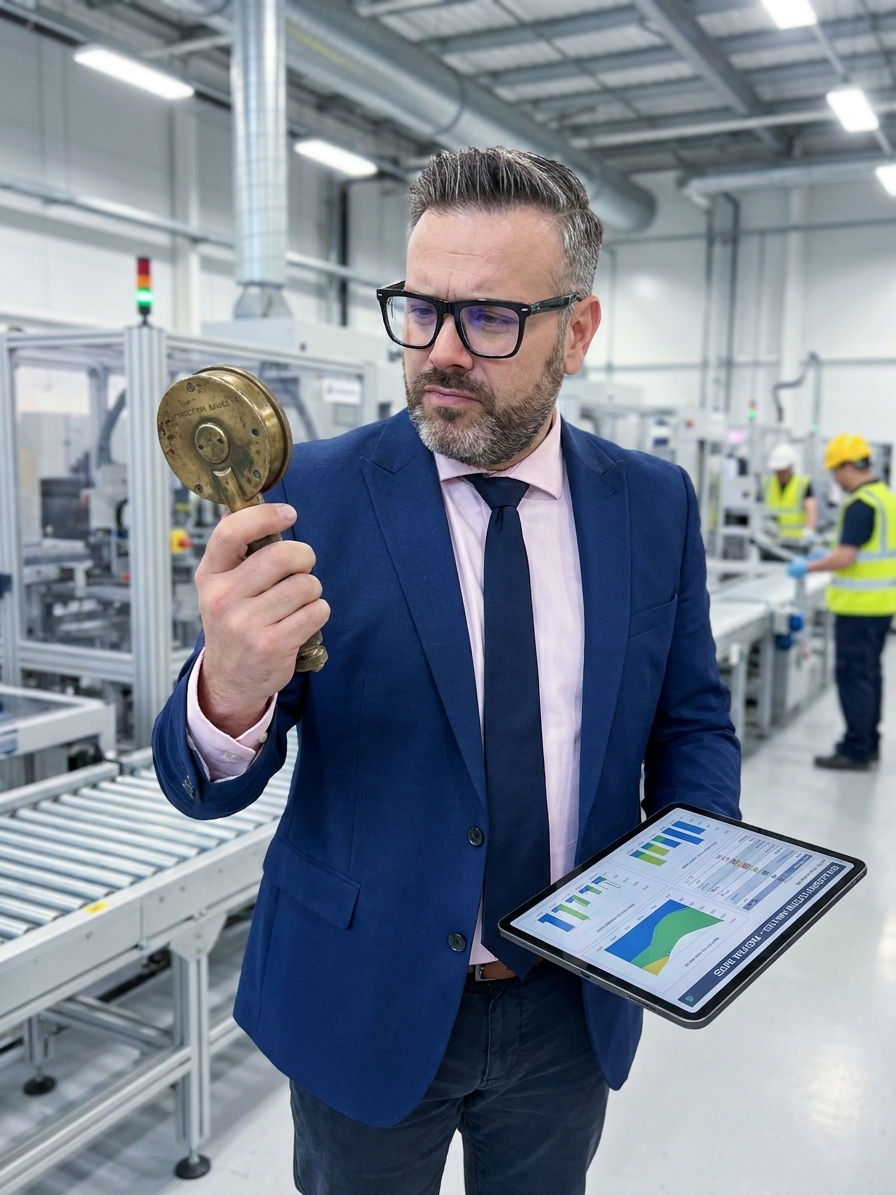
A manufacturing plant runs the same inspection protocol for fifteen years. The same checklist. The same gauges. The same sampling plan. Everyone knows the system has gaps. The quality manager knows it. The engineers know it. The operators on the floor know it. But when someone proposes a replacement — automated vision system, revised sampling methodology, redesigned workflow — the resistance is immediate and visceral.
Notice what drives the defence. It is not data. It is not a comparison of capabilities or a rational assessment of what the new system could do against what the old system does. It is based on something more primitive: the mere fact that the old system is already theirs. The Endowment Effect — the cognitive bias where people assign more value to things simply because they own them — is quietly destroying quality in manufacturing organisations worldwide.
I have audited plants that will defend a paper-based inspection system to the death while their competitors achieve ten times the throughput with automated optical inspection. The defence of the legacy system is never about its merits. It is about ownership, identity, and the psychological weight of letting go. In manufacturing quality, this bias manifests in a specific and destructive pattern: organisations systematically overvalue existing systems, not because those systems are superior, but because they are already in place.
What the Endowment Effect Actually Is
The Endowment Effect was first documented by psychologists Daniel Kahneman, Jack Knetsch, and Richard Thaler in the early 1990s. In their landmark experiments, participants given a coffee mug demanded roughly twice the price to sell it than other participants were willing to pay to buy the exact same mug. The mug had not changed. The market had not changed. The only variable was ownership.
The implication for quality management is direct. We do not value our processes and tools objectively. We value them more when we feel they are ours. This bias does not disappear when we walk through the factory doors. It distorts procurement decisions, sabotages improvement proposals, and protects obsolete systems from the scrutiny they require.
The result is a persistent, irrational resistance to improvement that has nothing to do with the merits of the proposed change and everything to do with the psychology of ownership. Quality directors reject proven technology because their team built the current process. Plant managers defend SPC charts that nobody reads because those charts have been on the wall since launch. The Endowment Effect transforms rational engineering decisions into territorial disputes.
How the Bias Manifests on the Manufacturing Floor
The pattern repeats across every level of the organisation, from the shop floor to the boardroom. A medical device manufacturer runs a manual inspection process designed in 2008, requiring three inspectors per shift with handheld gauges and paper forms. The false accept rate — defective parts that pass inspection — sits at roughly 2.3%. The false reject rate — good parts flagged as defective — runs near 7.1%. Both numbers are documented. Both are known to management.
A competitor adopts automated optical inspection with a false accept rate of 0.1% and a false reject rate of 0.8%. The technology is validated in similar environments. The ROI analysis shows a payback period of fourteen months, factoring in labour savings, scrap reduction, and warranty claim prevention. The proposal reaches the quality director's desk. He rejects it.

He is not evaluating the technology. He is defending his ownership of the existing system. The inspectors are his team. The gauges are his equipment. The process is his process. The Endowment Effect has transformed a rational procurement decision into a threat to professional identity. The same dynamic plays out with SPC charts that have not been recalculated since launch, defended because they are part of the quality system rather than because they detect process shifts.
The Cost: What the Endowment Effect Actually Destroys
The financial cost does not appear as a line item on any report. It shows up in the gap between actual quality performance and achievable quality performance — the distance between where you are and where you could be if you were willing to let go of what you have. It shows up in scrap rates that are higher than they need to be, in warranty claims that a better system would have prevented, in inspection labour that a smarter process would eliminate.
The True Cost Gap of Legacy Systems
But the deeper cost is strategic. When organisations overvalue their existing systems, they create a gravitational field that pulls every improvement proposal back to earth. New ideas are evaluated not against the objective standard of whether they are better, but against the subjective standard of whether they are worth disrupting what we already have. Because the existing system is inflated by the Endowment Effect, the bar for disruption is set impossibly high.
The quality organisation becomes trapped in a local maximum — a performance plateau that is comfortable but far below what a more objective assessment would reveal. Young quality engineers enter with fresh methodologies and encounter the bias in their first week, when they suggest a change to a process everyone knows is suboptimal and are told, with condescending patience, that is not how things are done here. The best ones leave for competitors who will listen. The Endowment Effect does not just protect bad systems — it repels the very people who could replace them with good ones.
Why It Happens: The Psychology Behind the Bias
The Endowment Effect is not stupidity. It is not stubbornness for its own sake. It is a deeply human response to several interacting psychological forces, and understanding those forces is the first step toward counteracting them. Loss aversion is the most powerful: the well-documented tendency for humans to feel the pain of a loss roughly twice as strongly as the pleasure of an equivalent gain. When someone proposes replacing your quality system, your brain frames it as a loss — of expertise, of familiarity, of comfort.
Identity compounds the problem. In manufacturing, quality systems are not abstract tools. They are extensions of the people who built and maintain them. The quality manager who implemented the current inspection protocol created a reflection of her professional competence. Attacking the process feels like attacking her. The Endowment Effect here is not about ownership of tools — it is about ownership of identity.
The effort heuristic turns sweat equity into perceived value. A quality system that took three years to develop, validate, and implement feels more valuable than a commercially available alternative deployable in six months — regardless of which one produces better results. And the status quo provides a safe harbour in an environment of constant pressure from production targets, cost reduction, customer audits, and regulatory compliance. Proposing a change introduces uncertainty, and uncertainty is the enemy of sleep for any quality manager who has survived enough crises.
Breaking the Bias: Structured Interventions That Work
Overcoming the Endowment Effect requires deliberate, structured countermeasures. The most effective is the zero-ownership audit. Every two years, evaluate every system, process, and tool as if you had inherited it from a company you just acquired — not as if you built it yourself. Ask whether you would choose this system if you were starting from scratch today. If the answer is no, you have identified an Endowment Effect distortion. Bring in external perspectives for this exercise: people who did not build the system and have no emotional investment in defending it.
The Pilot Escape Valve Sequence
- 01Propose pilot, not replacementFrame the new system as a parallel trial to avoid triggering loss aversion
- 02Run both systems concurrentlyCollect comparative data on defects, throughput, and false accept or reject rates
- 03Evaluate against pre-agreed metricsUse criteria established before the pilot to prevent moving the goalposts
- 04Transfer ownershipThe Endowment Effect migrates to the new system once users experience its advantages firsthand
The replacement cost framework forces the hidden costs into the open. Explicitly calculate the cost of not replacing the system: how many defects the current system misses, what those defects cost in scrap and warranty claims, how much labour the old system consumes. Compare that ongoing cost to the one-time cost of transition. When the numbers are explicit — when the cost of ownership is quantified — the Endowment Effect loses power. It is harder to defend a system that is demonstrably costing you money.
The pilot escape valve is the most powerful tool in practice. Instead of proposing a full replacement, run the new system alongside the old one for a defined period. A pilot is not a replacement — it is an experiment, and experiments feel safe. Nothing has been given up yet, so loss aversion is not triggered. In my experience, pilots often resolve the Endowment Effect entirely, because once people experience the new system and see its advantages, they develop ownership of it. The bias transfers.
Organisational Defences: Rotation and Pre-Mortems
Rotate quality personnel between plants, product lines, or process areas every two to three years. This is a direct attack on the identity and effort heuristics that fuel the bias. When a quality engineer inherits a system she did not build, she evaluates it objectively. She sees gaps the original architect became blind to. Job rotation is a well-established lean manufacturing practice, usually justified on grounds of cross-training and career development. Its most powerful benefit may be its ability to break the Endowment Effect cycle.
The system you refuse to replace does not stay the same. It decays while you defend it.
The pre-mortem protocol addresses a related risk: falling in love with new systems just as irrationally as you loved the old ones. Before implementing any new quality system, imagine it has been in place for three years and has failed catastrophically. What went wrong? What were the warning signs? The goal is not to replace one form of the Endowment Effect with another. It is to develop a culture of objective evaluation independent of ownership — past or future.
These interventions work because they attack the psychology directly. The zero-ownership audit removes the emotional investment. The replacement cost framework makes the hidden costs visible. The pilot escape valve sidesteps loss aversion by converting a threat into an experiment. Rotation breaks the identity bond between engineer and process. Together, they create a culture where systems are evaluated on their merits, not on who built them.
Your quality system is not your friend. It is not your legacy. It is not your identity. It is a tool. When a better tool exists, the only rational response is to pick it up. The question is not whether you can afford to replace your existing systems. The question is whether you can afford not to. If your first instinct is to defend what you have rather than calculate what you are losing, you have just felt the Endowment Effect at work. Recognise it. Name it. Then do the math.