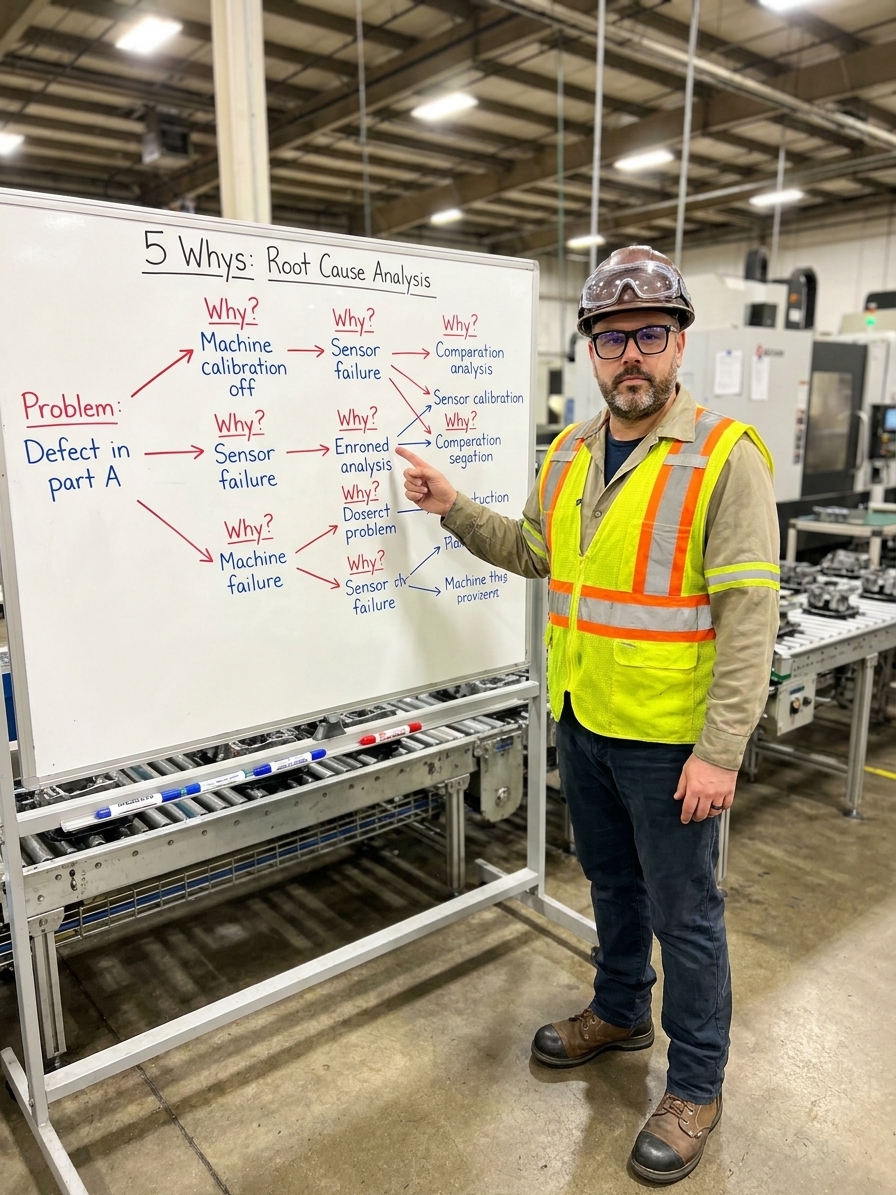
Every manufacturing professional knows the 5 Whys. Originated by Taiichi Ohno, it is simple enough to fit on a sticky note and intended to unravel complex defect chains. Your corrective action forms likely feature a neat table with five rows, and your IATF 16949 or AS9100 auditors are satisfied when you produce a completed worksheet.
But watch what happens on your production floor. A defect occurs, a team gathers in a conference room, someone facilitates a session, the rows are filled, and the form is filed. Three months later, the exact same failure mode returns. The same machine, the same scramble, the same 8D response.
This is not a failure of the technique. It is a failure of application. Having audited quality systems across automotive and aerospace plants, I see organizations use the 5 Whys to reach comfortable conclusions rather than systemic truths. They stop the investigation at actionable, low-friction answers instead of following the causal chain into management systems.
The Anatomy of a False Root Cause
Consider a typical failure: a critical dimension on a machined bracket is out of tolerance, and the customer rejects the lot. During the 8D investigation, the quality team maps a single causal chain. Why 1: the cutting tool was worn. Why 2: the operator did not replace it. Why 3: replacements were not at the workstation.
Why 4: the tool crib ignored the kanban system. Why 5: purchasing delayed the order due to a supplier invoice discrepancy. The team establishes a corrective action: implement a secondary supplier and build buffer stock. The logic seems flawless, the auditor is happy, and the 8D is closed.
The analysis is almost certainly incomplete. By forcing a complex manufacturing failure down a single path, the team ignored every other variable. The defect was not caused solely by a worn tool. It was the convergence of a worn tool, inadequate in-process inspection, a machine overdue for calibration, and an outdated setup sheet. Finding one root cause among many provides false assurance.
To make matters worse, the team stopped at a comfortable depth. If they had asked why a single invoice discrepancy halted procurement, or why there was no escalation procedure for blocked orders, they would have questioned approval hierarchies and procurement policies. Most teams never reach this depth because the answers demand structural changes management may resist.
Structural Flaws in the Standard Investigation

In most facilities, the 5 Whys acts as a blame magnet. The unstructured questioning possesses a gravitational pull toward human error. Ask why enough times in a manufacturing context, and you will inevitably land on the operator making a mistake or the supervisor ignoring a procedure.
Once the chain hits human error, the investigation stops. The corrective action becomes retraining or reinforcing the procedure. In reality, the operator made the error because the fixture was poorly designed, the work instructions were ambiguous, and production targets forced them to skip verification. The operator was merely the final link in a chain of systemic design failures.
This is compounded by the drive-through analysis mentality. Under pressure to restart the line, the quality engineer fills out the form in fifteen minutes. A proper root cause analysis for a significant defect requires days. It demands reviewing process data, checking machine logs, and testing hypotheses. The form is meant to be the starting point, but too often it becomes the entirety of the effort.
Drive-Through vs Structured Investigation
What teams do
- Conduct sessions in a conference room away from context
- Accept the first plausible single-chain causal path
- Stop at operator error or procedural non-compliance
- Complete the 8D form within 48 hours to close the ticket
What works
- Investigate at the gemba with the failed part in hand
- Map multiple causal paths using a fault tree
- Dig past human error into system design and constraints
- Verify the root cause physically reproduces the failure
The Confirmation Bias Trap
The person facilitating the investigation almost always carries a hypothesis before the first question is asked. They have seen this failure mode before and know what usually causes it. Because the 5 Whys is an unstructured tool with no built-in safeguards against bias, it will happily lead the team to whichever conclusion the facilitator expected.
If the quality engineer believes the problem is tooling, the questions naturally gravitate toward tooling parameters. If they suspect operator error, the chain will inevitably find its way to the operator. The technique does not test hypotheses; it constructs narratives. Without data to anchor each step, these narratives are seductive and notoriously difficult to challenge.
Consider how a cross-functional team might approach a weld defect. A process engineer might steer the questioning toward robot programming, while a maintenance engineer might focus on power supply stability. Both paths might yield logical answers, but only rigorous data, such as a robot log audit and a voltage monitoring record, can confirm which causal path is valid.
Building a Framework That Actually Works
Organizations that extract genuine value from root cause analysis never rely on the 5 Whys alone. They embed it within a structured investigation framework. The first step is Is/Is Not analysis. Before asking why, define what the problem is and what it is not. Which machines are affected? Which shifts? Which product variants?
The 5 Whys is a framework for asking questions, not a substitute for answering them with evidence.
This boundary definition narrows the field before the causal analysis begins. It prevents the team from chasing irrelevancies and immediately highlights patterns. If the defect only occurs on the night shift, the investigation into material hardness becomes irrelevant, and the focus shifts to lighting, supervision, or fatigue management.
Structured Root Cause Investigation Sequence
- 01Define the Scope (Is / Is Not)Determine exactly which parts, machines, and shifts are affected, and which are not, to narrow the analytical field.
- 02Map Multiple Causal ChainsUse a fault tree or fishbone diagram to capture every plausible contributing factor simultaneously.
- 03Gather Data at the GembaReplace operator guesses with machine logs, Cpk data, and material certificates gathered directly at the process.
- 04Test the HypothesisAttempt to physically reproduce the failure based on your suspected root cause before implementing any changes.
Verifying the Root Cause Physically
Data must replace opinions at every level of the investigation. Asking why a tool wore prematurely should not be answered by an operator's best guess. It must be answered by tool life data, spindle load logs, material certificates, and cutting parameter records. The analysis is only as strong as the objective evidence supporting each answer.
Before implementing a corrective action, you must verify the root cause by attempting to reproduce the failure. If your investigation concludes that a worn tool caused the dimensional defect, intentionally run a tool to that exact wear condition and measure the result. If the defect does not reproduce, your identified root cause is wrong, and you must restart the investigation.
Verification removes confirmation bias from the equation. It forces the team to prove their hypothesis rather than simply argue it in a conference room. When a quality engineer physically demonstrates that a specific machine alignment deviation produces the exact rejectable feature found on the customer part, the corrective action is guaranteed to address the actual failure mode.
The Cultural Requirements for Honest Analysis
The ultimate failure of root cause analysis in most organizations is cultural. The technique thrives at Toyota because the culture expects production to stop for investigation. It allows inquiries to go as deep as necessary, even when they point directly to executive decisions, capital allocation, or flawed engineering designs. Operators are trusted as process experts.
Most manufacturing environments operate on a culture of compliance, where the 8D form exists to satisfy the auditor rather than solve the problem. In this culture, systemic causes are buried to protect budgets and schedules. The 5 Whys becomes exactly what it was designed to prevent: a superficial exercise that treats symptoms as causes and allows real structural deficiencies to fester.
Commit to mapping multiple causal paths and refusing to stop at human error. Every operator mistake is a system that permitted or encouraged that error. Allocate the necessary time and resources to investigate failures properly, or accept that you will be solving the exact same problems next quarter. The tool requires discipline, courage, and the integrity to act on what you find.