
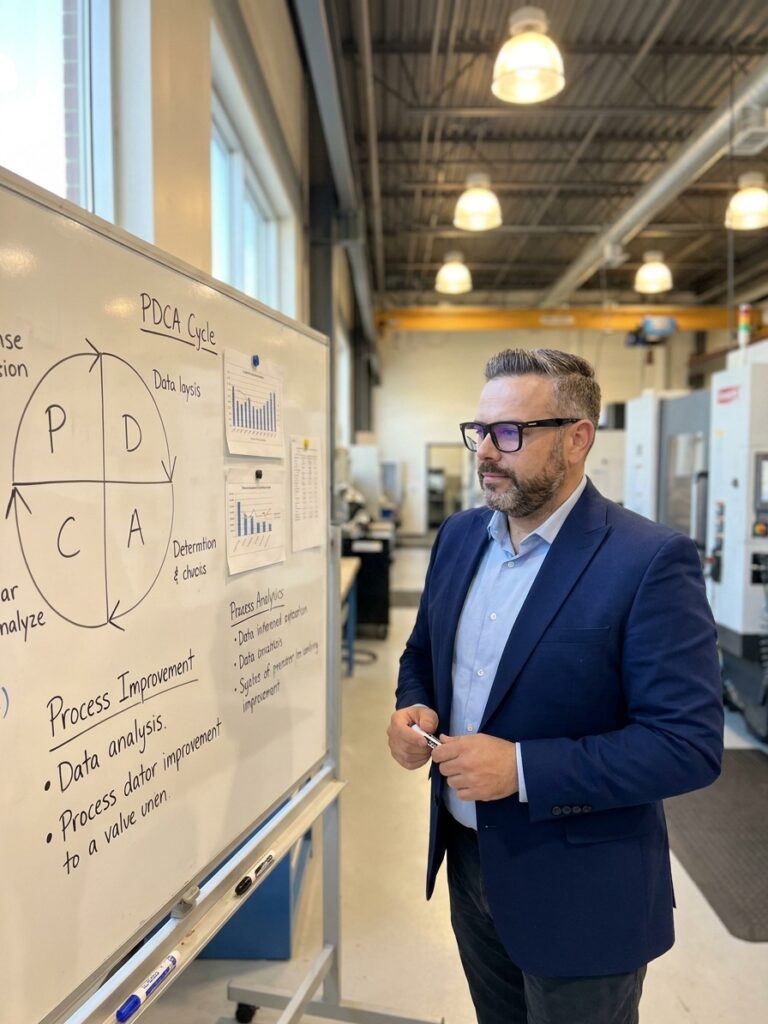
Every manufacturing facility I have audited over the last twenty years has the PDCA wheel somewhere on the wall. It is printed on laminated cards, drawn on conference room whiteboards, and embedded into every improvement methodology from IATF 16949 core tools to Six Sigma. Plan, Do, Check, Act. Four steps that are supposed to function as the engine of continuous improvement.
In practice, the wheel rarely makes a full rotation. A problem is identified, a team is assembled, and a plan is drafted with ceremony. Some actions are executed, and then the organisation moves to the next crisis. The Check step is reduced to a checkbox in an 8D closing report. The Act step, where you standardise the improvement and feed failures into the next cycle, simply never happens. The wheel spins once, wobbles, and falls over.
This is not a failure of the methodology. Deming's framework is mathematically and logically sound. It is a failure of organisational discipline. Because the concept is easy to understand, companies assume it is easy to execute. Each step demands a fundamentally different type of control, and most teams are only equipped to handle the first two.
The Discipline Required at Each Stage
Plan demands patience and root cause analysis. It requires slowing down to gather data, verify process capability, and design a controlled experiment. In most manufacturing environments, the pressure to immediately resolve a customer complaint overwhelms the patience required to plan properly. The result is a list of containment actions disguised as an improvement plan.
Do requires strict focus. It means executing the plan exactly as designed, without deviation, while systematically recording the data needed for evaluation. In practice, the Do step gets corrupted immediately. Operators modify the procedure on the fly, and supervisors add undocumented tweaks. By the time you reach Check, nobody knows what was actually tested.
Check requires uncompromising honesty. This is where you compare actual results against predicted expectations objectively. But objectivity is difficult when departmental budgets and performance bonuses are on the line. The Check step is where most cycles die, because the data rarely says what the project sponsor wants it to say.
Act requires sustained commitment. If the experiment worked, you update the standard operating procedure and retrain the shift. If it failed, you feed the learning into a new Plan. In most facilities, the Act step is replaced with a brief meeting where someone suggests keeping an eye on the process, and then nobody ever looks at it again.
Three Patterns of Organisational Failure
After decades of observing quality management systems in automotive and aerospace, three distinct failure patterns emerge consistently. The first and most common is Plan-Do-Declare Victory. A team implements a change, sees an initial positive shift, and immediately claims success in the management review. Nobody goes back ninety days later to verify if the improvement held.
Usually, the initial improvement was noise, a Hawthorne effect, or a temporary byproduct of the attention the process received. Because the Check step was skipped and Act was replaced with celebration, the process regresses. Six months later the exact same defect resurfaces on the scrap report, and everyone acts surprised.
The second pattern is Plan-Do-Plan-Do. These organisations are addicted to starting cycles but structurally incapable of closing them. Every shift problem triggers a new continuous improvement project. The kaizen board fills up with sticky notes, resources are spread thin, and attention fragments completely. They confuse activity with progress.
The third pattern is Plan-Do-Check-File, which thrives in ISO 9001 certified environments. The cycle is documented perfectly and the findings are filed in the quality management system. The quality manual gets thicker, but the actual process on the shop floor remains completely unchanged. This compliance trap is insidious because the paperwork creates the illusion of improvement.
Cycle Integrity: Appearance vs. Reality
What teams usually do
- Plan: Rush to contain the symptom and assign blame.
- Do: Allow undocumented tweaks during execution.
- Check: Cherry-pick data to confirm the intervention worked.
- Act: Add a checkbox to the audit form and move on.
What actually works
- Plan: Define the success metric and target before acting.
- Do: Execute exactly as designed and log all variables.
- Check: Compare raw results to the pre-defined target.
- Act: Update the SOP, retrain the floor, and audit adherence.
The Death of Objectivity in the Check Step
Real checking means comparing actual results to predicted results using data, not anecdotes. It requires running the statistical analysis even when you suspect the findings will be unflattering. You must distinguish between common cause variation and special cause variation, and between a genuine shift in process capability and a lucky run of good parts.
In reality, Check becomes a presentation exercise. The team lead assembles a slide deck showing that scrap decreased, carefully cherry-picking the time window that looks best. They might display a control chart with conveniently adjusted limits, or attribute a drop in customer complaints to their project while ignoring seasonal demand drops.
The antidote is straightforward but uncomfortable. Before the Do step begins, write down exactly what improvement you expect, by how much, over what specific time period, and how it will be measured. Lock the success criteria into the project charter. During Check, compare reality against that baseline. If you missed the target, say so.
A quality system that only records victories teaches the shop floor that the data is a performance, not a measurement.
Running PDCA at the Organisational Scale
The most powerful application of PDCA happens above the individual project level. At the organisational scale, Plan means setting quality objectives based on market data and internal performance metrics. Do means deploying those objectives through budgets, resources, and training. Check means reviewing actual performance against those targets continuously. Act means adjusting the strategy.
Few companies run PDCA at this level with any rigor. The annual management review required by IATF 16949 and AS9100 becomes a ritual. Last year's data is presented, last year's objectives are declared mostly achieved regardless of reality, and new objectives are set that look suspiciously identical to the previous year's goals. The wheel turns, but only because someone is manually spinning it.
Effective organisations share distinct characteristics. They tie quality objectives directly to business outcomes rather than isolated process metrics. They review performance monthly, not annually. Most importantly, they have the operational courage to abandon improvement strategies that are not working instead of quietly redefining success downward to match whatever happened.
The Layers of a Completed PDCA Cycle
- Compliance CompletionThe 8D report is closed and filed. The immediate symptom is gone, but the system is untouched.
- Project CompletionThe specific defect rate is reduced on one line, but the learning stays isolated.
- StandardisationSOPs are updated, training is delivered, and the process change is verified by internal audits.
- Systemic ImprovementRoot learnings are fed back into the PFMEA and control plan, preventing recurrence across all lines.
Separating Containment from Improvement
PDCA requires patience, and patience is in short supply when a major customer threatens to pull a contract over a quality escape. Nobody wants to hear about a four-step methodology when the line is down. The framework gets bypassed in favour of containment actions, band-aid fixes, and heroic interventions that solve the immediate crisis but guarantee recurrence.
Containment is appropriate and necessary when the house is on fire. But containment must trigger a parallel PDCA cycle, and too often it does not. The fire gets put out, the customer is appeased, and everyone returns to normal until the exact same failure mode ignites in the same location a quarter later.
The most disciplined operations I have worked with separate these functions entirely. They maintain a rapid response team for immediate containment and a structured continuous improvement team for permanent solutions. The two run simultaneously but are managed by different people operating on completely different time horizons.
This structural separation prevents the suffocating urgency of containment from consuming the patience required for root cause elimination. The shift supervisor handles the immediate fix; the quality engineer handles the systemic overhaul. Neither role impedes the other, and the documentation flows seamlessly between them.
Building the Mechanisms to Close the Loop
Fixing broken PDCA requires operational mechanisms, not motivational speeches. First, cap the number of open cycles. Before launching a new improvement project, review how many are currently open. If a team has six active cycles, they will finish none of them. Force them to close out existing projects before initiating new ones.
Second, enforce pre-defined success criteria tied to measurable standards. Require specific targets like reducing scrap on a specific press from 4.2 percent to below 2.5 percent, sustained for three consecutive months, as measured by the manufacturing execution system. This removes the temptation to move the goalposts during the Check phase.
Third, assign an honest broker to own the Check step. This must be someone who reviews the Cpk data without caring whose project it was or whether the result flatters the department head. The independence of the quality function is critical here. If the checker is reporting to the person who executed the Do step, the data will always be spun positively.
Fourth, standardise before celebrating. The Act step is a transition, not a conclusion. If the improvement worked, the PFMEA gets updated, the control plan is revised, training is delivered to all shifts, and the process owner signs off. Only then is the project closed.
Finally, measure cycle completion as a key performance indicator. Track how many PDCA cycles were initiated against how many resulted in a sustained, standardised improvement updated in the management system. The ratio of starts to completions measures the organisation's true capacity for improvement. The phrase continuous improvement implies a smooth upward trajectory, but in reality it is built on the disciplined repetition of finished cycles.