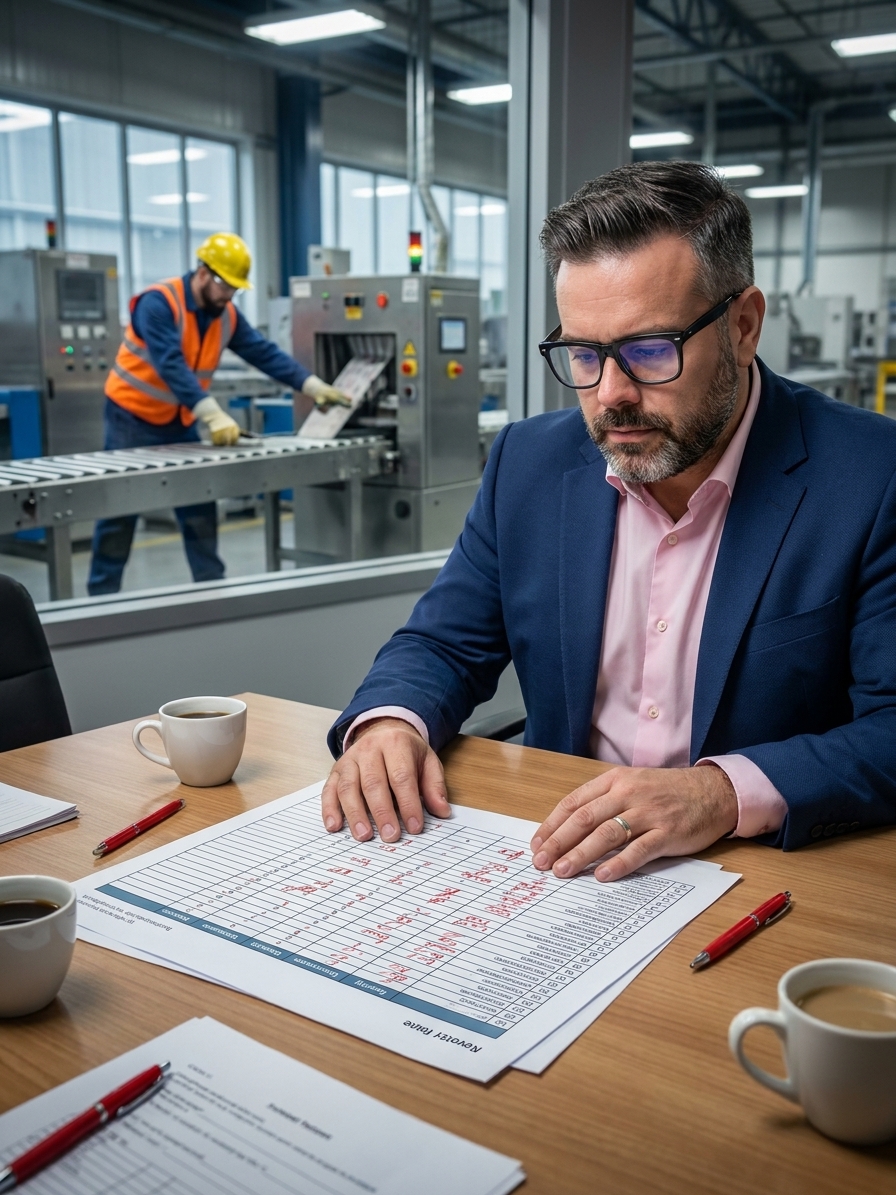
The ritual is identical across plants. A product is launching. The customer requires an FMEA. A cross-functional team gathers around a laptop, opens the template, and spends four hours arguing whether severity should be a 7 or an 8. Occurrence ratings are debated based on gut feeling because nobody has actual process data. Detection scores are assigned optimistically because the inspection step 'should catch it.'
The result is a spreadsheet with 85 rows, a handful of RPNs just below the action threshold, and the satisfying feeling that due diligence is done. The document is filed. The product launches. And the failures that bring production to a halt are the ones nobody thought to include in the FMEA at all.
This is the FMEA paradox. The most widely used risk analysis tool in manufacturing has become one of the least effective at preventing failures. The methodology is sound — AIAG, VDA, and IATF 16949 frameworks are structurally robust. But the way organizations practice FMEA has drifted so far from its analytical intent that the tool has become a compliance artifact, a paper shield, and a box to check for the registrar.
The Timing Collapse: Analysis After the Decision
The first structural failure is timing. In theory, FMEA should be one of the earliest activities in APQP. You analyze risks before committing to a design, before building tooling, before locking in the process flow. In practice, FMEA is almost always done late — after the design is frozen, after the process is laid out, after tooling capital is approved and spent.
At that point, the FMEA cannot analyze risks to prevent them. It documents risks you have already accepted. You cannot change the design because the tooling is built. You cannot modify the process because the capital is spent. The FMEA becomes a post-hoc justification rather than a preventive analysis. You are describing the risks you have already decided to live with.
When I review FMEAs at plants, the first thing I check is the revision date against the tooling kickoff date. When the FMEA postdates the hard tooling purchase order by weeks or months, the document is fiction. The team is not anticipating failure modes; they are reverse-engineering a rationale for decisions already locked in. Every action item becomes an aspiration because the window for actual engineering change has closed.
The RPN Negotiation and the Severity Trap
The Risk Priority Number — Severity × Occurrence × Detection — was designed as a prioritization tool. In practice, it has become a negotiation. Teams spend disproportionate time arguing over individual ratings, not because they disagree about the underlying risk, but because they need the RPN to fall below the customer's action threshold. If the threshold is 100, most RPNs will cluster at 95 to 99.

The most dysfunctional pattern is the treatment of severity. Severity describes the consequence if the failure occurs, not the probability that it will occur. That is what occurrence is for. But teams routinely downweight severity for unlikely events because they want to avoid the action items that a high-severity, high-RPN failure mode generates. 'It's never happened before' becomes the justification for a lower rating.
This is particularly dangerous in safety-critical applications. When a team assigns a severity of 5 to a failure mode that could cause injury because 'we have never had that happen,' they are not analyzing risk. They are conflating two independent dimensions — consequence and probability — and the entire risk assessment collapses into a single gut-feel judgment disguised as structured analysis.
The RPN Cluster Effect
The Detection Delusion
The detection rating is the most manipulated column in the FMEA. Detection assesses the likelihood that current controls will catch the failure before it reaches the customer. A rating of 1 means the failure is almost certain to be detected. A rating of 10 means there is essentially no detection capability.
In practice, teams assign optimistic detection ratings because the alternative — admitting there is no reliable way to detect a failure — triggers uncomfortable conversations about investing in poka-yoke, automated inspection, or process monitoring. So 'operator visual inspection' gets a detection rating of 3 or 4. This ignores the well-established reality that visual inspection catches roughly 80% of defects under ideal conditions and significantly less under production conditions.
'Final inspection' is credited as a detection control even when it is an AQL sampling plan that explicitly accepts a percentage of defects. 'SPC' is listed as a detection method for failure modes that would not cause out-of-control signals on the charts being used. Every inflated detection rating artificially deflates the RPN. The column intended to drive investment in better controls becomes a tool for avoiding that investment.
The Scope Problem and the Update Vacuum
A thorough FMEA for a moderately complex product should have hundreds of potential failure modes. In practice, most contain 50 to 100 rows because the team runs out of time, patience, or meeting room availability. The failures that get documented are the obvious ones everyone already knows about. The novel, interaction-based failures — the ones that actually cause new product launches to fail — never make it into the spreadsheet.
FMEA is supposed to be a living document, updated as new failure modes are discovered, as process changes are implemented, as field data reveals unanticipated risks. In reality, most FMEAs are written once, approved once, filed once in the PPAP package, and never meaningfully updated again.
An FMEA that catalogs past failures is a lessons-learned database. An FMEA that anticipates future ones is a prevention tool. Most organizations have the former and think they have the latter.
When a new failure occurs that was not in the FMEA, the 8D report references an FMEA update. But the update is usually a single row added retroactively to document what happened rather than to prevent what might happen next. The AIAG/VDA handbook replaced raw RPN thresholds with Action Priority and reinforced the living-document requirement. These are methodological improvements, but they do not fix the cultural problem. No handbook revision resolves a culture that treats FMEA as documentation rather than analysis.
Compliance FMEA vs. Analytical FMEA
Compliance-driven practice
- FMEA completed after design freeze and tooling commitment
- Detection ratings assigned optimistically to avoid action items
- RPNs cluster just below the customer's action threshold
- Updates are single rows added retroactively after an 8D
Analysis-driven practice
- FMEA started during concept development, updated at each gate
- Detection ratings reflect actual inspection capability data
- High RPNs treated as engineering problems to solve, not negotiate away
- Every field complaint and internal nonconformance triggers review
The Competence Gap
FMEA quality is directly proportional to the experience and analytical capability of the team performing it. A team of engineers who have seen similar products fail, who understand the physics of the process, who can imagine failure modes that have not yet occurred but are physically possible — that team produces a valuable FMEA. A team filling out their first template, guided by a facilitator focused on completing the document, produces a compliance artifact.
Most organizations do not invest in training engineers to think analytically about failure. They invest in training engineers to fill out the form correctly. The emphasis is on format, rating scales, and linkage to other PPAP documents. The emphasis is rarely on how to think creatively about what could go wrong, how to challenge assumptions, how to look for interactions between failure modes that amplify consequences.
The form is taught. The thinking is assumed. But the thinking is where the value is. A cross-functional team that includes a tooling engineer who understands wear patterns, a process engineer who knows the Cpk of each station, and a quality engineer who has triaged field returns from similar products will identify failure modes that a template-driven team cannot. Competence, not format, determines whether FMEA prevents failures or merely documents them.
What Better Looks Like
Organizations that get real value from FMEA share characteristics that have nothing to do with the form and everything to do with culture. They do FMEA early — during concept development, when changes are still cheap. They accept that the initial FMEA will be incomplete and will be updated as the design matures. They treat the first draft as a rough picture of the risk landscape, not a finished document to be filed.
They assign ratings honestly. They use process data where it exists — scrap rates, Cpk studies, warranty claims — and where it does not, they are conservative rather than optimistic. They accept that high RPNs or high action priorities are not failures of the design but invitations to improve it. They invest in detection that genuinely reduces escape probability: mistake-proofing, automated inspection, and process monitoring that produces out-of-control signals before defects ship.
They update relentlessly. Every customer complaint, every internal nonconformance, every near-miss triggers a review of the relevant FMEA. They conduct periodic reviews even when nothing has gone wrong, bringing fresh eyes from other product lines, other plants, and key suppliers to challenge the existing analysis. The FMEA is the living memory of the product's risk profile — current, not historical.
If your FMEAs have never identified a failure mode that surprised you, if every row is a failure everyone already knew about, and if the recommended actions column is filled with 'monitor' and 'train' rather than design changes and process improvements — the process is not analyzing risk. It is documenting what you already know in a format that satisfies a documentation requirement. One approach prevents failures. The other prevents audit findings. They are not the same thing, and organizations that confuse them learn the difference the hard way.