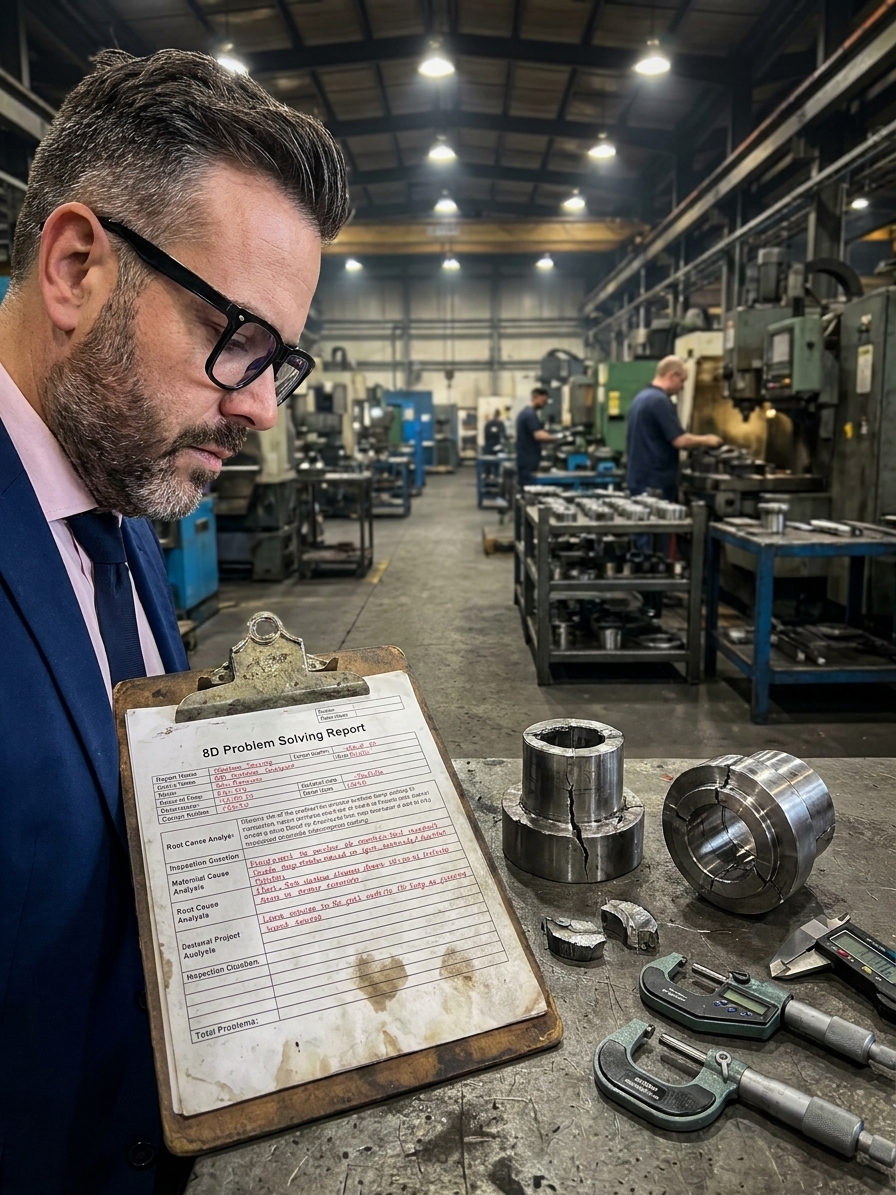
A major customer rejects a shipment. The conference room fills with silence as people calculate the cost of being blamed for the defect. Into that silence walks the 8D form.
The Eight Disciplines methodology originated from US military standard 1520 and was popularised by Ford in the 1980s. The framework is rigorous and sequential: form a team, describe the problem, implement interim containment, identify root causes, develop and implement corrective actions, prevent recurrence, and close the team. It forces engineering teams to stop and ask why through a documented chain of analysis that traces failure from symptom to system.
Applied with intellectual honesty, 8D is genuinely powerful. I have audited plants where the methodology drives continuous improvement at every level. But in most organisations, 8D has degraded into one of the most systematically corrupted quality processes in modern manufacturing. The form is filed, the boxes are checked, and the root cause remains untouched.
D1 and D2: The Excluded Operator and the Vague Problem Statement
The first failure occurs at team formation. The 8D team is supposed to be cross-functional, drawing on engineering, operations, quality, and supplier representatives. In reality, the team is whoever the quality manager can pull into a room on short notice. This usually means a quality engineer juggling six other open 8Ds, a production supervisor worried about cycle times, and a design engineer half-listening on a conference phone.
The operator who actually runs the process is almost never on the team. They are on the line and cannot be spared. This is the foundational failure of the entire methodology. The operator is the person most likely to identify the root cause in ten minutes, but they are never asked. A problem-solving team without the problem's institutional knowledge is a committee that will produce a plausible report and a wrong answer.
This compounds at D2, the problem description. Precise problem statements require data, investigation, and time that nobody wants to spend during a containment emergency. So the statement degrades into a summary email: 'Customer reported burrs on Part Number 45821.' Which plant? Which lot? What size burr? What specification for acceptable edge condition? These questions go unanswered because they require phone calls, retained sample pulls, and comparator measurements.
A forensic problem statement specifies the defect in measurable terms: the hole diameter measures 12.3mm against a specification of 12.0mm plus or minus 0.1mm, observed in three consecutive lots from the second shift. If you cannot reproduce the problem from the description alone, the description is incomplete. A vague problem statement guarantees a vague root cause analysis.
D3: The Interim Containment That Becomes Permanent
Interim containment is supposed to act as a tourniquet. You sort the inventory, inspect 100 percent at the customer, and add an inspection station on the line. These are temporary measures designed to expire when the corrective action from D6 takes over.
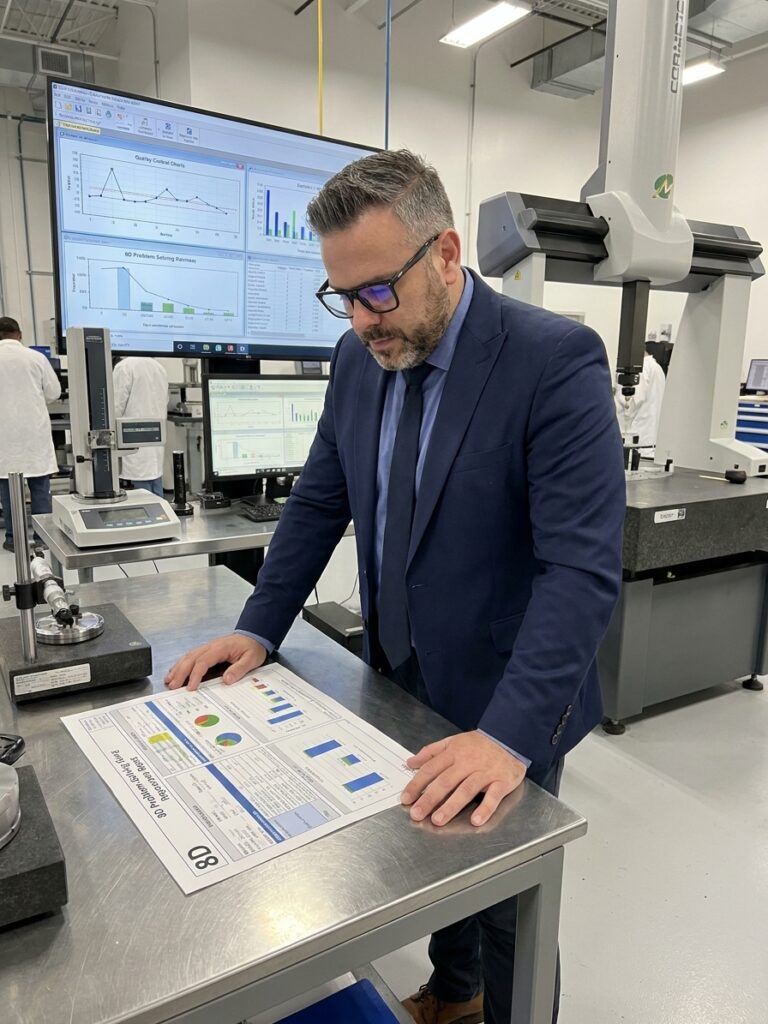
But the interim containment works. The defects stop reaching the customer. The urgency evaporates, and the 8D stalls somewhere around D4. The interim inspection station is still there eighteen months later, staffed by a temporary worker with a go/no-go gauge. The cost is buried in the operating budget as inspection labour, while the 8D sits in a file marked In Progress.
The mathematics of permanent containment are punishing. If extra inspection and sorting cost $5,000 per month, and the permanent corrective action costs $40,000 to implement, the break-even point is eight months. After two years, the organisation has lost $80,000. Many containments run for three to five years. The 8D form has a field for planned containment removal date, and it is almost always blank.
The Economics of Permanent Containment
D4: Root Cause Analysis That Finds the Comfortable Answer
Root cause analysis is the heart of the methodology. D4 asks the team to separate symptom from cause from root cause through a layered analysis, typically the 5 Whys. Applied honestly, a 5 Whys chain traces the failure from a worn cutting tool to a manually reset counter, to the lack of a shift handover procedure, and finally to process documentation treated as a compliance exercise rather than an operational tool.
That chain leads to a system-level fix: redesign the shift handover process and implement automated tool-life monitoring. But this chain requires honesty, which is scarce when the root cause points to management decisions. Instead, the team finds a comfortable answer. The operator made an error. The supplier sent a bad lot. These are immediate causes dressed up as root causes.
The phrase 'retrain the operator' appears in more 8D reports than any other corrective action. It is the Swiss Army knife of quality theatre. It sounds responsible, costs almost nothing, and implies the problem was human error rather than a system that set up a human being to fail. The operator was not retrained; they were blamed. Somewhere in the factory, the same defect is preparing to happen again because nothing in the system actually changed.
D5 and D6: Corrective Actions That Are Never Verified
The discipline that separates real problem-solving from paperwork is verification. D5 asks whether the proposed corrective action will actually eliminate the root cause. D6 asks whether it works in production, confirmed with data. Honest verification means running trials on one line, monitoring defect rates over a defined period, and comparing before and after results with statistical significance.
In practice, D5 and D6 are usually handled in a single sentence: 'Corrective action implemented on 15 March. No further defects reported.' That last clause is doing heavy lifting. No further defects reported could mean the fix worked. It could also mean the customer stopped inspecting. It could mean the defect is still occurring at a lower rate that the sampling plan does not catch, or that a different defect is now masking the original one.
Verification requires measurement, and measurement requires time and resources that nobody wants to allocate after the urgency has passed. The 8D moves to D7 with corrective actions that are assumed effective rather than proven effective. The organisation moves on to the next fire, and the unverified fix quietly degrades.
Root cause analysis that ends at human behaviour is root cause analysis that has not been completed.
D7 and D8: The System Fix Nobody Makes
Prevent Recurrence is the discipline that asks what system, procedure, standard, or design practice needs to change so that this category of failure never happens again. It is the most valuable question in the entire methodology, and it is the one most consistently skipped. Preventing recurrence means involving people who were not on the 8D team, spending money outside the quality budget, and disrupting production schedules.
A proper D7 for the burr example requires five actions across four departments: updating the PFMEA to reflect the tool-wear failure mode, revising the control plan to include tool-life monitoring, updating shift handover work instructions, implementing a poka-yoke that prevents counter resets without supervisor authorisation, and auditing similar processes across all production lines. In most organisations, D7 reads: 'Work instructions updated. Operator retrained.'
D8 closes the loop with team recognition. In most organisations, 8D closure is a non-event. The database is updated and the quality engineer moves to the next open report. There is no celebration because the team knows, at a level they will not say out loud, that the 8D did not actually solve the problem. The root cause is still there, dormant, waiting for the next time the conditions align.
The Economics of 8D Theatre and the Path Forward
A typical mid-sized manufacturer runs 50 to 200 8Ds per year. Each consumes 40 to 80 hours of engineering time. At a loaded labour rate of $80 per hour, that is $160,000 to $1.28 million per year in direct costs. When fewer than 30 percent of closed 8Ds actually eliminate the root cause, 70 percent of that investment is consumed by paperwork that does not prevent recurrence.
The real cost is not the labour but the false confidence. Each closed 8D tells leadership the problem is solved. Each root cause checkbox tells management the organisation understands its failures. The quality engineer believes the root cause is real. The executive believes the organisation is improving. None of them are looking at the factory floor, where the conditions that produced the original failure are quietly reassembling.
The 8D You Have Versus the 8D You Need
What teams do
- Form teams based on who is available, not who has process knowledge
- Write problem descriptions as summary emails without measurement data
- Stop the 5 Whys at 'operator error' and mandate retraining
- Leave interim containment in place indefinitely without cost tracking
What works
- Refuse to start until the operator and process engineer are in the room
- Write forensic descriptions with photographs, specifications, and lot histories
- Push the analysis to the system failure that made the human error possible
- Track containment as financial debt with a mandatory monthly review date
The methodology is not broken. Ford's original framework was designed for an environment where defects had clear causes and corrective actions had measurable effects. It still works in environments that treat it as an investigation tool rather than a documentation requirement. The question is whether your 8D reports would survive scrutiny from an outside engineer.
Could an independent auditor read your D4 and agree you found the root cause? Could they read your D6 and agree the corrective action was verified with statistical significance? If the answer is no, your 8D process is manufacturing the illusion that problems have been solved. That illusion is more dangerous than the original defect, because the original defect triggers a response while the illusion triggers complacency.