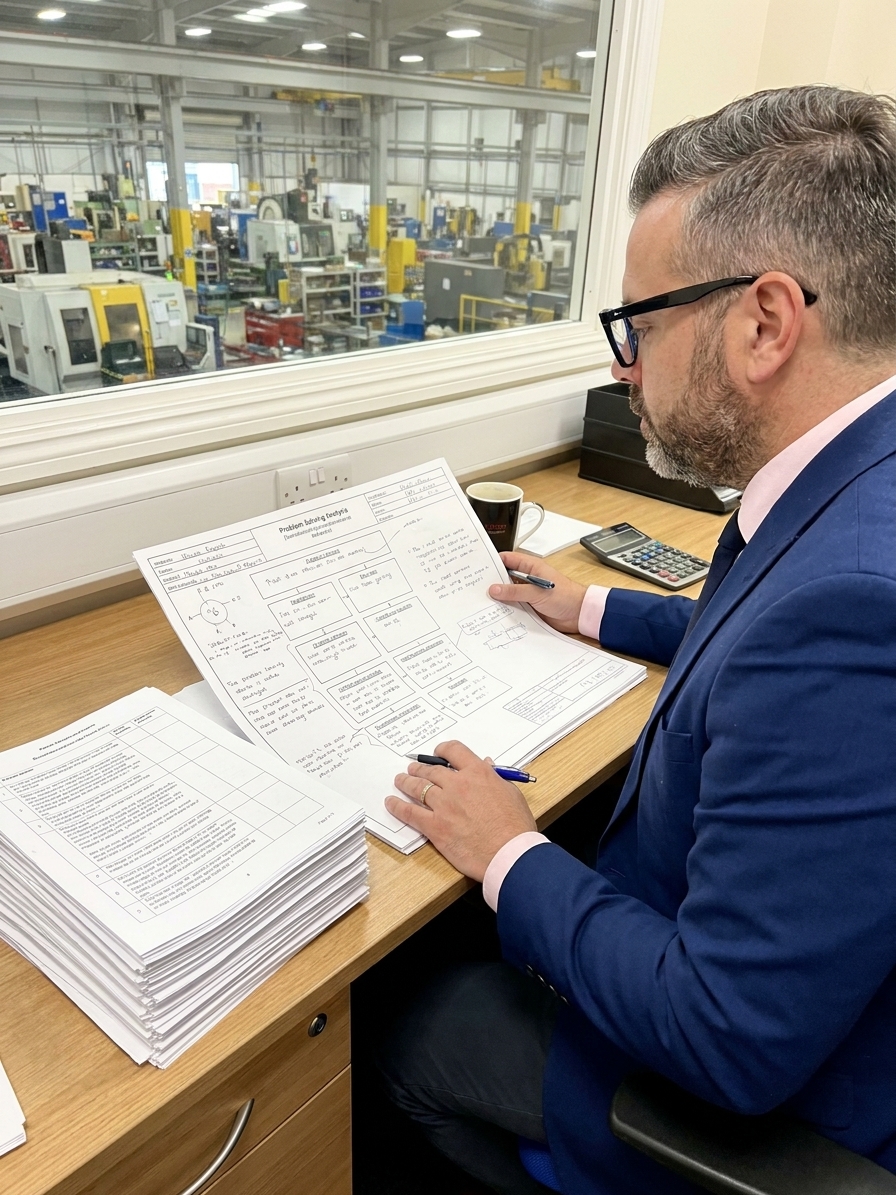
The A3 report is one of the most effective problem-solving tools to come out of Toyota. Named after the international paper size, it was designed to force a specific discipline: capture an entire problem, from background and current condition through root cause, countermeasures, and follow-up, on a single page.
The genius of the format is not the paper itself, but the thinking it enforces. When you have only one page, you must be precise. You must distinguish between symptoms and root causes. You cannot hide behind volume.
At Toyota, the A3 is not a document, it is a structured conversation. A manager reviews it to challenge the logic, not to approve a conclusion. The constraint of the format demands intellectual honesty because there is nowhere to bury weak logic in a forest of slides. In most organisations, this ideal collapses entirely.
From Thinking Tool to Box-Checking Exercise
The decay begins when a facility adopts the format without understanding its purpose. A quality manager sees an A3 template at a lean conference, standardises the corporate problem-solving procedure around it, and mandates its use for every 8D or corrective action.
The focus immediately shifts from structured analysis to document production. Engineers spend hours formatting boxes in PowerPoint, adjusting font sizes until everything technically fits on a single page. The content becomes secondary to the layout.
The result is a report that looks perfect and says nothing. The current-condition section features a process map copied from a standard operating procedure rather than drawn from actual observation. The root-cause analysis simply lists operator error. The countermeasure is retrain operator. Every box is filled, but no actual problem-solving has occurred.
This is the first stage of degradation. The A3 becomes a compliance document you produce because the quality management system demands it. It is checked by a reviewer who confirms the boxes are filled, then filed in a system nobody ever searches again.

The Expansion Problem and the Loss of Prioritisation
The second failure mode is spatial. Manufacturing problems are genuinely complex. There are multiple root causes, stakeholders, and variables. Engineers feel the single-page constraint is arbitrary, so they attach appendices, data tables, and risk assessment matrices.
Before long, the A3 is a thirty-page packet. The review meeting becomes a walkthrough of the attachments. The one-page summary serves as a table of contents for a report that no one reads in full.
Toyota's format works because the constraint forces prioritisation. When you have one page, you must identify the critical few causes among the trivial many. You must choose the countermeasure that addresses the deepest systemic root cause, not the one that is easiest to implement.
When you remove the constraint, you remove the discipline. Everything becomes important, which means nothing is prioritised. The tool designed to force brevity becomes a vehicle for verbosity. The thirty-page packet takes longer to produce, longer to review, and longer to file than the actual problem took to surface.
When the Review Becomes a Rubber Stamp
In a functioning lean environment, the A3 review is a mentoring relationship. A senior manager challenges the problem solver's thinking, asking what data supports a claim or whether they actually observed the process during all three shifts. This dialogue builds organisational capability.
In most manufacturing environments, this step is perfunctory. A quality engineer submits the A3 to a plant manager who has fifteen minutes between meetings. The manager skims the summary, confirms the countermeasure seems reasonable, and signs off. There is no challenge and no learning.
The Mentoring Review vs the Compliance Check
Compliance check
- Reviewer checks if all boxes are filled
- Focus is on document formatting and layout
- Takes five minutes between other meetings
- Results in the A3 being filed and forgotten
Mentoring review
- Reviewer challenges the stated root cause logic
- Focus is on whether evidence supports claims
- Takes thirty minutes of probing dialogue
- Results in revised thinking and deeper analysis
Problem solvers quickly realise the review is superficial. They know no one will ask whether they actually went to the shop floor to observe the failure mode. They optimise for the path of least resistance: fill in the boxes quickly, make the document look professional, and move on to the next task.
This creates a vicious cycle. Because the reviews are shallow, the reports are shallow. Because the reports are shallow, managers learn that reading them closely produces no value. The process degrades until it is pure theatre, produced to satisfy an IATF 16949 or ISO 9001 auditor rather than to fix the process.
Reverse-Engineering the Logic
The deepest failure of the A3 process is the substitution of documentation for understanding. The format was designed as a thinking tool to guide an investigation. In most facilities, it has become a documentation tool used to justify a decision that was already made.
If you know the solution before you start the analysis, the analysis will always confirm your solution.
When used as a documentation tool, the current-condition section is reverse-engineered to support a preferred countermeasure. The root-cause analysis is written to confirm existing beliefs. The data is selected to make the case, ignoring contradictory evidence from the PFMEA or capability studies.
The A3 process then actively undermines problem solving by creating the illusion of rigour. The document looks thorough. The logic appears to flow from one section to the next. But the thinking is entirely circular, starting with a conclusion and working backward to fill in the reasoning.
An outside auditor or customer cannot easily tell the difference between an A3 built through genuine investigation and one reverse-engineered for compliance. The format provides excellent cover for shallow thinking. The better your template, the easier it is to produce a convincing document without doing the actual analytical work.
Characteristics of Effective A3 Practice
Organisations that use A3 effectively share several distinct traits. They start with the problem, not the form. The document is built during the investigation, drafted on the shop floor based on actual observation, not copied from a standard operating procedure that describes an ideal state.
They rigorously separate the analysis phase from the solution phase. The current-condition and root-cause sections are written first, reviewed, and challenged. Only after the analysis is independently confirmed does the countermeasure section get completed.
The review is substantive and targeted. A proper review takes thirty minutes or more, with the reviewer asking what countermeasures were considered and rejected, and why. This is how organisational problem-solving capability is actually built, one conversation at a time.
Finally, the A3 is treated as a living document within the PDCA cycle. It is updated as countermeasures are implemented and Cpk data is measured. If the countermeasure failed, the A3 explicitly states this, and the problem solver returns to the root-cause section.
The Living A3 Investigation Cycle
- 01Observe realityGo to the shop floor and document the actual current condition, not the theoretical SOP state.
- 02Isolate root causeComplete and challenge the root-cause analysis before any countermeasures are proposed.
- 03Mentor reviewA senior leader challenges the evidence and logic, not the formatting or font size.
- 04Implement and measureExecute the countermeasure and track real outcomes like defect rates or Cpk shifts.
- 05Confirm or reviseIf the defect persists, explicitly return to the root-cause step and begin the cycle again.
Rebuilding the Analytical Discipline
If your facility's A3 process has decayed into document production, you rebuild it through cultural change, not by altering the template. Start by reviewing existing reports honestly. Gather a sample of recent 8D submissions and ask whether the documented countermeasure would have changed if the root-cause analysis had been more rigorous.
Change the review process completely. Train plant managers and quality leads to challenge thinking, not check boxes. Make it explicitly acceptable for an A3 to be incomplete. A report that honestly states we do not yet know the root cause is worth far more than a polished document that blames the operator.
Measure outcomes rather than document completion. Track whether the problems identified through the A3 process actually stay solved over the following ninety days. If the same defects recur on your weekly scrap report, the process is failing, regardless of how perfectly formatted the documents look for the auditor.
The A3 is a brilliant tool, but it only works when the people using it are doing the hard, unglamorous work of observing reality, questioning assumptions, and following evidence wherever it leads. No template can substitute for that discipline.