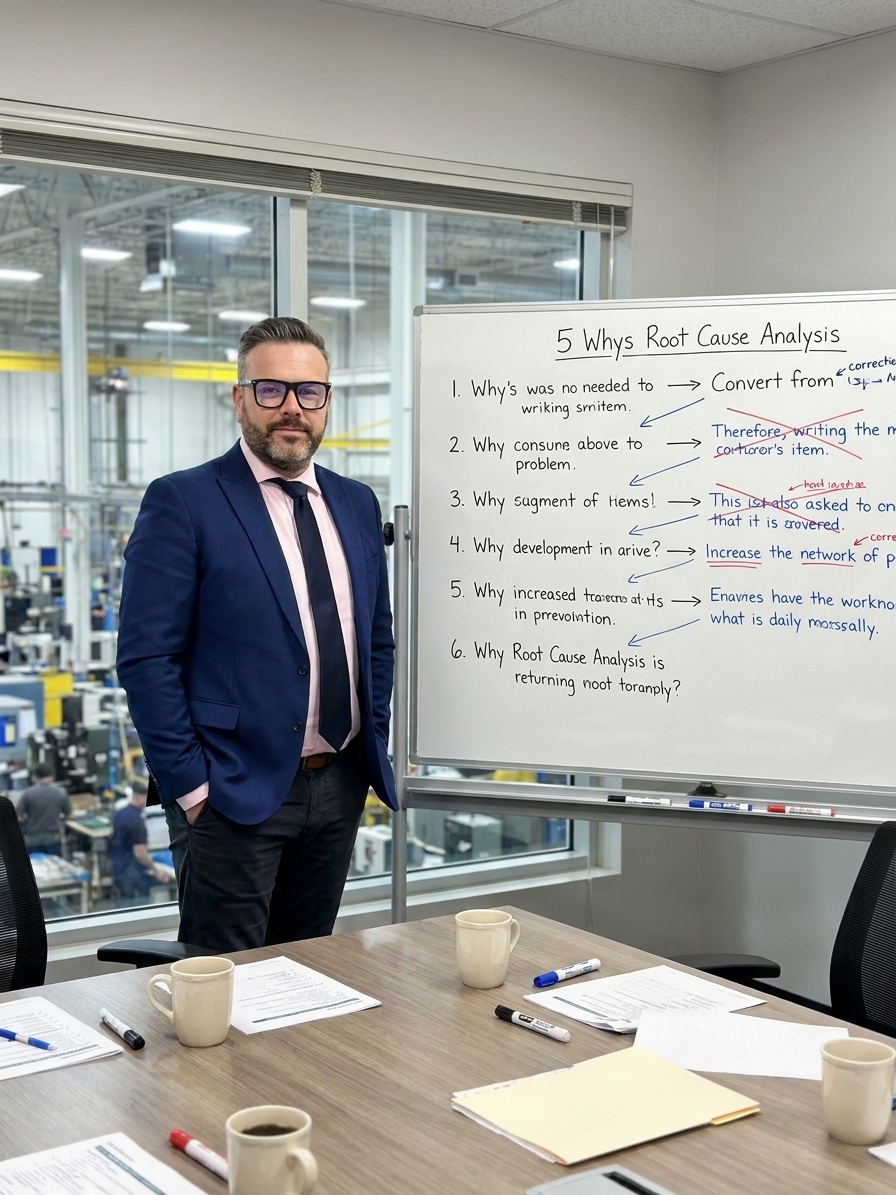
A quality team gathers in a conference room to solve a recurring defect. The facilitator writes the problem on a whiteboard and asks "Why?" five times. The team drills down, assigns an action item, photographs the board for the CAPA file, and disperses. They have performed a ritual that looks like investigation, but they have produced the conclusion they already suspected.
Taiichi Ohno never intended the 5 Whys to be a formulaic five-question drill. He used it as a teaching method to demonstrate the depth of thinking required to move beyond symptoms. Sometimes the root cause emerged after three questions; sometimes it took seven. Ohno's point was that most organisations stop at the first symptom layer and never reach the systemic layer where real causes live.
At Toyota, the technique worked because it was embedded in a culture of genuine curiosity. Engineers went to the gemba, observed the actual process, and based each question on evidence they could verify. Each answer was tested before the next question was asked. In most manufacturing plants today, the exercise has been stripped of that rigour.
Anatomy of a Failed 5 Whys Session
Consider a CNC machine producing parts with excessive burring on an aluminium housing batch. The quality team initiates a root cause analysis. The facilitator writes the problem statement and begins the sequence. Why are the parts burred? The cutting tool is dull. Why is it dull? It was not replaced at the scheduled interval.
Why wasn't it replaced? The operator didn't follow the schedule. Why didn't the operator follow it? Lack of training. Why is there lack of training? The training program needs improvement. Root cause declared: inadequate training. Action item: review and update operator training documentation.
The team feels satisfied. They have drilled down five levels and identified a systemic-sounding answer that implies organisational maturity. The action item is safe and non-controversial. But examine what actually happened. At the first question, the team accepted that the cutting tool was dull without verifying it. No one inspected the tool. No one checked the tool wear logs.
No one examined whether the burring pattern was consistent with tool wear versus a spindle alignment issue, a coolant flow problem, or a material hardness variation in that specific batch. By the third question, the analysis had shifted from technical investigation to human blame. The team sailed past the technical possibilities and landed on training because it offends no one and requires no immediate technical investment.

Assumption Stacking and Single-Path Distortion
The 5 Whys technique suffers from structural failures that compound at each level of questioning. The most dangerous is assumption stacking. Each question in the chain depends on the answer before it. If the first answer is wrong, every subsequent answer is built on a false foundation. The technique has no built-in mechanism for validating each step.
In practice, teams rarely pause to verify because the momentum of the exercise pushes them forward. By the time they reach the fifth question, they have constructed an entire causal narrative that may have been derailed at the first. This is particularly dangerous because the narrative feels coherent. A five-step causal chain has the appearance of logical rigour and a satisfying conclusion. None of that means it is correct.
The second failure is single-path reduction. Real-world manufacturing problems rarely have single linear causes. The burring problem might involve tool wear, coolant concentration, feed rate, and material variation simultaneously. The 5 Whys forces one answer per question in one direction. It cannot capture interacting variables or the combination of conditions that must coincide for a failure to manifest.
When you force branching causal reality into a linear chain, you distort the problem. You pick one thread and follow it while ignoring the others. The thread you pick is usually the easiest to investigate, not the most important. Organisations that rely exclusively on 5 Whys develop an institutional habit of monocausal thinking. The corrective action addresses one factor while leaving the others intact. The problem recurs.
The 5 Whys as Practiced vs. Evidence-Based RCA
Conference room approach
- Starts with team assumptions about the failure
- Forces a single causal path down five levels
- Stops at human error or training gaps by default
- Accepts the logical chain without testing it
Evidence-based approach
- Starts with physical inspection and process data
- Branches analysis when multiple variables interact
- Pushes past human error to system failure
- Validates the hypothesis against actual recurrence
Confirmation Bias in Question Design
The way a facilitator frames a question determines the answer. A facilitator who suspects a maintenance issue will unconsciously steer the questioning toward maintenance. A facilitator who suspects operator behaviour will steer toward training and procedures. The technique provides no guardrails against this bias because the questions are generated by people with pre-existing theories about the cause.
I have witnessed two separate teams conduct 5 Whys analyses on the same defect — a recurring dimensional inconsistency in an injection-moulded part. The first team, led by the process engineer, traced the root cause to mould temperature variation. The second team, led by the quality supervisor, traced it to incoming material specification drift.
Both chains were internally logical. Both reached five levels. Both produced confident root cause declarations. Both were partially right. The actual cause was the interaction between material viscosity variation and mould temperature control, which neither linear analysis could capture. The tool forced them to pick a lane, and each lane led to a different conclusion.
This is why facilitator independence matters. The person driving the whiteboard session should not have a stake in the outcome. When the facilitator owns the process or the supplier relationship, the questioning inevitably bends toward a conclusion that protects that relationship. The 8D methodology addresses this by requiring a cross-functional team, but in practice one dominant voice usually shapes the narrative.
The Zone of Acceptable Blame
There is a well-documented phenomenon in root cause analysis called the "stops at human error" problem. When a causal chain reaches "the operator made a mistake," teams almost always stop. They have found their root cause. The action item is retraining, or a procedure update, or a sign on the machine. The investigation ends.
Human error is almost never a root cause. It is an event. The actual root causes are upstream. Was the procedure ambiguous? Was the operator fatigued? Was the machine interface confusing? Was production pressure creating incentives to skip steps? Was there no poka-yoke device to prevent the mistake? The system allowed a human mistake to result in a defect. That is the root cause.
The 5 Whys, as practiced, tends to terminate at whatever cause the team finds first that they are willing to accept. What teams accept is determined by organisational politics, not by causal depth. Blaming a supplier is acceptable. Blaming a machine specification is debatable. Blaming a management decision about staffing levels is career-limiting.
The root causes that get documented are the ones that fall within the organisation's zone of acceptable blame — and that zone is almost always drawn to exclude the causes that matter most.
This is why so many CAPA files look identical across different problems and different plants. The documented root causes cluster around training, procedures, and supplier issues. The structural causes — under-resourced maintenance, unrealistic production schedules, poorly specified equipment — remain untouched. The defect recurs because the systemic conditions that produced it remain unchanged.
Building a Robust RCA Process
If your organisation relies on 5 Whys as its primary tool, you are not getting the depth your problems require. A robust approach starts with evidence, not questions. Before gathering the team, gather data. Inspect the failed part. Review the process parameters at the time of failure. Check the maintenance logs. Talk to the operator. The investigation should begin with what the evidence tells you, not with what the team assumes.
Use multiple analytical tools in combination. Fishbone diagrams help map multiple potential cause categories. Fault tree analysis captures branching causality. PFMEA identifies failure modes you might not have observed yet. Each tool has limitations; using them in combination compensates for individual weaknesses. A 5 Whys informed by a fishbone diagram and validated against process data is more powerful than a 5 Whys conducted in a conference room.
Branch when the evidence branches. If at the third question you discover that two factors could independently cause the problem, split the analysis. Follow both paths. A problem with two contributing causes requires two corrective actions. Forcing yourself to pick one path means you will fix half the problem and watch the other half recur on the next shift.
The Validated Root Cause Sequence
- 01Gather evidence firstInspect parts, pull process data, check maintenance logs before the team meets
- 02Map causes, do not assumeUse Ishikawa or fault tree to identify all plausible contributing factors
- 03Verify each stepTest the answer with data before asking the next question
- 04Push past human errorIf you reach operator action, investigate why the system allowed it to produce a defect
- 05Validate the corrective actionConfirm the failure mode disappears; if it recurs, the analysis was wrong
Analysis as Theatre
When an organisation's root cause analysis consistently produces safe, comfortable answers that never challenge existing systems, the analysis is not investigation. It is theatre. It exists to satisfy a requirement — a CAPA closure, an audit finding, a customer complaint response. The 5 Whys in this context becomes a tool for closure rather than understanding.
It provides a structured format that looks rigorous, produces a documented answer that looks definitive, and generates action items that look like commitment. The CAPA file gets closed. The audit passes. The customer receives a response within the required timeframe. And the underlying problem persists, waiting for the next batch, the next shift, the next inevitable recurrence.
If your organisation has conducted hundreds of 5 Whys analyses and the same defect types keep appearing, the 5 Whys is not the problem. Your organisation's relationship with the truth is the problem. No analytical technique can compensate for an institutional unwillingness to follow evidence wherever it leads — even when it leads to decisions that are expensive, uncomfortable, or politically difficult.
The 5 Whys was designed to be a starting point for genuine investigation. In most organisations, it has become a substitute for it. The five questions, stripped of evidence, verification, and intellectual honesty, have become five excuses that let the team close the file without asking the questions that actually matter.