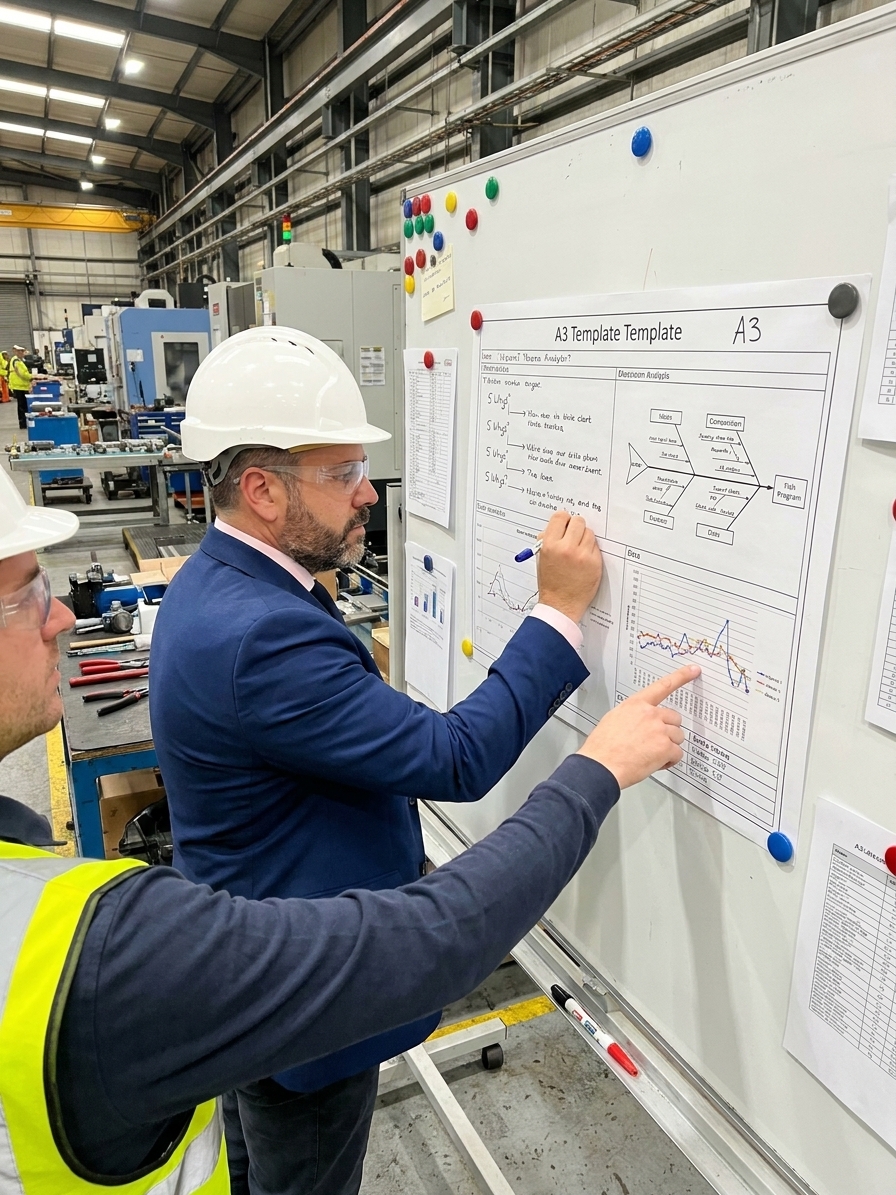
The A3 report, borrowed from Toyota's production system, was engineered as a discipline rather than a document. It forces a specific logical sequence: understanding current reality before designing a future state. The constraint of a single sheet of paper demands rigorous distillation. You must compress complex investigation into a format a reviewer can challenge in minutes.
In most manufacturing environments, this discipline has collapsed. The A3 has devolved into a PowerPoint template distributed by quality departments and filled out to satisfy audit requirements. The logical flow is bypassed entirely. Teams start with a predetermined solution and reverse-engineer the analysis to justify it.
I have audited plants with binders full of completed A3s spanning years, only to find the identical problems recurring in the newest reports. The root causes change. The countermeasures change. The problems remain. This is not problem solving. It is problem describing with extra steps, and it actively damages an organisation's ability to resolve real issues.
The Logical Structure That Demands Rigour
A functional A3 follows an unforgiving left-to-right logic. The left side establishes the current reality with observed data and process mapping. The right side designs the future state, proposing countermeasures directly linked to proven root causes. The discipline lies in the transition: you cannot draft the right side until the left is genuinely complete.
The current condition requires observable, measurable facts. It demands a value stream snapshot with real performance data. This is where most teams fail, substituting shift supervisor opinions for direct observation. The problem statement must define a specific gap. It requires quantified boundaries, not vague complaints like "quality is bad" or "customers are unhappy."
The root cause section is the crucible. It requires systematic investigation using 5 Whys, fishbone diagrams, and data triangulation. Every proposed countermeasure must trace directly to a validated root cause. If the link is missing, the analysis is storytelling. The follow-up plan must define exactly how effectiveness will be verified, measured, and sustained over time.
The A3 Logical Sequence
- 01BackgroundEstablish the business context and justify resource allocation for this specific issue.
- 02Current ConditionMap the process with actual data gathered through direct floor observation.
- 03Problem StatementDefine a quantified gap between the current reality and the target.
- 04Root Cause AnalysisInvestigate systematically until the answer points to a system failure, not a person.
- 05CountermeasuresPropose targeted actions that link directly to the proven root causes.
- 06VerificationDefine exact metrics and timelines to confirm the solution holds.
How Templates Replace Thinking
The decay of A3 practice follows a predictable pattern. It begins with genuine enthusiasm after a manager attends a Lean conference. Templates are distributed, training is scheduled, and the tool is integrated into management reviews. For a brief period, teams attempt the rigorous work of genuine analysis.
The rot begins under deadline pressure. A mid-level manager realises that completing an A3 backwards is significantly faster than working through the methodology. They start with the equipment they want to purchase or the procedure they want to rewrite, then cherry-pick data to support the predetermined investment.

Once shortcutting becomes normalised, the A3 transforms into a deliverable for compliance. It is filed in shared drives and presented to customer auditors. The document accumulates like sediment. The logical reasoning it was built to enforce disappears entirely, replaced by narrative paperwork designed to satisfy metrics rather than fix processes.
The Failure Modes That Destroy Value
The most damaging subversion is the predetermined solution. The team decides to change suppliers or buy new machinery, using the A3 as a justification document rather than an investigation tool. The root cause analysis is engineered to support the desired outcome, and alternative explanations are actively ignored.
I reviewed an A3 from an automotive supplier that justified a $2.3 million automated inspection system by identifying inspection capability as their root cause. The new machine caught more defects, but the overall defect rate remained unchanged because the process continued producing bad parts. The actual root cause was uncontrolled variation in injection moulding parameters. The A3 looked flawless; the capital was wasted.
Another critical failure mode is the unverified countermeasure. The report claims a new procedure was written and operators retrained, with a follow-up note to monitor for thirty days. But nobody collects the before-and-after data. When the defect recurs months later, it is treated as a new problem requiring a new A3, generating further paperwork.
Finally, organisations consistently misinterpret the single-page constraint. At Toyota, a finished A3 represents the summary of twenty pages of investigation. It undergoes multiple iterations as managers challenge the logic and push back on assumptions. In Western implementations, the A3 is typically written once, filed immediately, and never subjected to genuine scrutiny.
When your root cause analysis lands on operator error, you have found the person present when your broken process finally failed.
The Structural Cost of Cargo-Cult Problem Solving
A hollow A3 process eliminates the ability to distinguish between resolved issues and papered-over symptoms. Every completed form signals a solved problem. Management dashboards turn green. Eighteen months later, a major customer discovers a systemic defect that has been present the entire time, hidden beneath layers of compliant documentation.
Institutional learning stagnates. A genuine A3 captures the transparent reasoning of how a problem was understood and addressed, serving as a teaching tool for new engineers. Fake A3s contain no real reasoning and teach nothing. The organisation's collective capacity to solve complex problems degrades measurably.
Teams lose the habit of rigorous thinking. Practising genuine A3 problem solving trains people to ask why before asking what to do. It builds resistance to premature solutions and forces a reliance on data over opinion. When the A3 becomes a ritual, this critical thinking atrophies. People default to jumping to conclusions because the discipline of slowing down has been lost.
Rebuilding Genuine A3 Behaviour
The path back from cargo-cult compliance is not a template redesign. It requires rebuilding the management behaviour that surrounds the document. Start with one chronic, well-known problem that has resisted previous fixes. Assign a dedicated owner and give them real, uninterrupted time to observe the process and gather data.
Review the draft at a whiteboard, not in a conference room via projector. Bring the people who actually run the process into the room. The first question must always probe the current condition: how long did you observe the floor? What data did you collect? What surprised you? Challenge the root cause relentlessly before allowing the conversation to shift to countermeasures.
The first genuine A3 may take a month. That pace feels unproductively slow, but it is the speed at which real understanding develops. When that solution holds and the problem permanently disappears, the organisation rediscovers the purpose of the methodology.
Compliance vs. Genuine A3 Practice
Ritual Compliance
- Starts with a predetermined solution and works backwards.
- Root cause analysis engineered to support desired outcome.
- Countermeasures implemented on paper, effectiveness assumed.
- Document is filed immediately and never challenged.
Genuine Investigation
- Begins with direct floor observation and data collection.
- Root cause analysis driven by 5 Whys and triangulation.
- Effectiveness verified with defined metrics and timelines.
- Logic is challenged through multiple iterations at a whiteboard.
The Management Discipline That Sustains It
In a functional A3 culture, the review meeting is a mentoring exercise, not a status update. The manager challenges the data, questions the logic, and sends the owner back to investigate further. The conversation remains anchored in the current condition and root cause long before any countermeasure is discussed or approved.
The critical metric for an A3 program is not the quantity of reports filed. It is whether the analysis ever changed someone's mind. If your root cause investigations never reveal something surprising, your teams are not investigating deeply enough. If your countermeasures never solve a problem so thoroughly that it disappears permanently, your methodology is broken.
The A3 is a mirror reflecting the quality of your organisational thinking. If what you see is a pile of completed paperwork, the problem is not the document. Stop filling out templates. Start demanding the rigorous, patient thinking the tool was originally designed to enforce.