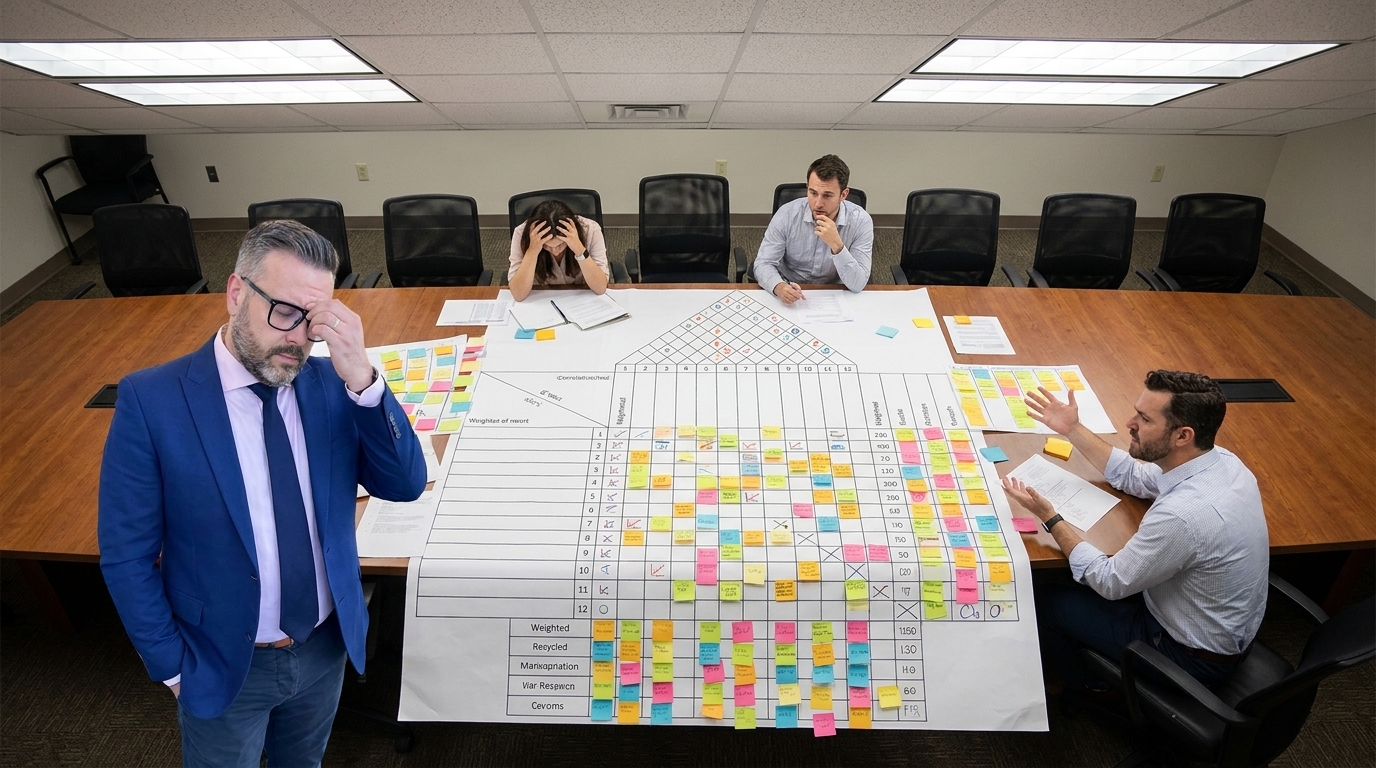
Most Quality Function Deployment matrices are dead before the first component is ever specified. The failure does not happen during production launch and it does not happen during supplier escalation. It happens during the early design stage, inside a conference room, long before the process engineers see the package. A cross-functional team gathers to translate customer demands into engineering targets, and the methodology degenerates into an exercise in data entry within the first three weeks.
The mechanism of failure is structural and it is created upstream. Instead of a disciplined translation tool that forces difficult trade-off decisions into the open, the House of Quality becomes a compliance artefact built to survive a gate review. Across two decades in automotive and aerospace quality, I have seen perfectly constructed QFD matrices buried in shared drives, never opened after initial project approval, carrying no traceable connection to the engineering specifications that followed.
The consequences of this upstream corruption are severe and entirely preventable. When the matrix is fabricated, the PFMEA that follows is built on assumed risks rather than verified customer needs. When the deployment stops at the first house, the process parameters established during PPAP have no documented link to what the market actually demands. The factory eventually inherits a design shaped by intuition, and the quality team inherits the defect costs.
The Architectural Collapse of the Input Stage
The most critical corruption happens at the input stage, where customer language is supposed to be captured and verified. Real voice-of-customer research requires structured interviews, ethnographic observation, and careful coding of qualitative data. Most engineering organisations lack the patience or the budget for this level of rigour. They substitute it with internal assumptions that rapidly harden into perceived facts.
The engineering team sits in a room and writes down what they believe customers want. The marketing team submits a list of competitor features, reframed as customer requirements to satisfy the template. The sales team contributes complaints from the three loudest distributor accounts, weighted equally with systemic market demands. None of this is voice of the customer. It is the voice of the organisation talking to itself, and it forms the foundational WHATs of the entire matrix.
This fabricated input is particularly dangerous because the QFD matrix lends it an aura of scientific validity. A product manager's hunch, once entered into a weighted grid with correlation symbols, looks like objective analysis. The engineering team proceeds to design against invented requirements, and by the time the product reaches the factory floor, nobody remembers that the core assumptions were never validated by the actual market.

Matrix Bloat and the Loss of Engineering Focus
The second upstream failure is matrix bloat. Akao emphasised that QFD should concentrate on the critical few requirements that differentiate the product. The original Kobe shipyard implementations worked with ten to fifteen critical demands, not fifty. This constraint forced the team to make hard decisions about priorities before any engineering characteristics were defined.
Western implementations routinely abandon this discipline. Teams attempt to capture every focus group comment, survey response, and sales anecdote as a separate row. The matrix grows from a manageable grid into an incomprehensible sprawl. When the grid exceeds thirty customer requirements, the human brain stops processing relationships and starts processing cells. You are no longer thinking about how a specific tearing force relates to packaging ease. You are filling in numbers to complete the spreadsheet.
The comprehensive approach of capturing every conceivable want was a misinterpretation of the methodology. It turned a precision instrument into an unmanageable data dump. The sheer size of the matrix guarantees the outputs will never be used for actual engineering decisions, because no chief engineer will base a design specification on a fifty-row grid that nobody fully comprehends.
The Scale Differential in Functional QFD
The Abandoned Trade-off Roof
The correlation matrix in the roof of the House of Quality is the point where genuine engineering is supposed to begin. Positive correlations mean two characteristics reinforce each other. Negative correlations mean they conflict, and the design team must make a deliberate decision about how to handle that conflict before releasing any models. This is the mechanism that surfaces technical tension.
In practice, most design teams fill in the roof as a bureaucratic afterthought. They put positive marks everywhere because it feels productive and avoids uncomfortable conversations in front of management. When genuine negative conflicts are identified, the discussion that should happen rarely does. The conflict is noted in the cell, the file is saved, and the engineers proceed with whatever approach they had already decided upon.
Engineers resist admitting they cannot simultaneously maximise structural rigidity and minimise overall mass. The roof becomes decorative, filled with symbols that nobody acts on. Because the trade-offs were never genuinely debated during the design phase, they are discovered later as physical problems during production launches, driving up scrap costs and delaying timelines.
Severing the Cascade to the Factory Floor
The deployment aspect of QFD is what makes it uniquely valuable, and it is almost universally ignored. The methodology requires customer needs to cascade through four linked matrices. The first house drives design characteristics. The second converts those characteristics into component specifications. The third establishes process parameters. The fourth defines the daily production controls that operators execute on the line.
Almost no implementation goes past the first house. The team builds the initial matrix, presents it to the steering committee, receives project approval, and stops. The cascading traceability that links the customer's original words directly to an operator's work instruction never materialises. The quality system is left with a chain of evidence that stops at the engineering department.
Without full deployment, the methodology is just a heavy-weight prioritisation matrix. The customer requirements identified in the first house die in that same spreadsheet. They never reach the PFMEA, never reach the process FMEA, and never inform the control plan. The shop floor is consequently managed against engineering assumptions rather than verified market demands.
The Four-Stage QFD Deployment Chain
- 01Product PlanningTranslate verified customer needs into measurable design characteristics.
- 02Component DeploymentConvert design characteristics into specific component-level engineering targets.
- 03Process PlanningDetermine the manufacturing process parameters needed to achieve the component specs.
- 04Production PlanningEstablish the daily work instructions and production controls operators follow.
The Frozen Document and the Audit Illusion
Markets shift, competitors introduce new features, and material technologies evolve. The House of Quality, if it is to maintain engineering relevance, must be a living document. In reality, QFD matrices are created once, presented once, and frozen in project archives. They sit as perfectly preserved artefacts of what the design team believed at a single point in time.
Many organisations build the House of Quality purely to satisfy an IATF 16949 or AS9100 auditor rather than to drive design decisions. When the methodology is reduced to a check-box exercise, the engineering output is entirely disconnected from the documented analysis. The quality manual states that customer needs drive the design process, but the shop-floor reality shows the design was driven by the chief engineer's experience.
A product manager's hunch, once entered into a weighted matrix with correlation symbols, looks like analysis. It is not.
This audit-driven approach actively damages product quality because it creates the illusion of customer focus. The rigorous documentation that should protect the production team instead masks the fact that no structured analysis took place. When defects arise during serial production, the quality team cannot trace the failure back to a flawed design assumption, because the assumption was never explicitly documented.
Determining If the Tool Fits the Context
Many world-class product organisations do not use QFD at all. They achieve customer-aligned design through direct engineer-to-customer engagement, rapid prototyping, and iterative feedback loops. In environments with continuous deployment, the elaborate up-front analysis that QFD demands may be significantly less valuable than simply building, testing, and refining the physical output.
This does not render the methodology obsolete. For complex products with long development cycles, structured QFD provides traceability that iterative approaches cannot easily replicate. If an organisation is investing years and significant capital into a new automotive platform or aerospace assembly programme, spending months on rigorous QFD analysis is a rational investment that prevents costly design changes downstream.
The decision to deploy QFD must be governed by the specific product context and the organisation's maturity. If the team lacks the discipline to implement it honestly, or the willingness to conduct the difficult trade-off debates the roof requires, the tool will generate false confidence. A poorly executed House of Quality is worse than no matrix at all, because it suppresses the critical thinking it was designed to provoke.
The Integrity Test for Design Leadership
The simplest test for whether a QFD implementation has genuine engineering integrity is to ask the design leadership one question. Would they be willing to show the working House of Quality to their most demanding customer? Not the sanitised presentation deck. The actual working document, complete with the competitive assessment that reveals where the product is weaker than the market alternatives.
Show the customer the trade-off matrix that reveals which requirements were deliberately deprioritised and why. Show them the weighting that demonstrates what the team decided mattered most. If the answer is no, if the document would cause embarrassment because the customer inputs are fabricated and the roof correlations are filler, then the design team does not have a House of Quality. They have a compliance form.
Quality Function Deployment is a precision tool for complex, high-capital product development. Used correctly, it creates unbroken alignment between what the customer needs and what the factory produces. Used incorrectly, it creates documentation while the actual engineering decisions are made by intuition, office politics, or whoever speaks loudest in the review meeting. The difference between these outcomes is never the matrix itself. It is the integrity of the people building it.