
A Tier-2 heat-treatment shop changed their quenching oil supplier to save eight cents per part. They did not notify anyone. Six months later, field failures appeared in the final product. By the time the root cause was traced back to the unauthorised oil change, my client had recalled 12,000 units, lost a major OEM contract, and was facing a six-figure legal claim.
Under ISO 9001:2015, this client had passed their surveillance audit. They maintained an approved supplier list, executed annual supplier reviews, and held a valid evaluation form on file. What they lacked was visibility into daily supplier operations and a mechanism to detect an unauthorised process change buried two tiers deep in the supply chain.
ISO 9001:2026 changes the expectations around supply chain quality management more drastically than any other section of the standard. The transactional model of checking goods at receiving is obsolete. If you treat supplier management as a documentation exercise, the transition will expose you. You must build a system that actively manages risk across all tiers.
Clause 8.4: Shifting from Inspection to Partnership
The 2015 version of Clause 8.4 operated on a control paradigm: evaluate suppliers, define controls, verify deliveries. It was reactive. You inspected the goods at the door, logged nonconformities, and retained the records for the auditor. This approach assumes quality is assured at the point of manufacture, which is rarely true for complex assemblies.
The 2026 edition enforces a partnership paradigm. The language mandates that organisations understand their extended supply chain, monitor performance proactively, and ensure quality requirements cascade effectively through the tiers. This reflects a reality I have seen across automotive and aerospace plants: you cannot inspect quality into a product at receiving.
To comply, you must categorise suppliers by risk and direct your resources accordingly. Attempting to apply the same level of scrutiny to a provider of standard fasteners and a supplier of safety-critical brake components will overwhelm your quality team and destroy your margin. Risk-based segmentation is the only sustainable approach.
Risk-Based Supplier Segmentation
- CriticalSafety or regulatory components: full Tier-2 mapping, on-site audits, real-time performance monitoring.
- SignificantProduct performance components: Tier-2 risk assessment, remote audits, quarterly performance reviews.
- StandardNon-critical components: self-assessment questionnaires, annual performance evaluation.
At WITTE Automotive, we managed a supply base of 340 Tier-1 suppliers. We categorised 47 as critical, 128 as significant, and 165 as standard. Critical components received full Tier-2 mapping and on-site audits. This risk-based approach lets you focus your expanded monitoring efforts where a failure will actually trigger a field action or a recall.
Achieving Sub-Tier Supply Chain Visibility
The 2026 monitoring requirements extend beyond first-tier suppliers to include visibility into critical Tier-2 and Tier-3 suppliers where quality risk is significant. You need to know not just who your suppliers are, but who supplies their critical materials. This does not require formal quality agreements with every sub-tier vendor.
It requires mapping your critical supply chain to identify exactly where quality-critical processes occur in the lower tiers. You must then verify that your Tier-1 suppliers have effective quality management systems governing their own suppliers. If your Tier-1 supplier cannot demonstrate control over their sub-tier, they are a liability under the new standard.
Build a process to escalate concerns through the supply chain rapidly. If a Tier-3 raw material provider faces a shortage, your Tier-1 supplier must have a mechanism to notify you before production stops. Without this mapped escalation path, you are managing blind spots, which the new standard explicitly penalises during audits.
Real-Time Data Over Annual Scorecards
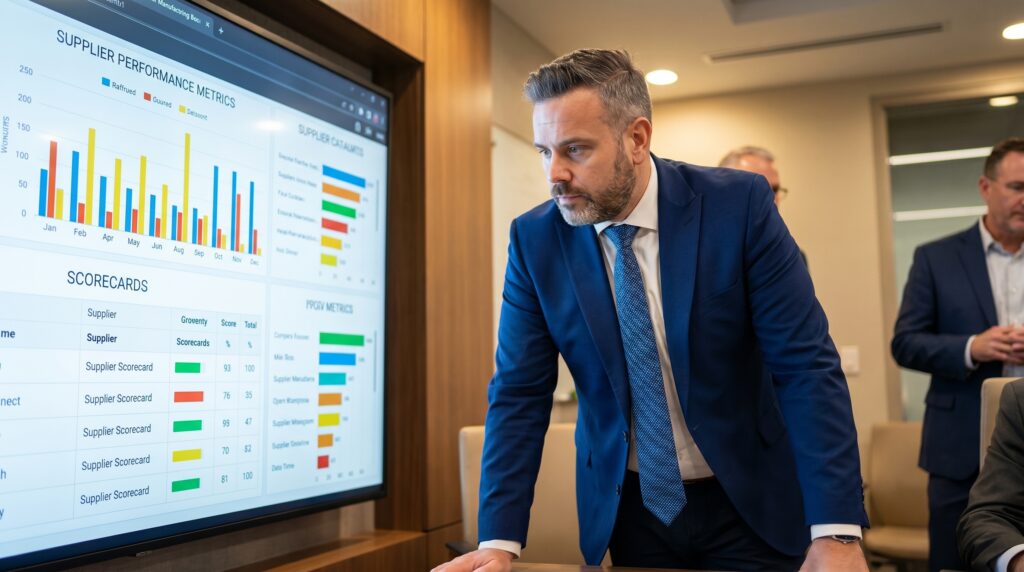
If your supplier performance data comes from a spreadsheet updated quarterly, you are operating on a 2015 model. The 2026 expectation is that your system provides timely visibility into supplier quality metrics. Annual reviews asking if the supplier is satisfactory are no longer acceptable evidence of effective monitoring.
For critical suppliers, implement monthly performance reviews with automated data collection covering PPM levels, on-time delivery, and complaint data. Significant suppliers require quarterly performance reviews with structured data. The data must drive action. A scorecard that tracks eight corrective actions overdue by sixty days is a tool for intervention, not archiving.
A meaningful supplier scorecard tracks PPM, delivery performance, complaint response time, corrective action effectiveness, and improvement initiatives. Review these metrics regularly with the supplier. The goal is to identify negative trends before they manifest as a nonconforming shipment at your receiving dock.
Enforcing Proactive Change Notification
The 2026 standard strengthens expectations around supplier change notification. You must have agreements with critical suppliers requiring advance notification of any changes that could affect quality. This includes process changes like modified parameters or relocated production, and material changes like alternative raw materials or new sub-suppliers.
Organisational changes matter. If a critical supplier loses their quality manager or faces acquisition, your risk profile changes. Quality system changes, such as a loss of IATF 16949 certification or a major reorganisation of quality functions, must trigger immediate review.
Build change notification clauses into your purchasing agreements, not just your quality agreements.
If notification requirements exist solely in the quality agreement, the commercial team will frequently override them. When a supplier offers a price reduction based on an undisclosed process change, the purchasing department will accept it. Change control requirements must carry commercial weight to be enforced effectively across departmental boundaries.
Structured Supply Chain Risk Management
Risk-based thinking now extends explicitly to the supply chain. Your risk register must include specific supply chain scenarios. It is insufficient to list the generic risk of a supplier failing to deliver. You must document single-source dependencies for critical components and map geographic concentrations of suppliers.
I implemented a quarterly supply chain risk review at a manufacturing client. The first review identified eleven undocumented risks, including two single-source dependencies the company had carried unknowingly for years. Mitigation plans were developed for the top five risks within ninety days. Proactive identification is what the standard demands.
Supply Chain Containment Escalation Path
- 01Issue DetectionField failure, internal nonconformance, or proactive supplier notification triggers the alert.
- 02Immediate ContainmentQuarantine suspect inventory at your facility and ship-stop the affected supplier pipeline.
- 03Sub-Tier TraceabilityTrace the nonconformance to the specific Tier-2 or Tier-3 source and isolate affected batches.
- 04Root Cause AnalysisDeploy 8D methodology with the supplier to identify the actual failure mechanism.
The heat-treatment oil incident took eleven days to resolve because there was no established containment procedure for a Tier-2 quality issue. We lacked the relationships and data access to trace the material quickly. Today, that same client initiates full supply chain containment within four hours because the procedures and tier relationships are established.
Supplier Development as an ROI Engine
The 2026 standard's emphasis on supply chain partnership means supplier development is no longer optional for critical vendors. Actively helping suppliers improve their processes is a requirement for maintaining a compliant and resilient supply base. This includes joint process improvement projects and shared problem-solving workshops.
At SNOP, we ran a structured supplier development program with our top fifteen critical suppliers. We executed joint process audits and shared problem-solving workshops for recurring defects. Over two years, the average PPM defect rate across the group dropped by 62 percent. The program cost was recovered within months.
The savings from reduced incoming inspection, fewer line stoppages, and lower warranty costs outweighed the investment significantly. Supplier development is not charity. It is the most direct way to secure your supply chain and drive measurable quality improvements that satisfy the 2026 requirements.