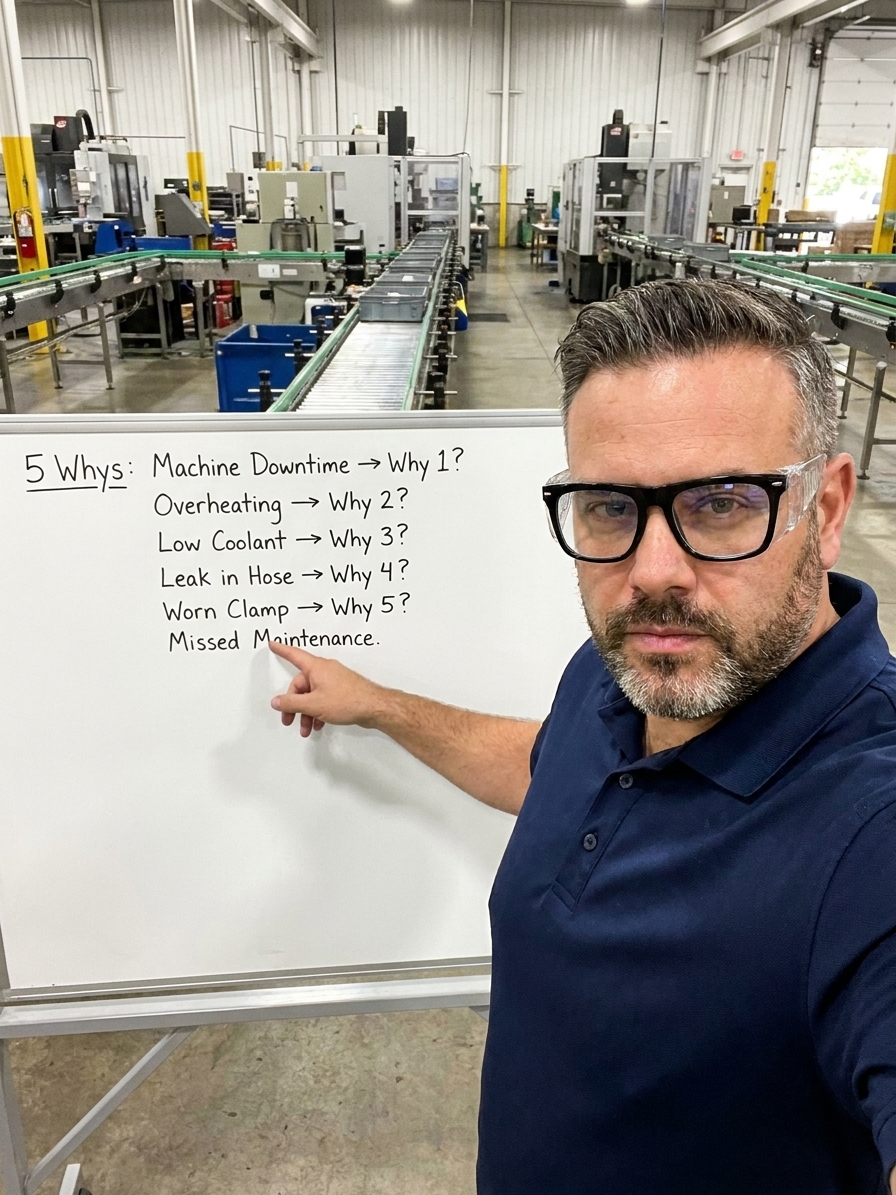
A defect appears. A customer complains. A line stops. You gather the team, stand at a whiteboard, and ask the simplest question in quality management: why did this happen? You ask it five times, write an action item for the fifth answer, and close the 8D or CAPA record. Everyone goes home feeling productive.
Three months later, the same defect shows up again. Different shift, different lot, same nonconformance you swore you eliminated. The 5 Whys analysis you ran was theatre. It produced documentation that looks like evidence and delivered exactly zero lasting improvement.
I have audited plants that run dozens of these investigations a month, yet their internal scrap rates never move. The 5 Whys became a ritual. The technique originated at Toyota under Taiichi Ohno, but somewhere between the factory floor and the modern conference room, it lost its discipline, its evidence, and its rigor.
Stopping at the first comfortable answer
The most common failure mode in root cause analysis is stopping at the first comfortable answer. You ask why the part failed, and someone says the operator made a mistake. That is a reasonable answer. It might even be factually correct. But it is not a root cause. It is a single event.
The immediate next question must be: why did the operator make that mistake? The answer is where the investigation gets uncomfortable, because it usually points to inadequate training, ambiguous work instructions, poorly designed fixtures, or production pressure. All of these are harder to fix than simply retraining the operator.
When the chain of questions starts pointing toward systemic issues like understaffing or poor tooling design, teams develop a sudden collective satisfaction with whatever answer they have reached. The third or fourth why feels sufficient. The investigation stops one or two layers short of the actual root, and the CAPA closes on a symptom.
To break this habit, the facilitator must treat human error as a trigger for deeper investigation, not a conclusion. Whenever an operator action is cited as a cause, require the team to analyze the process design that made the error possible. You do not fix human error with memos. You fix it with poka-yoke and robust process controls.
Forcing multi-causal problems into a single track
Real-world manufacturing problems rarely have a single linear cause. A defect might emerge because of a raw material substitution combined with progressive tooling wear, compounded by a shift supervisor who failed to brief the incoming team about a recent engineering change. That is three converging causes, each necessary but none sufficient on its own.
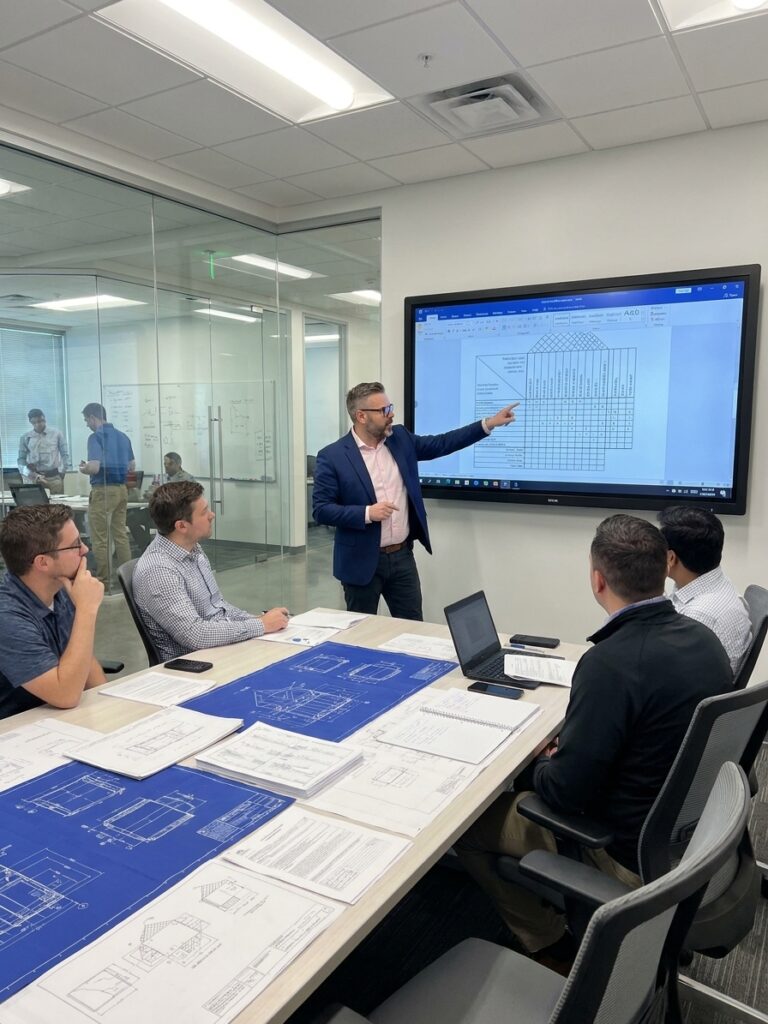
The traditional 5 Whys format pushes investigators down a single path. You pick one answer to each question and follow that thread. If the honest answer is that the failure happened for three different converging reasons, the standard format cannot capture it without losing critical context.
Teams that force complex problems into a single linear chain produce analyses that are neat, presentable, and wrong. They declare victory while two other causal threads remain completely unexamined. This is why experienced investigators pair the tool with Ishikawa diagrams. The fishbone ensures you consider multiple cause categories, while the 5 Whys drives depth within each branch.
Used alone, 5 Whys is a flashlight. Used alongside structured tools like a fishbone diagram or a fault tree analysis, it becomes a floodlight. If a single question yields two valid answers, the analysis must branch. A proper investigation often looks more like a causal tree than a straight line.
Confirmation bias dressed as investigation
Engineering teams often form a hypothesis about a failure before the root cause analysis begins. They might suspect a new supplier's material or a recent process change. Once a preferred answer exists, the 5 Whys discussion gets gently steered toward that pre-selected conclusion.
Alternative explanations are dismissed or attributed to coincidence. Dissenting voices are overruled by consensus or authority. The resulting 8D documentation looks impeccable because the logic chain reads perfectly, but the entire investigation was a reverse-engineered justification for a decision already made.
This failure mode is particularly dangerous because you cannot audit for intellectual honesty. The defense against confirmation bias is requiring objective evidence at each step of the chain. Not assumptions, not probability, but documented data that the stated cause actually produced the observed effect.
The single-track fallacy in root cause analysis
What teams do
- Force a multi-causal defect into a single linear path
- Pick the most obvious factor and ignore the rest
- Close the investigation when one plausible thread is exhausted
- Miss systemic interactions between material, machine and method
What works
- Map the problem using an Ishikawa diagram first
- Identify all necessary but insufficient causes
- Branch the 5 Whys to drive depth into each major factor
- Verify the interaction effects through designed trials
Skipping validation at the gemba
The most systemic problem with 5 Whys is that each link in the causal chain is stated as fact but rarely verified. The team agrees that a misaligned fixture caused the part to be drilled off-spec, but nobody actually measures the fixture. Nobody checks whether the misalignment is mechanically sufficient to produce the deviation.
In Toyota's original practice, going to the gemba was inseparable from asking why. You did not sit in a conference room and speculate. You went to the actual place where work happens, observed the process, talked to the operator, examined the equipment, and gathered evidence. The questions were informed by direct observation, not committee discussion.
Most organizations have abandoned this principle. The analysis happens in a meeting room, relying entirely on memory and assumption. Because nobody validates the causal chain, the entire investigation might be elegant, internally consistent, and completely disconnected from what actually happened on the floor.
To fix this, treat every causal link as a hypothesis. If you believe the fixture misalignment caused the dimensional error, go measure the fixture. Calculate the expected deviation, compare it to the actual measurement system analysis data, and confirm the correlation. If the evidence does not support the hypothesis, the chain is revised.
Corrective actions that do not match the root cause
Even when an investigation reaches a genuine root cause, the corrective action often fails to address it. The true root cause might require capital investment, organizational change, or a fundamental PFMEA update. The team does not have the budget, authority, or timeline for that, so they do something easier.
A 5 Whys chain without physical evidence at each step isn't analysis. It's speculation with formatting.
They add a check sheet. They schedule refresher training. They issue a memo. These containment actions are easy to implement, easy to document, and easy to verify in an IATF 16949 or AS9100 audit. They just do not prevent recurrence. They address a symptom while the underlying process failure remains intact.
This creates a perverse incentive structure. Teams learn that the goal of a 5 Whys analysis is to find a root cause that has an actionable fix within current constraints. The analysis becomes constrained not by what is true, but by what is feasible. Since the feasible solution does not address the real problem, recurrence is baked in.
If the root cause is a systemic issue that cannot be fully addressed with available resources, document that honestly. Implement robust interim controls to contain the risk. Escalate the capital expenditure or process redesign proposal through the management review process. Nobody should pretend a check sheet solves a tooling design problem.
Building investigation discipline and capability
If your organization's root cause analyses consistently fail to prevent recurrence, the problem isn't the tool. The problem is the practice. Facilitating a proper investigation is a technical skill. It requires the ability to challenge answers without becoming adversarial, to maintain rigor under time pressure, and to stop groups from jumping to solutions.
Make it a standing rule that every causal link in a 5 Whys chain must be supported by documented evidence. Measurement data, observation records, test results, and operator interviews are evidence. Consensus and probability are not. If a team cannot produce data to support a link, they must return to the floor to gather it.
Disciplined root cause validation sequence
- 01Observe the gembaExamine the defective part, review the process, and interview operators before forming any hypothesis.
- 02Map the causal branchesUse Ishikawa to identify all contributing categories, then apply 5 Whys to each major branch.
- 03Test the hypothesesRequire hard data or physical measurement to validate every single link in the chain.
- 04Match action to causeEnsure the corrective action directly addresses the verified systemic failure, not just the symptom.
- 05Track recurrenceMonitor the defect long-term to confirm the action was effective, escalating if the problem returns.
Use 5 Whys as one tool within a larger quality toolkit, not as the entire methodology. Pair it with fishbone diagrams for breadth and fault tree analysis for complexity. No single tool is sufficient for every manufacturing problem, and relying on one leaves systematic blind spots in your 8D reports.
Finally, track recurrence rates rigorously. If your CAPA system does not measure whether problems come back, you have no feedback loop to improve your investigation process. Recurrence rate is the single most honest metric of root cause analysis effectiveness. If a problem returns, the original investigation failed, regardless of what the paperwork says.