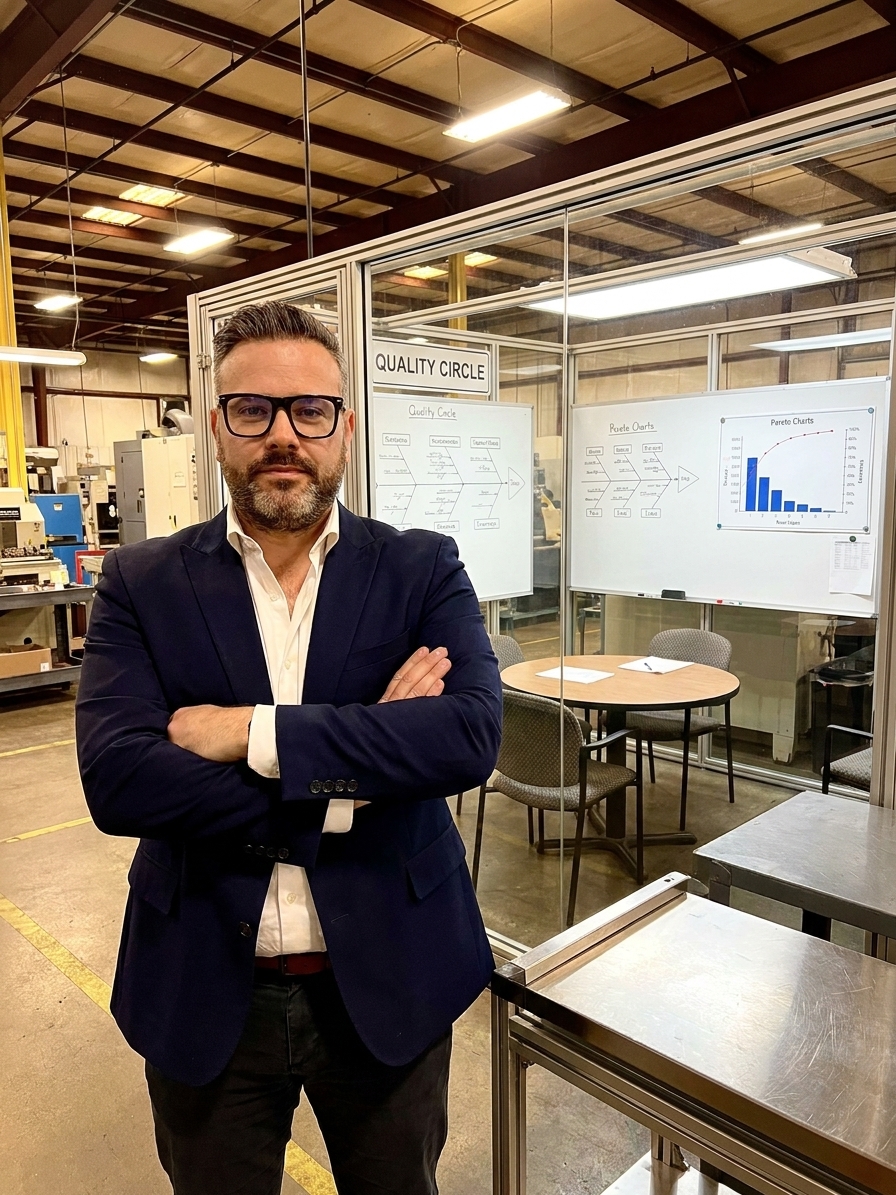
The quality circle spreadsheet tells you when the programme died, but never why. Attendance figures drop to zero three months before anyone in management notices, and by the time a corrective action is initiated, the operators who originally volunteered have already returned to working around problems instead of solving them. The post-mortem is always conducted too late to save the initiative.
Across two decades implementing ISO 9001 systems in automotive and aerospace, I have been brought into plants to investigate why these initiatives collapse. The diagnosis almost never reveals a training gap or a facilitation shortcoming. It reveals an implementation architecture that systematically stripped the operator of the authority needed to close a problem loop, transforming problem solvers into data-entry clerks for the engineering department.
To diagnose the failure correctly, work backwards. Start with the visible consequence — dormant teams and abandoned projects trackers — and trace each dead initiative back to the specific management decision that severed the ownership chain. The framework that follows isolates the architectural defects that kill these programmes, not the behavioural symptoms that mask them.
When the Supervisor Owns the Topic List
The first structural defect is the management-selected problem. In a functioning quality circle, members identify the anomalies that matter in their specific work area because they live with the consequences daily. When leadership provides a list of approved topics or aligns circle activity to strategic departmental metrics, the circle degenerates into an extension of the engineering task force. The selection process strips away the personal stake that drives rigorous root-cause analysis.
A cell operator who picks a recurring burr issue because it slows down every afternoon shift brings a fundamentally different analytical intensity than one assigned to improve a corporate scrap metric. The first operator is motivated to eliminate the failure mode permanently because their working life improves. The second operator completes the required documentation, attends the meetings, and waits for the project cycle to end so they can return to their actual responsibilities.
This ownership transfer happens quietly. A well-intentioned quality manager circulates a list of priority problems aligned to the monthly review, and supervisors steer their teams toward these topics because compliance looks good during audits. The operators never push back explicitly. They simply stop investing the intellectual effort required to challenge initial hypotheses or pursue countermeasures beyond the obvious. The analysis becomes shallow because the ownership was never genuinely theirs.
Run a direct diagnostic on any failing programme. Ask each circle member to name the problem they are working on and explain why it matters to their daily work. If the answer references a departmental KPI, a supervisor priority, or a corporate initiative, the ownership chain has been broken at the selection stage and no amount of facilitation training will repair it.
The Approval Queue That Kills Engagement
The second structural defect is the gating mechanism. A quality circle that can analyse a problem but cannot physically implement the solution without management approval is not a quality circle. It is a recommendation committee. The distinction is not semantic. It determines whether the operator experiences the satisfaction of mastery or the frustration of bureaucracy.
Frontline workers who watch their carefully developed countermeasures sit in an engineering review queue for months learn one devastating lesson: their analytical contributions do not matter to the business. They stop bringing complex problems to the circle because the system cannot process the solutions. The meetings continue on inertia, filling time with template completion and discussion of problems the circle has no authority to fix.

Kaoru Ishikawa formalised quality circles through JUSE in the 1960s based on a specific operational premise: the operator running the machine is the foremost process expert. The structural design gave the circle documented authority to implement solutions within defined physical and financial boundaries without seeking permission from an engineering review board. Western manufacturers imported the meetings, the Ishikawa diagrams, and the presentation formats, but retained a fundamentally Taylorist management philosophy where workers execute instructions and engineers generate ideas.
This translation error created the bureaucratic shell that kills programme after programme. The visible mechanics survived the transfer intact. The invisible infrastructure of implementation authority did not.
Presentation Culture and the Reward Inversion
Many organisations design the programme so the culmination of a project is a competitive presentation to management. This architectural choice cascades backwards through the entire problem-solving cycle. Problems are selected for their visual impact and presentability rather than their operational significance. The tool worship that plagues these programmes — spending disproportionate time teaching workers to construct fishbone diagrams and Pareto charts as an end goal — is a direct consequence of presentation culture.
I have reviewed programmes where circles won quarterly awards for slide decks describing projects that were never implemented, while circles that quietly eliminated an entire defect category went unrecognised because they did not present. The reward system actively punished the behaviours the programme was designed to promote. The signal sent to the shop floor was unambiguous: producing an impressive chart matters more than fixing a machine.
How Presentation Culture Distorts Problem Selection
- 01Topic filteringVisually demonstrable problems are chosen over chronic but invisible process variations.
- 02Analysis depthEffort is channelled into diagram aesthetics rather than verifying root-cause hypotheses on the floor.
- 03Solution designCountermeasures are selected for presentation clarity, not for robustness against recurrence.
- 04ImplementationPhysical changes are deprioritised because the presentation has already delivered the recognised outcome.
- 05RecognitionLeadership rewards the report. The actual defect category often persists unaddressed.
The chart begins to serve the management presentation, completely divorcing the exercise from the underlying physical problem on the shop floor. The operator learns to produce documentation that satisfies the programme requirements without producing the process improvement that justifies the programme's existence.
Vanity Metrics and the Accountability Vacuum
The metrics a programme tracks reveal what leadership actually values. Programmes that measure the number of active circles, meetings held, and presentations delivered are tracking activity, not outcomes. These vanity metrics look impressive in quarterly engagement reports but carry zero diagnostic value. They cannot distinguish a programme that is transforming shop-floor problem-solving from one that is consuming resources without changing a single process.
The diagnostic question that matters is not how many circles exist but what physically changed because they existed. You must track defect rates, cycle times, and scrap percentages in active work areas against baseline data taken before the circle began its analysis. Programmes with twenty active circles and zero measurable process improvements are failing, regardless of what the engagement dashboard claims.
Metrics That Separate Programmes from Reporting Exercises
Human outcomes carry equal diagnostic weight. Voluntary retention and the percentage of members who re-enrol for the next cycle are the truest signals of programme health. If retention drops below eighty percent, a structural defect is suppressing engagement. If participation is sustained only by supervisor pressure or performance-review linkage, the programme is already a bureaucratic shell.
A fast-track review mechanism is essential for solutions that exceed the circle's direct implementation boundary. If a countermeasure requires modest capital expenditure or crosses into another department's process, the approval must be measured in days, not months. A queue that backs up for a quarter signals that management views the programme as a nuisance, and operators will respond accordingly by disengaging from the analytical process entirely.
Defining the Implementation Boundary
Correcting a failing programme requires structural changes to the authority matrix, not programmatic adjustments like refreshed training materials or improved facilitation techniques. Circles must possess documented authority within explicit physical and financial boundaries. The boundary is straightforward: any change within the work cell that does not alter product specification, does not compromise AS9100 or IATF 16949 compliance, and costs less than a defined capital threshold can be implemented directly by the circle without external approval.
This boundary must be documented, communicated, and defended by leadership when engineering or quality functions attempt to override it. The most common failure mode I have observed is a well-meaning quality engineer who insists on reviewing every countermeasure for compliance risk, creating a de facto approval queue that the circle cannot bypass. The engineer is not acting maliciously. They are applying the gatekeeping behaviour their role training reinforced, and the programme architecture allowed it to colonise the circle's implementation authority.
A quality circle that cannot implement its own solution without management approval is a recommendation committee.
The resource question cannot be avoided. Solutions require capital, however modest. A circle needs time away from production, trained facilitation, and materials for physical changes like a modified gauge or a new fixture. When a circle develops a viable solution and is told no budget exists, the programme's credibility is destroyed instantly. The mechanism dies even if the meetings continue for another quarter on organisational momentum.
Leadership Behaviour and the Belief System
Quality circles are not a standalone shop-floor technique. They are the physical manifestation of a management belief system regarding who in the organisation is capable of creating value. If that belief is genuine, the circles will function despite administrative imperfections. If the belief is absent, no amount of ISO 9001 alignment, structural engineering, or exhortation will force the mechanism to work.
Leadership must demonstrate belief in frontline expertise through visible action, not motivational posters. When leaders visit work areas, they must ask questions rather than issuing directives. They must publicly acknowledge when a circle solves a problem that the engineering team failed to crack. This single behavioural pattern sustains engagement more effectively than any training curriculum, recognition banquet, or quarterly award ceremony.
The defining test of a programme's health is whether the circle can change its own process without external gatekeeping. If the answer is no, the initiative is consuming operator time and management resources to produce documentation that describes improvements the system will not allow anyone to make. Restructure the authority matrix first. Everything else follows from that single decision.
The post-mortem framework is ultimately a leadership accountability tool. Each architectural defect traces back to a management decision that was made — explicitly or by default — to retain control over a process the operators were supposedly empowered to improve. Correcting the programme means reversing those decisions, not retraining the operators who already understood the problems and stopped trying to solve them in a system that would not let them finish the job.