Kotter's 8-Step Change Model remains heavily referenced in manufacturing because it feels structured and sequential. Yet most implementations stall around step four, leaving behind posters, exhausted town halls, and a workforce trained to wait out the latest initiative.
The model was originally built for corporate transformations like mergers and strategy shifts. Applying it to a factory floor requires translation. Manufacturing demands faster cycles, deeper technical problem-solving, and frontline operator engagement that corporate change frameworks rarely account for.
I have led and watched dozens of change efforts across automotive and aerospace plants. When Kotter's model fails in these environments, it fails predictably. Here is where the framework breaks down and what it takes to make it produce operational results rather than meeting minutes.
The Framework at a Glance
| Step | Kotter's Label | Core Question |
|---|---|---|
| 1 | Create urgency | Why must we change now? |
| 2 | Build a guiding coalition | Who carries this with us? |
| 3 | Form a strategic vision | Where are we going? |
| 4 | Enlist a volunteer army | Who shows up willingly? |
| 5 | Enable action by removing barriers | What stops people from acting? |
| 6 | Generate short-term wins | What proves this is working? |
| 7 | Sustain acceleration | How do we keep momentum? |
| 8 | Institute change | How does this become standard work? |
Step 1: Create Urgency Without Manufacturing Alarm
Plant managers routinely confuse alarm with urgency. Showing a red trend line on a dashboard of declining margins creates alarm. Urgency requires a connection between the macro problem and the individual's daily work.
Most operators on the floor already know the plant is in trouble. They can tell you about quality escapes, delivery misses, and equipment failures long before a quarterly review surfaces them. What they lack is belief that anything will be done about it.
I once watched a plant manager spend forty minutes presenting competitive benchmarking data to line operators. The presentation was thorough, well-designed, and emotionally flat. When he finished and asked for questions, the longest-tenured operator raised his hand and said: "So what do you want us to do differently on Line 3 tomorrow morning?"
That question is the test. If your urgency message cannot answer it, you have created alarm, not urgency. Effective urgency comes from making the threat tangible at the cell level. Instead of sharing aggregate scrap rates, show the team how much scrap their specific line produced last week in dollars. Read the actual customer complaint emails. Invite the customer to tell the team directly.
Step 2: Build a Coalition Beyond the Org Chart
In practice, manufacturing change efforts typically assemble a coalition of department heads: the quality manager, production manager, engineering manager, and perhaps HR. They meet monthly. They review progress. They are almost without exception the wrong group to drive real change.
The people who understand why your process produces defects are not in those meetings. They are on the floor, running the equipment, dealing with the daily reality of your PFMEA and control plans. A guiding coalition without operator representation is missing its most important members.
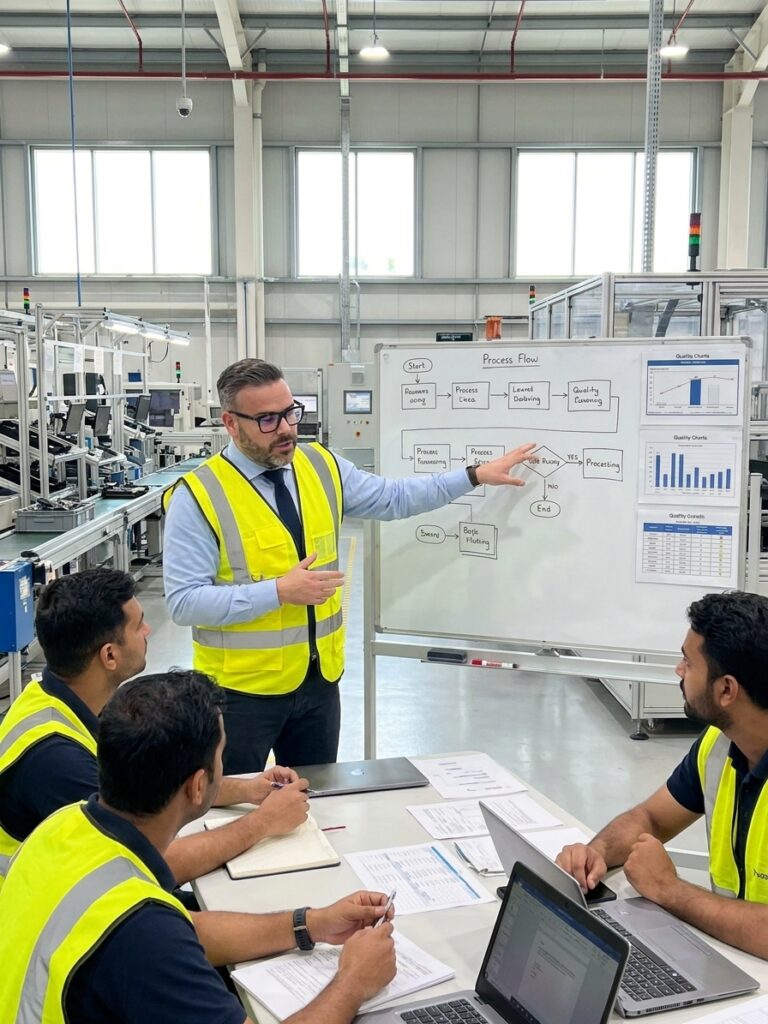
During a Lean transformation at an automotive supplier, an executive steering committee spent three months debating cell layouts. When they finally involved the operators who ran the cells, the operators pointed out in fifteen minutes that the proposed layout would block access to a critical adjustment point, making the new configuration worse than the current one.
Step 3: Form a Vision, Not a Slogan
"We will be world-class" is not a vision. It is a bumper sticker. "Our goal is 100% on-time delivery with zero defects" is closer, but still generic enough to be meaningless at the floor level.
A real vision answers specific questions. What will the plant look like in two years? How will work flow? What will a typical day feel like for an operator? What will the customer experience?
Consider this vision statement from a mid-tier electronics manufacturer: "By 2027, every product leaving our facility will pass first-time inspection at 99.5% or better, our lead times will be under 48 hours for standard orders, and every operator will have the authority and tools to stop the line when they see a problem."
That vision is measurable. It describes the future state in terms an operator can connect to their daily decisions. It tells maintenance what they are supporting, gives quality a clear Cpk target, and provides purchasing with constraints.
Step 4: Communication Requires Dialogue
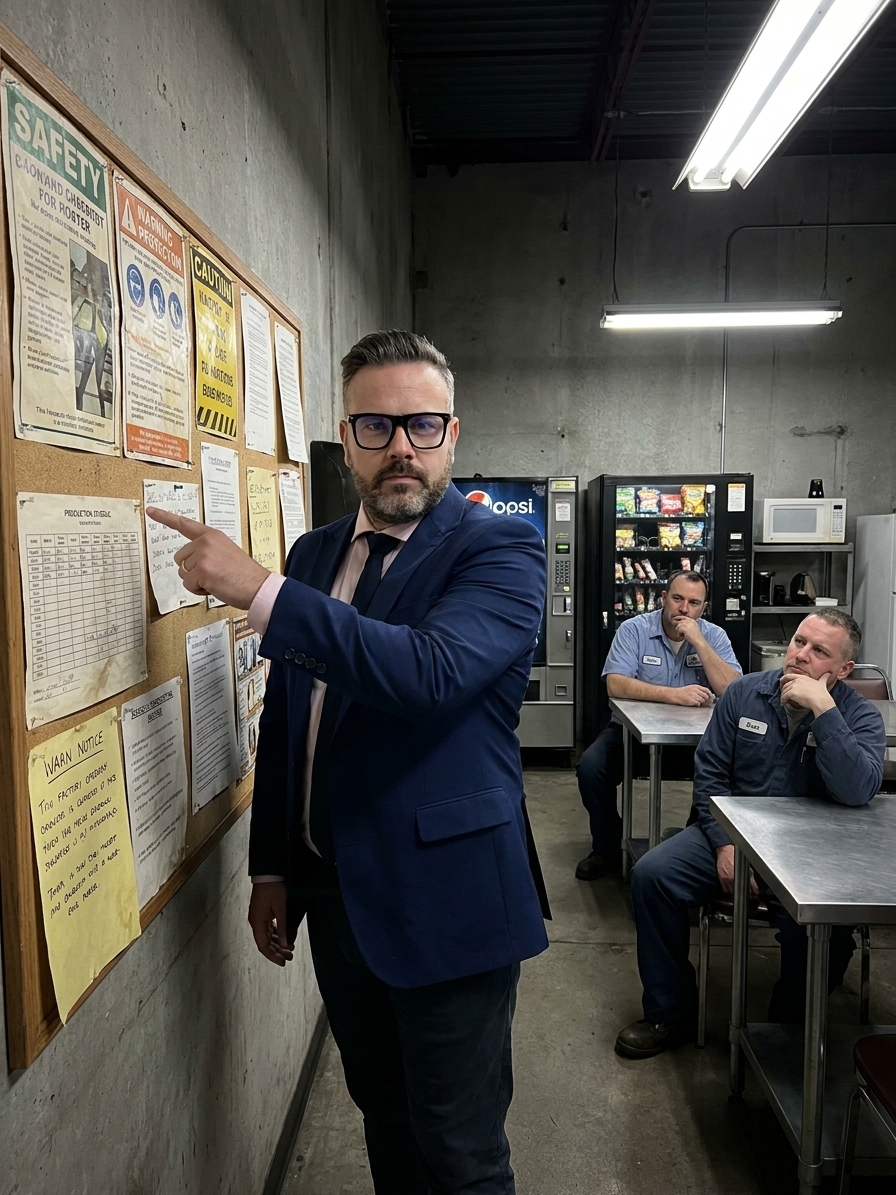
This is where most manufacturing change efforts lose their audience. Organizations typically communicate change through a single town hall presentation, an email from the plant manager, and posters in the break room. Then they wonder why nobody got the message.
Effective change communication is not about broadcasting. It is about creating dialogue. People need to hear the message, process it, ask questions, push back, and arrive at their own understanding of what it means for them.
The most effective communication tool in a manufacturing environment is the daily shift huddle. A ten-minute stand-up where the supervisor shares relevant information, asks for concerns, and connects the day's work to the broader vision. Done consistently, these huddles create a rhythm of communication that far outperforms any quarterly town hall.
Step 5: Remove Barriers Through Floor Presence
You cannot identify barriers from a corner office. You have to go to the gemba, watch the work, talk to the people doing it, and ask a simple question: "What is keeping you from doing this the way we discussed?"
Identifying Change Barriers on the Floor
What teams assume
- People resist change because they do not understand it
- More training will fix the compliance gap
- Process failures are primarily motivation issues
- Emails and posters count as communication
What actually stops action
- Outdated procedures contradict the new MSA standard
- IT systems do not support the new workflow data
- Supervisors undermine the change when auditors leave
- Procurement policies buy cheap parts that cause failures
When workers see real obstacles being removed, their belief in the effort grows. When they report barriers and nothing happens, cynicism sets in fast. Removing these obstacles is where management proves its commitment to the change initiative.
Steps 6 and 7: Generate Wins and Sustain Acceleration
Short-term wins matter because they provide evidence that the change is real. Good wins in manufacturing share specific characteristics: they are visible, unambiguous, connected to the change effort, and happen within a timeframe that maintains engagement.
Scrap reduction on a specific line after a focused improvement event. First-pass yield improvement on a product family following a PFMEA update. Setup time reduction on a critical machine after SMED implementation. Customer complaint elimination on a specific defect type after a Poka-Yoke installation.
Avoid the temptation to claim wins that are not real. I have seen organizations celebrate milestones that were really just activities completed: training sessions held, meetings conducted, documents published. These are inputs, not outputs. If the output has not changed, there is nothing to celebrate.
Kotter's seventh step addresses a predictable pattern: organizations declare victory too early, relax their efforts, and watch gains evaporate. In manufacturing, this happens when a successful pilot does not scale or when a focused improvement event does not lead to daily practice.
If the new procedure is not in the standard work document, it does not exist. Period.
If the change effort shows signs of fading, workers will revert to old behaviors out of practical survival instinct. Integrate changes into standard work. Update training materials so new hires learn the new way from day one. Adjust performance metrics so the measurement system rewards the new behaviors, not the old ones.
Step 8: Institute Change Until It Becomes Normal
The final step is about embedding changes so deeply they become part of the organizational identity. In manufacturing, institutionalization looks like operators following new procedures without being reminded because they understand the purpose and see the benefit.
Supervisors coach to the new standard because it is the standard, not because of a change initiative. Quality data is reviewed against new baselines. Hiring criteria reflect the skills the new way of working requires. When a problem arises, the team uses structured problem-solving methods like 8D by default.
Here is a simple litmus test for whether change has been institutionalized: stop talking about it. If the new behaviors, processes, and metrics continue without the constant reinforcement of the initiative, the change has taken root. If performance slides the moment you stop pushing, you are still in the acceleration phase.
Where Kotter Falls Short in Manufacturing
The model has genuine limitations in a manufacturing context. Kotter's model was developed with corporate transformations that play out over years. Manufacturing problems often require faster cycles. A quality crisis hitting a PPAP deadline cannot wait for a six-month urgency campaign.
Many manufacturing changes require deep technical work: process engineering, equipment modification, statistical analysis. The eight steps tell you how to manage the people side, but they do not tell you how to solve the technical problem.
Real change is also iterative. You may need to revisit urgency after a failed pilot, rebuild your coalition after a key leader leaves, or revise your vision based on what early results reveal. Treating the steps as a strict sequence creates artificial constraints.
Making the Model Work on the Factory Floor
Adapting Kotter for the Production Environment
- 01Compress Steps 1-3Run urgency, coalition, and vision in weeks. The urgency already exists on the floor.
- 02Ground in Floor DataUse specific metrics: scrap dollars, cycle times, Cpk values, customer returns.
- 03Embed OperatorsInvolve them from day one as core members, not as an afterthought or pilot phase.
- 04Pair Technical WorkRun data analysis during urgency building. Begin tool training during vision communication.
- 05Commit to PersistenceBudget for years of reinforcement. Leadership persistence is the biggest predictor of success.
Kotter's model is a map, not a vehicle. It tells you where to go and in what order, but it does not move you there. Movement comes from leadership commitment, floor-level engagement, technical competence, and the willingness to keep pushing long after the opening enthusiasm has faded.
If your organization is planning a change initiative using this framework, ask one question before you begin: are we prepared to still be working on this in three years? If the honest answer is no, save your town hall budget. The floor will see through it anyway.