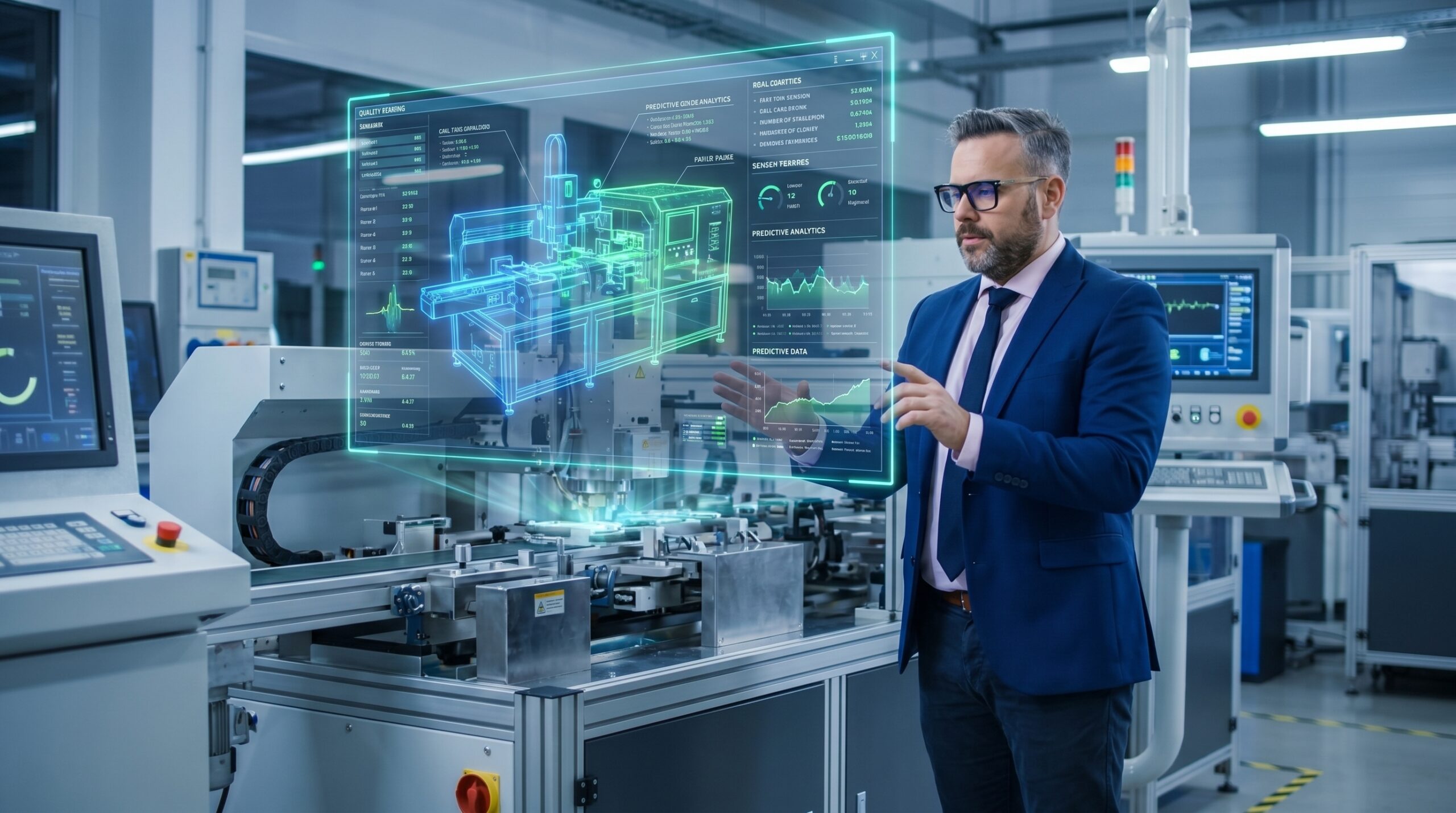
A digital twin is a real-time virtual replica of a physical manufacturing process. Every sensor reading, machine state, and measurement stream flows into a model that mirrors the physical line, computes against physical constraints, and feeds predictions back to operators and control systems. The value is not the visualisation — it is the closed-loop correction that happens before a defect is produced.
In my experience transitioning ISO 9001 and IATF 16949 systems across automotive and aerospace plants, the gap between detection and prevention is where most scrap is born. Traditional SPC tells you a process drifted after the parts are already nonconforming. A digital twin tells you the process is about to drift, identifies which parameter is driving it, and recommends the adjustment before the next cycle.
The technology has moved past the evaluation stage. Tier 1 automotive suppliers and aerospace primes are running digital twins on critical processes — heat treatment, CNC machining, injection moulding — with measurable results in reject reduction, predictive accuracy above 95%, and unplanned downtime cut by more than half. The question is no longer whether to deploy, but where to start and how fast to scale.
Architecture: The Three Layers That Make a Twin Work
A functional digital twin rests on three integrated layers. The physical layer is your actual production line: machines, IoT sensors capturing temperature, pressure, vibration and speed, measurement systems for dimensions and hardness, and machine-state data covering uptime, maintenance status and tool wear. Without comprehensive, reliable sensor data, the twin is blind.
The digital layer is the virtual model itself. It combines physics-based simulation of the process with machine learning models trained on historical production data. The physics model encodes what should happen — thermal expansion rates, material behaviour, cutting forces. The ML layer captures what actually happens, including the drift, variation and boundary conditions that the physics model alone cannot predict.
The connection layer is what separates a digital twin from a digital model. Data must flow both ways: real-time telemetry from the physical line updates the digital model continuously, and the digital model sends back control recommendations or automatic parameter adjustments to the physical process. This two-way communication, with continuous learning from every new data point, is the mechanism that turns a static simulation into a living system.
Predictive Quality: Stopping Defects Before They Form
The core problem with conventional quality control is timing. You produce a part, measure it, discover it is out of tolerance, and then react. The part is already scrap. Predictive quality inverts this sequence: the digital twin forecasts the outcome before the part is made, giving the operator a window to intervene.
Consider a milling operation. The twin analyses current tool wear from vibration signatures, spindle temperature, material batch parameters and historical trend data. It predicts that at current feed rates, the critical dimension will land at the upper specification limit. It recommends reducing feed speed by 2%. The operator adjusts before the cut — not after inspecting a nonconforming part.
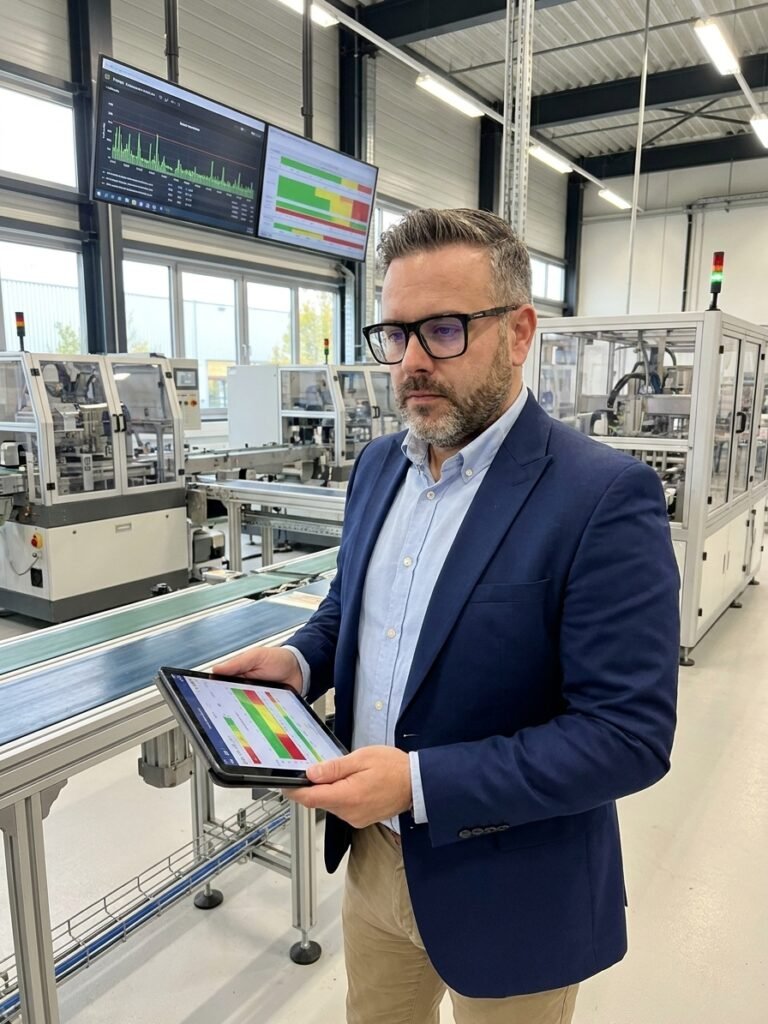
This is where Cpk targets intersect with real-time control. A process running at Cpk 1.33 on paper can drift to Cpk 1.0 within a shift if tool wear accelerates or material hardness varies by batch. The digital twin detects the drift early and flags it as a risk to the capability index, allowing correction before the next subgroup of measurements confirms the loss.
Process Optimisation and Virtual Commissioning
Optimising a process on the physical line means trial and error — dozens of test runs, weeks of lost capacity, and real scrap generated at real cost. The digital twin compresses this into minutes. You simulate thousands of parameter combinations against the physics and ML models, identify the top candidates, and validate only those on the physical line.
Virtual commissioning applies the same principle to new lines or new products. Before a single piece of equipment is installed, you simulate the process flow, identify bottlenecks, optimise cycle times, and run what-if scenarios across different demand patterns. The Control Plan for the new line is designed from simulation data, not guesswork.
Digital Twin Deployment Sequence
- 01Digital ShadowReal-time data collection and visualisation on critical machines — observe before modelling.
- 02Digital ModelPhysics-based process model with ML predictions validated against historical results.
- 03Digital TwinFull two-way integration: live model updates, operator recommendations, QMS linkage.
- 04Intelligent TwinClosed-loop autonomous parameter adjustment and cross-process optimisation.
I have audited plants where new line commissioning consumed three months of unplanned downtime chasing problems that simulation would have exposed in an afternoon. Virtual commissioning typically cuts physical commissioning time by around 40%, with far fewer startup defects and faster ramp to full production volume. The PFMEA for the new process is also more accurate because failure modes are identified from simulated stress tests, not from hindsight.
Predictive Maintenance Through Condition Monitoring
Reactive maintenance means the machine fails mid-shift, production stops, and you scramble. Calendar-based maintenance means you replace components that still have useful life, or you miss a failure that develops between intervals. Both approaches are expensive — one in unplanned downtime, the other in unnecessary parts and labour.
The digital twin enables genuine condition-based maintenance. On a CNC spindle, it tracks vibration trends, bearing temperature and load profiles against a historical failure model. When the combined indicators match a pattern that preceded previous failures, the model predicts remaining useful life — 72 hours, for example, at current trend. You schedule the spindle replacement for the next planned maintenance window instead of reacting to a catastrophic failure at peak production.
This directly supports OEE improvement. Unplanned downtime is the largest single drag on availability in most plants, and it is the hardest to predict with conventional methods. A digital twin that forecasts equipment failure with 72-hour lead time converts unplanned stoppages into planned maintenance, protecting both the schedule and the quality of output from a degrading machine.
Implementation: What a Real Deployment Looks Like
A practical digital twin deployment on a critical process — heat treatment, precision machining, or welding — follows a phased structure. The model is built, validated against reality, and deployed only when its predictions are trustworthy. Skipping validation is the most common reason these projects fail.
In a typical heat-treatment application for an automotive Tier 1 supplier producing hardened steel components, the process operates within ±3°C tolerance, a 45-minute cycle time, and a reject rate of 3.8%. Hardness must land between 58 and 62 HRC. These are tight boundaries where small temperature deviations or material variation produce out-of-specification parts that cannot be reworked.
The model must be wrong in known ways before you trust it — validation is where you learn the boundaries.
Phase one builds the physics model of the furnace — temperature distribution, heat-up rates — and a material model of how the steel responds at different thermal profiles. Two years of historical production data train the ML layer. Phase two validates predictions against actual results over a test period. Only when correlation reaches above 90% does the model move to live deployment in phase three, running alongside production with real-time alerts and optimisation recommendations.
| Metric | Before Digital Twin | After 12 Months |
|---|---|---|
| Reject rate | 3.8% | 0.2% |
| Predictive accuracy | Not measured | 96% |
| Unplanned downtime | Baseline | Reduced by 70% |
| Energy consumption | Baseline | Reduced by 15% |
Overcoming the Barriers That Kill Most Projects
Cost is the first objection, but it is usually the wrong frame. A full-plant digital twin is expensive and unnecessary. Starting with one critical process — the operation that generates the most scrap or downtime — delivers focused ROI that funds expansion. The deployment sequence above is designed precisely to spread cost over phases, each of which returns value.
Data availability is a real barrier, not an excuse. Many plants lack the sensor infrastructure to feed a twin because critical machines were never instrumented. The answer is to begin at the digital shadow level: install IoT sensors, connect measurement systems, build a real-time dashboard. You cannot model what you do not measure, and the data collection phase often reveals process behaviour that changes quality assumptions on its own.
Common Objections vs Practical Responses
What teams say
- Too expensive to justify
- We don't have enough data
- Nobody here has the skills
- Operators will resist it
What works
- Start with one critical process, scale on proven ROI
- Begin at digital shadow level — collect first
- Partner with a technology firm or university
- Show operators how it prevents scrap on their shift
Skills and change management are the barriers that persist longest. The modelling expertise required — physics simulation, ML training, real-time data architecture — is rarely in-house at a typical manufacturing plant. Partnering with a technology provider or academic institution bridges the gap while building internal capability. On the floor, operator resistance dissolves quickly when the twin prevents the first batch of scrap on their shift. Demonstrating that the tool supports the operator rather than replacing them is essential to adoption.