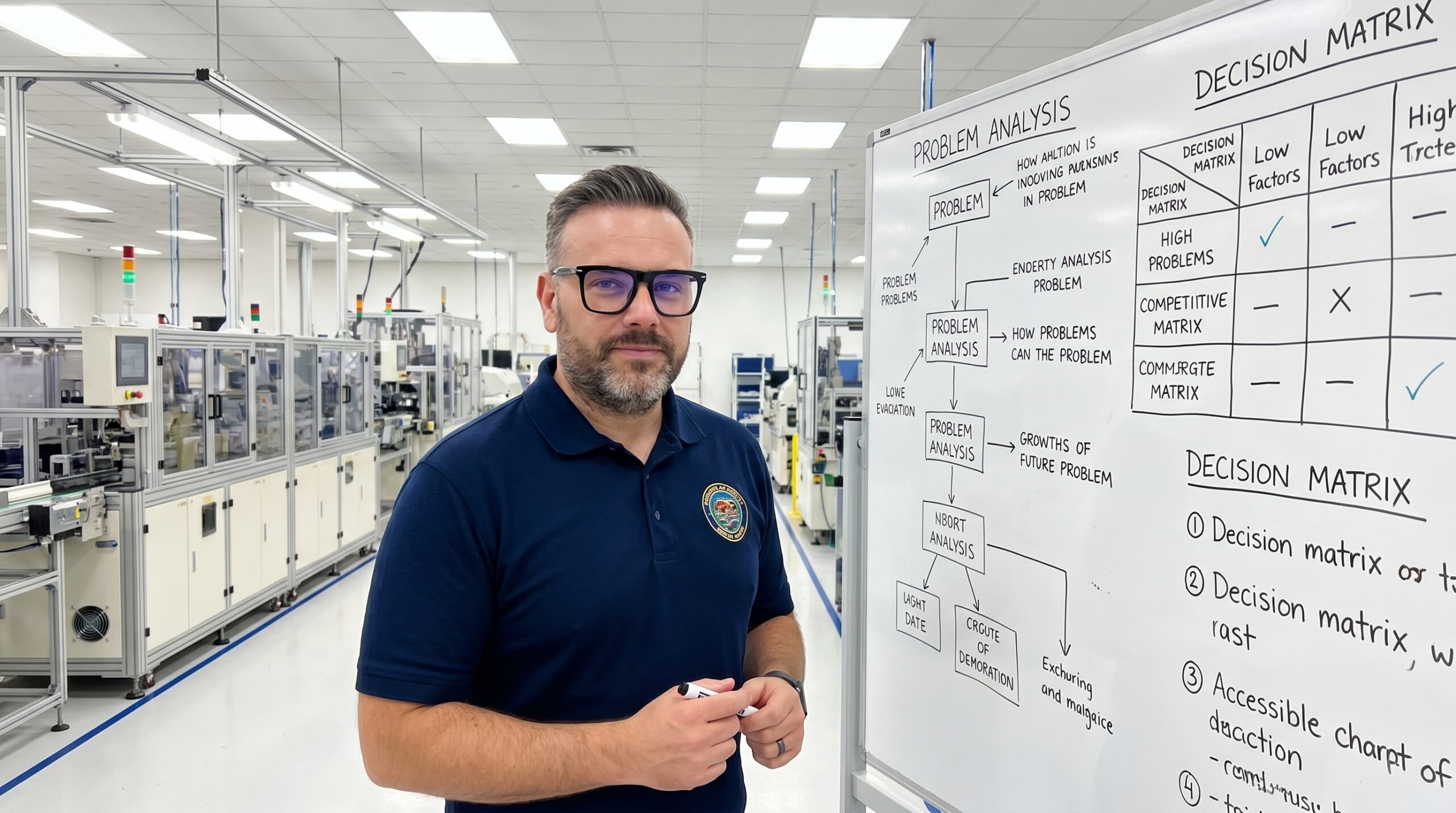
A plant manager called me on a Friday evening. A brake control unit assembly line was running at a 12% defect rate against a 0.3% standard. The customer had already issued a formal escalation. A 14-million-euro annual contract was on the line. His first question was predictable: tell me what to do right now.
My answer was to stop. Rushing into containment mode without understanding the failure mechanism guarantees wasted hours and corrupted data. Before deploying any 8D methodology or quarantine action, we needed to separate facts from assumptions. That requires structured analytical thinking.
This is where I introduced the Kepner-Tregoe (KT) method. Developed in the 1960s by Charles Kepner and Benjamin Tregoe, it is a rigorous framework for rational inquiry. It maps how effective managers actually think during a crisis and formalises that cognition into repeatable steps. KT does not compete with IATF 16949 tools; it provides the cognitive operating system that makes them work.
Situation Appraisal: Imposing Order on Chaos
When I arrived at the plant on Monday morning, the team was in full panic mode. A software technician was auditing line logic. An engineer was interrogating the component supplier. The quality manager was drafting a customer report. Nobody had stopped defective units from reaching the dispatch area.
Situation Appraisal (SA) is the triage step. It forces a team to list every known issue, distinguish between root problems and mere symptoms, and assign priorities and ownership. We gathered the cross-functional team and mapped the situation. Within 45 minutes, we realised we were facing three distinct issues, not one.
The 12% defect rate was a symptom. A faulty pressure sensor was a problem. Impending customer line stoppage was a threat. Priority one was immediate containment to protect the customer. Priority two was isolating the faulty components. Priority three was root cause analysis. This 45-minute sorting exercise saved days of uncoordinated effort.
Problem Analysis: Systematic Root Cause Isolation
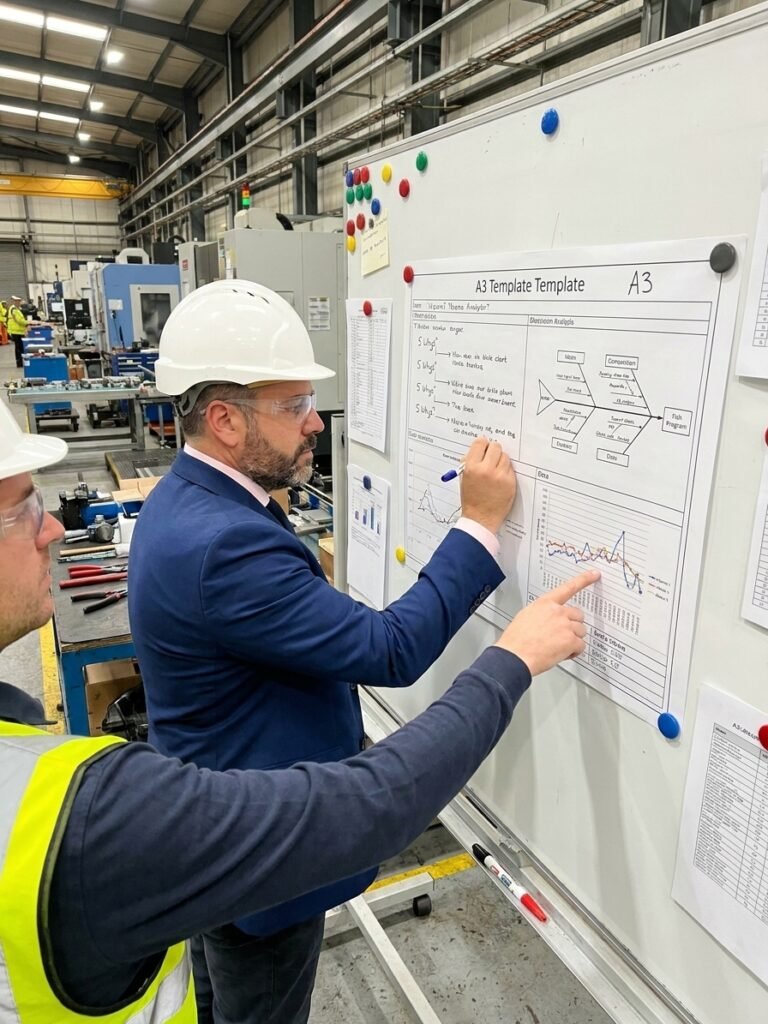
With priorities established, we deployed KT Problem Analysis (PA). This method rejects the standard brainstorming approach of guessing a cause and testing it. Instead, it uses rigorous comparative analysis. You define exactly what the problem is, what it is not, and identify the distinguishing characteristics between the two.
We analysed the data. The defect manifested exclusively on Line B, during the third shift, using components from supplier batch 2026-04-11. Crucially, identical units assembled on Line A during shifts one and two, using batch 2026-04-09, functioned perfectly.
The boundary was clear. The differentiating factor was a pressure sensor from the newer batch. A review of supplier change logs revealed the answer: the supplier had altered their sensor calibration process on April 8th without submitting a new PPAP. The new sensors exhibited a 0.15 mV calibration curve shift, invisible at incoming inspection but fatal during final EOL testing.
Isolating this exact mechanical deviation took four hours. Without KT comparative logic, the team would have spent days randomly swapping variables, generating conflicting theories, and delaying the corrective action.
Decision Analysis: Weighing Risk and Consequence
Once the root cause is confirmed, leadership demands immediate action. But reacting to a supplier deviation involves heavy operational trade-offs. Kepner-Tregoe Decision Analysis (DA) strips emotion from this phase by forcing an explicit evaluation of objectives, alternatives, and risks.
| Option | Action | Primary Risk |
|---|---|---|
| A | Return batch to supplier and halt assembly | 3 days of lost production, severe customer line-down penalties |
| B | Implement 100% pre-assembly sensor testing | Line cycle time increases by 30%, added sorting labour cost |
| C | Request supplier performs on-site recalibration | Supplier engineer availability, minimum 2-day preparation delay |
We defined our parameters. The absolute requirement (Must) was stopping defective shipments within 24 hours. Desired outcomes (Wants) included minimising financial penalty, preserving supplier relations, and maintaining delivery volume. We selected Option B, modified to run in parallel with an emergency replacement batch request.
The immediate sorting protected the customer while we awaited compliant parts. Within 48 hours, the new batch arrived, testing ceased, and cycle time normalised. We delivered a verified root cause and evidence-based containment to the customer, and the escalation was withdrawn.
Potential Problem Analysis: Anticipating Failure
Most quality teams conclude their work once the immediate fire is extinguished. The root cause is documented in an 8D report, containment is lifted, and the team moves on. Kepner-Tregoe Potential Problem Analysis (PPA) intervenes here. It asks what else can go wrong and forces preemptive mitigation.
Resolving a crisis with speed is pure luck. Resolving it with a system is engineering.
We had to ensure this specific calibration drift never reoccurred. We also had to check if other programs used the same sensor platform. If another customer's product utilised that part, they would face identical field failures. We traced the bill of materials across the plant to verify exposure.
Our preventive actions included upgrading incoming inspection protocols for all pressure sensors to mandate calibration verification. We forced a Level 3 PPAP submission from the supplier for the modified process. We updated the PFMEA and Control Plan to reflect this new failure mode and its detection method.
PPA takes minimal time but prevents maximum damage. Spending an extra hour mapping future vulnerabilities saves months of resolving repeat failures or managing warranty claims down the line.
Integrating KT with Standard Quality Frameworks
Kepner-Tregoe is not a replacement for your existing ISO 9001 or AS9100 architecture. It is the connective tissue that ensures those tools function as intended. The analytical rigour forces clarity into documentation that is too often treated as administrative overhead.
Mapping KT to Quality System Requirements
- 01Situation AppraisalApplies to Management Review and daily quality meetings to triage competing priorities.
- 02Problem AnalysisProvides the analytical engine for root cause determination within an 8D report.
- 03Decision AnalysisBrings structure to APQP gating and the selection of corrective actions.
- 04Potential Problem AnalysisUpgrades PFMEA from a paperwork exercise into a genuine risk-mitigation tool.
When teams write an 8D report without KT Problem Analysis, they frequently jump to conclusions based on recent history or operator error. When they run an APQP gate review without Decision Analysis, they select suppliers or processes based on initial cost rather than total risk profile.
KT eliminates this cognitive bias. It forces engineers to document what they know versus what they assume. It makes the distinction between a symptom and a defect explicit. This precision is what turns quality management from reactive firefighting into actual engineering.
Deploying KT on the Shop Floor
Adoption does not require external consultants or multi-week certification courses. It requires a shift in daily operational language. Take one unresolved nonconformance from your current NCR log. Apply the four Problem Analysis questions. Define what the defect is, what it is not, and trace the deviation.
At your next management review, replace the standard open-issues list with Situation Appraisal. Demand that attendees prioritise based on risk and consequence, not just chronological order. Enforce the discipline of assigning clear ownership and deadlines before the meeting ends.
Use Decision Analysis for your next significant investment, whether that is a new measurement system for the metrology lab or a secondary supplier approval. Explicitly map the Musts and Wants, and score the alternatives against those criteria rather than relying on intuition.
The goal is to build a culture where structured inquiry is the default reaction to abnormality. When a process deviates, the team should automatically ask what changed, not who to blame. That cognitive discipline is the ultimate competitive advantage in manufacturing.