
At 06:00 on a Monday, an operator starting the third shift at a gearbox plant spotted micro-cracks on a gear tooth. The component was designed to withstand thousands of revolutions per minute. Left unchecked, the defect would cause catastrophic field failure.
In most facilities, this defect would be logged in a shift report and emailed to the quality department. Production would continue through the night. By the time engineers convened to review the issue days later, hundreds of nonconforming parts would be embedded in the supply chain.
Under a Quick Response Quality Control (QRQC) system, the timeline looks radically different. Within five minutes, a quality engineer reached the line. Within ten, the supervisor stopped production to verify the extent. Within thirty, a cross-functional team stood at the board performing a 5 Whys analysis. They traced the root cause to an unapproved steel supplier change—a violation of the PPAP process—and implemented immediate containment actions before the shift ended.
QRQC is not a supplementary form to file. It is an operational ruleset that dictates exactly how an organisation mobilises around a nonconformity. It forces a structural shift away from delayed, opinion-based meetings toward immediate, data-driven resolution on the shop floor.
The Operational Mandate of QRQC
Rooted in the Toyota Production System and the principle of jidoka, QRQC was formalised in its modern industrial state by Faurecia (now FORVIA). The methodology demands that problems are resolved at the exact location where they occur, by the personnel who discovered them, supported by verifiable data rather than hearsay.
This approach directly counters traditional manufacturing latency. Too often, a first-shift defect sits dormant until a second-tier management meeting two days later. Information degrades as it passes through email chains and shift handovers. By the time an engineer reads the report, the critical context of the machine environment is gone, and the team works from a caricature of the actual event.
QRQC eliminates this degradation by enforcing strict temporal and geographical constraints. It defines precisely who must react, when they must react, and where that reaction must take place. The system functions only when leadership accepts that stopping the line to solve a problem is inherently more valuable than running defective parts to meet a short-term takt time.
Speed, Location, and Data as System Pillars
Speed of response is measured from the moment of detection, not from when a supervisor decides to escalate the issue. The standard QRQC clock mandates a reaction within thirty minutes for internal defects, one hour for customer-reported 0-kilometre defects, and twenty-four hours for field failures. These are operational requirements, not suggestions.
Every minute without containment multiplies risk. If a line outputs sixty parts per hour and containment is delayed by a single shift, the plant has generated nearly five hundred defective components. The financial and logistical burden of sorting or scrapping that volume rapidly eclipses the cost of stopping the line immediately.
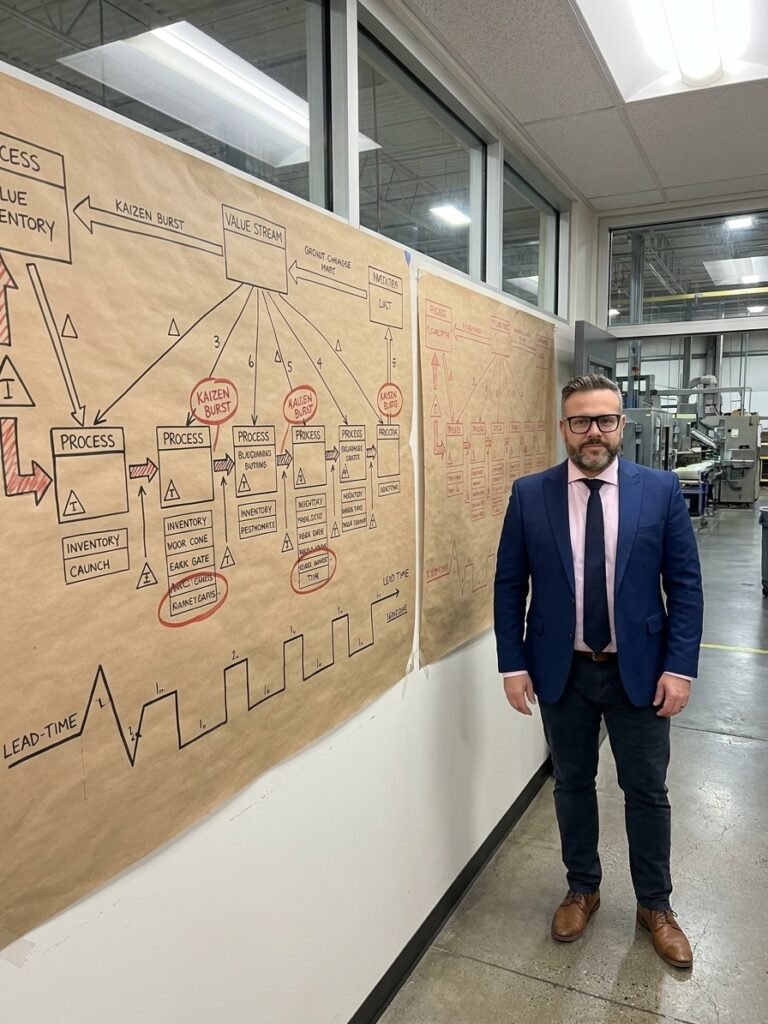
Response must occur at the gemba. Engineers cannot diagnose a machine anomaly from a conference room screen. When the team physically stands at the station, examines the defective parts, and observes the ambient process conditions, they eliminate guesswork. They transition from debating abstract theories to analysing verifiable measurements and reproducing the failure mode.
The Six-Phase Containment Sequence
Execution of QRQC follows a rigid sequence. It begins when an operator or sensor detects a nonconformity and activates the andon system to stop the line. The immediate priority is containment—physically isolating suspect stock, blocking downstream shipments, and securing affected material batches to halt the defect's propagation before any analysis begins.
The QRQC Execution Sequence
- 01Detection and StopOperator identifies the nonconformity and stops the line immediately.
- 02Immediate ContainmentIsolate suspect parts and block shipments to prevent escalation.
- 03Root Cause AnalysisTeam performs 5 Whys and change analysis directly at the machine.
- 04Corrective ActionImplement immediate fixes, followed by permanent systemic solutions.
- 05Verification and StandardisationConfirm the defect is gone and update FMEA and Control Plans.
With the flow of defective parts halted, the team initiates root cause analysis on the shop floor. QRQC does not require a protracted DMAIC study at this stage. The objective is rapid identification of the physical trigger using tools like 5 Whys, good-versus-bad part comparison, and rigorous change analysis regarding materials or machine parameters.
Once the mechanism is understood, the team implements immediate corrective actions, such as swapping a worn tool or adjusting a heat-treat temperature. The final and most frequently ignored step is horizontal deployment. The team must update the PFMEA, revise the Control Plan, and verify whether identical machines or sister plants face the same risk, breaking the cycle of repeat failures.
Anatomy of the QRQC Board
The operational heart of the system is the QRQC board, located directly on the shop floor. This is a working tool, not a display panel for audits. It provides absolute visual transparency of current nonconformities, assigning explicit ownership, containment status, and chronological deadlines.
Traditional Reporting vs QRQC
Traditional Reporting
- Response time measured in days or weeks
- Root cause debated in remote conference rooms
- Containment applied sporadically and retroactively
- Accountability diluted across email chains
QRQC Discipline
- Response time measured in minutes from detection
- Root cause verified at the machine with physical parts
- Containment executed before analysis begins
- Ownership assigned to a named individual on the board
During daily management walks, leadership convenes at the board rather than in a boardroom. They review open issues based on real-time data, verify the effectiveness of recent corrective actions, and ensure that permanent changes have been standardised into the quality management system.
The board forces accountability. When a problem remains open past its deadline, the delay is visible to anyone walking the floor. This visibility strips away the ability to quietly ignore systemic failures, compelling management to provide the resources necessary to close loops promptly.
Common Implementation Failures
Organisations routinely fail at QRQC by treating it as an administrative form rather than a cultural shift. Printing a new template and demanding compliance changes nothing if management still penalises operators for stopping the line. The entire methodology collapses without unequivocal leadership support for immediate, production-halting responses.
Conducting QRQC analysis in an office is another frequent failure mode. When engineers attempt to diagnose complex machine failures through CMMS logs and spreadsheets, they miss the physical context—the ambient vibrations, the tooling wear, the operator interaction. The result is an incorrect root cause and a corrective action that inevitably fails.
A digital QRQC board without the discipline to stop the line is just an expensive monitor.
Skipping verification is equally disastrous. Teams frequently implement a corrective action and immediately disperse to fight the next fire. Without monitoring the subsequent production runs to confirm the defect rate dropped to zero, the organisation leaves the door open for immediate recurrence, often in a more severe and costly form.
I have audited plants that implemented flawless digital QRQC dashboards but still shipped defects because they skipped physical containment. The dashboards tracked the failure beautifully, but nobody walked to the line to physically lock up the nonconforming stock. Technology accelerates data flow, but it does not replace the physical act of isolating parts.
Deploying QRQC With Discipline
Transitioning to QRQC requires a focused pilot rather than a facility-wide mandate. Select a single, high-risk line and install a physical board at the station. Define the alarm thresholds and train the specific shift leaders, operators, and maintenance technicians on the exact timeline required for their response.
Enforce the discipline aggressively during the first month. When the pilot line stops, the assigned engineers must arrive at the board within the designated window. If they fail, management must address the delay immediately. This repetition builds the muscle memory required to make QRQC an institutional reflex rather than a forced exercise.
As the methodology stabilises on the pilot line, scale horizontally to adjacent processes. Update the associated IATF 16949 documentation to reflect the new containment timelines and standardise the board's layout across the plant. The goal is to make the rapid, gemba-based response the default operational state for every nonconformity detected.