
Owning a quality outcome while holding no direct power over the people who produce it is a common and structurally difficult position. The customer holds you accountable for escapes from a supplier whose hiring, training, maintenance budgets and shift patterns you cannot influence. Purchasing negotiated the price, engineering negotiated the technical package, and quality inherits whatever combination of the two emerges on the shop floor.
The first principle: you cannot manage what you cannot see, and you cannot see what you have not contractually secured the right to see. Across two decades in automotive and aerospace supplier quality, most failures I have dealt with were not caused by dishonesty or incompetence. They were caused by blindness — the customer discovered a process drift weeks after it began, because nobody had negotiated access to the data that would have revealed it.
The second principle: persuasion substitutes for power only when it is systematic. Ad hoc emails, occasional visits and escalation by telephone produce noise. What works is a defined oversight model, agreed interfaces, named people on both sides, and data flowing continuously rather than on demand.
Choosing an Oversight Model That Fits the Risk
Tier contract manufacturers by consequence of failure, not by spend. A machined bracket for an interior trim assembly and a friction-welded steering component may come from the same factory; they do not merit the same oversight. For low-consequence parts, a desktop review of inspection records plus an annual audit may be adequate. For safety-critical or flight-critical hardware, that approach is negligence dressed up as efficiency.
Three models dominate. Remote oversight: the supplier reports data, you review it, physical presence is occasional. Periodic presence: scheduled process audits, unannounced visits, source inspection at defined gates such as first article, lot release or pre-shipment. Embedded oversight: your people or contracted agents sit at the supplier daily. Each costs more than the last, so tiering is fundamentally a resource-allocation decision — revisit it whenever the part, the process or the supplier's ownership changes.
One failure mode recurs constantly: model drift. The supplier starts under embedded oversight during launch, and the arrangement quietly lapses once production stabilises, with nothing replacing it. The countermeasure is planned de-escalation — remote oversight takes over with defined triggers that restore the heavier model automatically. If the re-escalation conditions live only in someone's head, they will never fire until after the customer has found the problem for you.
Planned de-escalation and re-escalation
- 01Launch: embedded oversightResident presence daily through PPAP and ramp-up
- 02Stabilisation: periodic presenceProcess audits, source inspection at defined gates
- 03Routine: remote oversightContinuous data feed, monthly scorecard review
- 04Trigger eventContainment, missed data submission or unnotified change
- 05Automatic re-escalationHeavier model restored without renegotiation
The Resident Engineer: System Oversight, Not Reinspection
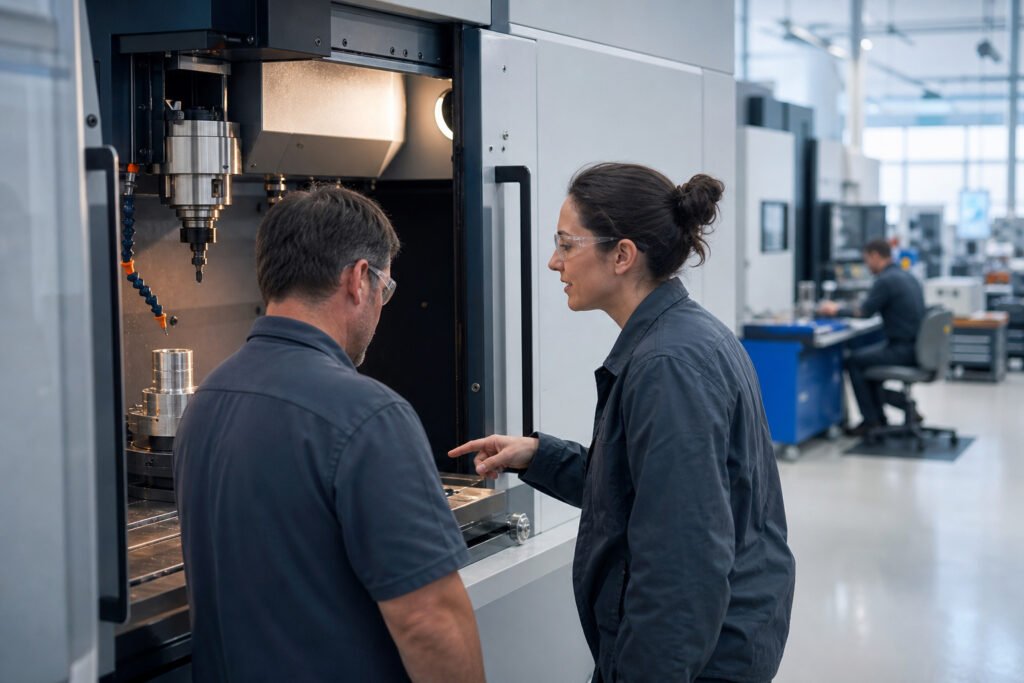
Placing an engineer at a contract manufacturer is the most powerful oversight tool available and the most frequently wasted. The classic mistake is using the resident as a premium inspector, standing at end-of-line checking parts the supplier's own people should have checked. That is expensive reinspection, and it lets the supplier's internal quality system atrophy because yours is doing its job. The resident's purpose is oversight of the system, not substitution for it.
A good resident spends the day on process verification: watching parameter logs, reviewing the supplier's reaction to their own SPC signals, tracing a nonconformance through the supplier's containment process, sitting in on shift-change quality briefings. They should attend the supplier's internal quality meetings, not merely the customer-facing ones — that is where you learn whether the corrective action culture is real. They verify that the layered process audits the supplier claims to run actually happen, with real checklists and honest findings.
Selection matters more than headcount. Send someone who can read a process, not a junior who will be socialised into the supplier's habits within a month. The resident needs explicit protection against capture: rotation back to your organisation, a reporting line that never runs through the supplier, and a mandate that includes reporting bad news early. If after a year the resident is still catching everything, the supplier is unfixable and the commercial relationship should be challenged, not the oversight budget.
Data Access Rights: Negotiate Them Before You Need Them
When I review supplier contracts, the data access clause is the first thing I look for, and it is missing more often than not. At minimum, you need contractual rights to process parameter logs for your parts — cycle times, temperatures, pressures, torques, weld currents — dimensional results by cavity, tool, machine or line, scrap and rework records, calibration status of gauges used on your product, and change notifications with defined lead times before implementation. Without these, your oversight is theatre performed during audits.
Real-time access beats periodic reports for one simple reason: periodic reports are curated. You want the raw data feed, not a monthly summary prepared by the supplier's quality manager. Many manufacturers now run MES or quality systems that can expose this through a portal or API, and negotiating a read-only view during contract negotiation costs the supplier almost nothing. Trying to negotiate it after an escape has occurred costs enormously, because at that point the data request looks like preparation for litigation.
Watch the sub-tier blind spot. Your contract manufacturer buys castings, stampings, plating or heat treatment from others, and your data rights must flow down contractually. A plating thickness problem originating at a sub-tier the supplier has never audited is a classic escape path in both automotive and aerospace supply chains. Require an approved sub-tier list for your parts, notification of changes to it, and audit rights at least one tier down for critical characteristics. Supplier resistance to this is itself useful information about where your risk actually sits.
What to Measure Remotely and What the Numbers Tell You
Once data flows, know which signals matter. From parameter logs, watch stability rather than absolute values: a machine holding temperature within a wide but stable band is less concerning than one drifting steadily. Drift means something in the process is degrading — a heater band, a tool, a sensor — and it will eventually cross the tolerance wall.
From inspection data, track reject rates by cavity and by tool individually. Averaged data hides the one worn cavity producing intermittent defects, which is among the most common escape mechanisms in multi-cavity moulding and multi-spindle machining. The offending cavity may contribute only a fraction of total rejects, yet it will be the source of every field escape from that tool.
Divergence between your data and the supplier's data is the most valuable signal of all. When incoming inspection at your plant rejects a lot the supplier passed, something is broken: their gauges, their sampling, their process discipline or their honesty. Trend the correlation over time. A supplier whose self-reported quality improves beyond plausibility, or whose data shows suspiciously low variability, deserves a physical visit promptly. Real manufacturing data is messy; data that looks perfect has usually been cleaned.
You cannot order a contract manufacturer to fix its culture, but a documented, persistent, evidenced demand is very hard to ignore.
The remote scorecard
Escalation and Leverage
Escalation is your substitute authority, and it must be built deliberately. Define a ladder in the contract: quality engineer to quality engineer, then quality manager to plant manager, then your purchasing organisation to their commercial leadership, then a formal supplier corrective action request — with defined response times at each step. An escalation path that exists only in goodwill produces silence under pressure.
The leverage in the relationship is nearly always commercial: payment withholding on nonconforming lots, source inspection costs charged back, volume commitments tied to performance. Agree these mechanisms when the relationship is warm. Invoking an undefined penalty clause in a crisis leads to lawyers rather than parts.
Know the difference between a supplier having a problem and a supplier being the problem. The former deserves support: joint problem-solving, engineering resources, sometimes funding a fixture or a gauge if the return is sound. The latter shows a pattern — repeated containment for the same failure mode, corrective actions closed on paper only, change notifications arriving after implementation, auditors seeing a rehearsed show. My test is whether findings from the last audit reappear at the next one. Recurrence of known findings means the management system is decorative, and no amount of oversight will fix that.
Knowing the Limits of Oversight
Be honest with your own organisation about what oversight cannot do. If the commercial team sourced on price alone and the technical package left no process margin, no oversight model will fully compensate. No resident engineer and no data feed repairs a Cpk that the part design never allowed.
Document that risk formally, escalate it internally, and make sure the decision to accept it sits with whoever owns the commercial consequence — not quietly with quality. An accepted risk with a named owner and a signature is a managed risk; the same risk buried in a quality file is a liability with a due date.
Responsibility without authority is survivable; responsibility without authority and without a voice is not. The tools above — tiered oversight, contractual data rights, systematic measurement, defined escalation — are how quality builds that voice. Use it before the escape, not after.