
The line finishes the last piece of Series A. In two hours, Series B must run. That window requires die changes, parameter updates, gauge calibration, and verification that the first parts meet the customer specification. In those two hours, the financial trajectory of the entire month is decided.
Most plants document this transition thoroughly. In reality, every changeover operates differently. The setter uses a personal system, operators rely on memory, and the inspector arrives only after the first twenty pieces are already machined. If half of those parts fall outside tolerance, two hours of planned downtime becomes four, and the plant's OEE collapses.
The problem is not the personnel. The problem is that manufacturing leadership rarely treats changeover as a critical quality process, choosing instead to view it purely as a logistical exercise in machine availability.
Defining Changeover Quality
Changeover quality is not an independent methodology. It is a systematic approach to managing variability during the windows where a product, parameter, material, or tool changes. In practice, it demands that we control these transition periods with the exact same discipline applied to steady-state serial production.
Industry experience shows that a disproportionate amount of internal nonconformities trace directly back to the startup phase. The changeover window combines three factors that create a perfect storm for process failure: changed machine settings, intense pressure to resume production, and high cognitive load on operators switching between task modes.
Shigeo Shingo’s Single-Minute Exchange of Die (SMED) remains a monumental contribution to lean manufacturing. By separating internal tasks from external tasks, plants successfully compressed die changes from hours to minutes. However, SMED addresses speed exclusively, not capability.
If you optimise a changeover from 120 minutes down to 15, but generate a 40% scrap rate on the startup parts, you have not improved the system. You have simply relocated the waste. You traded machine downtime for wasted material and lost labour. Changeover quality asks the necessary follow-up question to SMED: we have a fast transition, but is it a clean transition?
Pre-Changeover Discipline and Setup Verification
The most frequent failure occurs before the old series even stops. Personnel begin changing settings before the necessary components are prepared. Material is missing, the schematic is outdated, or the inspection gauge is not calibrated for the new tolerance range. Every changeover requires a strict pre-start checklist that must be signed off before the machine halts.
The checklist must verify that materials are staged, specifications are current, tools are validated, and the First Article Inspection (FAI) plan is ready. This prevents the chronic scenario where a changeover is delayed because an operator forgot to fetch the correct coil of raw material.
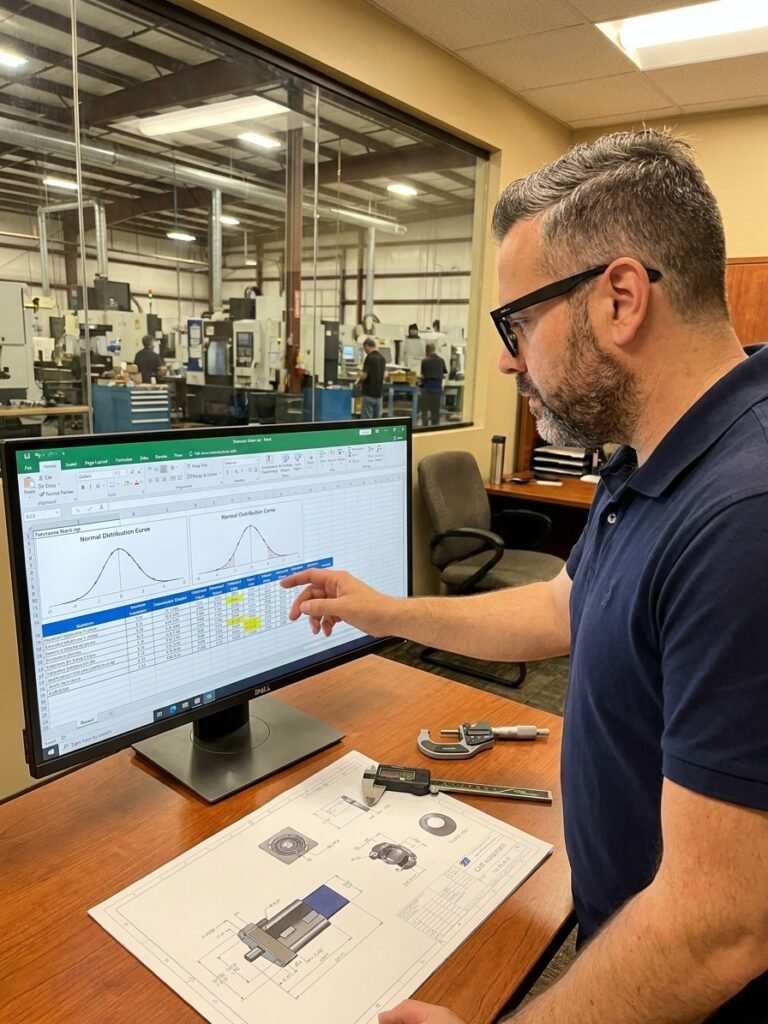
Once the machine stops, the setter must execute setup verification rather than setup assumption. In a broken system, the setter dials in parameters, signals completion, and starts the line. In a robust system, the setter physically proves the setup is correct by measuring critical dimensions on a setup part. The line does not start until verification is absolute. This requires clear visual setup sheets, defined verification criteria, and the absolute authority for the setter to halt the start if something feels wrong.
The Setup Verification Sequence
- 01Pre-Changeover ChecklistMaterials, tools, and calibrated gauges staged before the machine halts.
- 02Parameter SetupSetter dials in new parameters according to the visual setup sheet.
- 03Setup Part VerificationCritical dimensions measured on a test part to prove the setup.
- 04Line Start AuthorisationProduction begins only after verification is signed off.
First Article Inspection and Run@Rate
First Article Inspection (FAI) is the first real test of the new setup. In many facilities, FAI takes too long. The inspector queues the part, measures it, logs the data, and reviews it. Meanwhile, the production line keeps running. If the setup was incorrect, the plant just manufactured a pile of nonconforming material while the paperwork was being processed.
The speed of FAI is critical. Facilities must define a quick check: three to five critical characteristics measured immediately on the first piece. If the quick check passes, production continues under the condition that the full FAI is completed within 30 minutes. If the quick check fails, the line stops. This approach slashes startup scrap dramatically because it prevents sustained production against an invalid setup.
Borrowing from the automotive PPAP standard, a Run@Rate philosophy dictates that you must prove the process produces conforming output at full cycle time. You cannot validate a setup while the machine crawls in slow setup mode. The line must run at production speed for at least 50 pieces, monitoring the dimensional trend. The first piece might be perfect, but piece twenty might drift out of tolerance due to thermal expansion or tool deflection. Stability is proven through a trend, not a single data point.
Managing the Transition Phase and Building Maturity
A standard production control plan is written for steady-state manufacturing. A changeover possesses its own distinct risks, critical control points, and reaction requirements. A dedicated transition control plan covers the period from the halt of the old series to the stabilisation of the new one.
This document dictates what is checked in addition to standard production, the inspection frequency during startup, and the exact criteria required to downgrade from intense startup monitoring to normal serial production. If the startup fails, the reaction plan dictates immediate containment.
Changeover Quality Maturity
- ReactiveNo pre-checks; operators rely on memory, resulting in high startup scrap and unstable OEE.
- ProceduralBasic checklists introduced; FAI conducted but after excessive nonconforming parts are already made.
- VerifiedSetup is physically proven via test parts; Quick Checks halt the line before sustained scrap occurs.
- Data-DrivenTransitions are mapped, measured against targets, and supported by automated recipe loading.
I audited a plant that operated three lines with an average of six changeovers per shift. Their baseline startup scrap rate was 3.2%. By mapping the changeovers over a two-week span, we found that 47% of the scrap originated from incorrect temperature settings not detailed on the setup sheet. Another 28% came from delayed FAI, where sixty pieces were machined before the inspector arrived. We added the missing temperature parameters, implemented a three-dimension quick check on the line, and reduced their startup scrap to 0.4% within six months.
Metrics That Drive Disciplined Behaviour
If a facility does not measure the quality of its changeovers, it cannot improve them. Metrics force the organisation to treat the transition as a distinct, critical process. Tracking these specific indicators shifts the focus from merely getting the line running to getting the line running correctly.
| Metric | Definition | Target |
|---|---|---|
| Startup Scrap Rate | Percentage of defective pieces during the new series startup. | < 0.5% |
| First Pass Yield at Start | Percentage of FAI parts passing on the first attempt. | > 95% |
| Changeover Time to Quality | Time from halting the old series to the first approved piece of the new series. | SMED target + 10 min |
| Stabilization Time | Time from the first piece to achieving a stable Cpk (≥ 1.33). | < 30 min |
Examine the stabilisation metric closely. If a process requires more than 30 minutes to achieve a Cpk of 1.33, the setup methodology is flawed. A capable process should be stable from the moment full cycle time begins, not after a half-hour of scrapping parts while the machine thermally stabilises.
Overcoming the Common Operational Delusions
Several recurring fallacies destroy changeover quality. The loudest is the claim that there is no time for verification, only time for production. The mathematics argue otherwise: every minute saved by skipping setup verification costs twenty minutes of rework, sorting, and material loss down the line.
A fast changeover is not automatically a clean changeover. SMED is a necessary condition, not a sufficient one.
Another failure is relying entirely on an experienced setter's intuition and bypassing the checklist. Experience does not negate human error under time pressure. Checklists exist as a safety net, identical to the ones experienced airline pilots execute before every flight.
Finally, treating changeover purely as a production responsibility—where quality only arrives after the line is running—guarantees scrap. Quality cannot be inspected into a process retroactively. It must be engineered into the startup sequence from the very first cycle.
Technology offers solutions, but it cannot replace this discipline. Automatic parameter recipe loading can eliminate setting errors, and digital setup sheets on tablets can enforce checklists. IoT sensors can detect vibration or pressure deviations during the first minutes of a run. However, if the underlying culture allows operators to bypass the digital prompts, the technology merely acts as an expensive decoration over a broken process.
Improving changeover quality begins with observation. Spend one week tracking every transition in the facility. Record the time taken, the scrap generated, the reasons for delays, and the personnel involved. Review the data with the team, identify the patterns, and update the control plans accordingly. Treat the transition between series with the exact same rigour as the serial production itself.