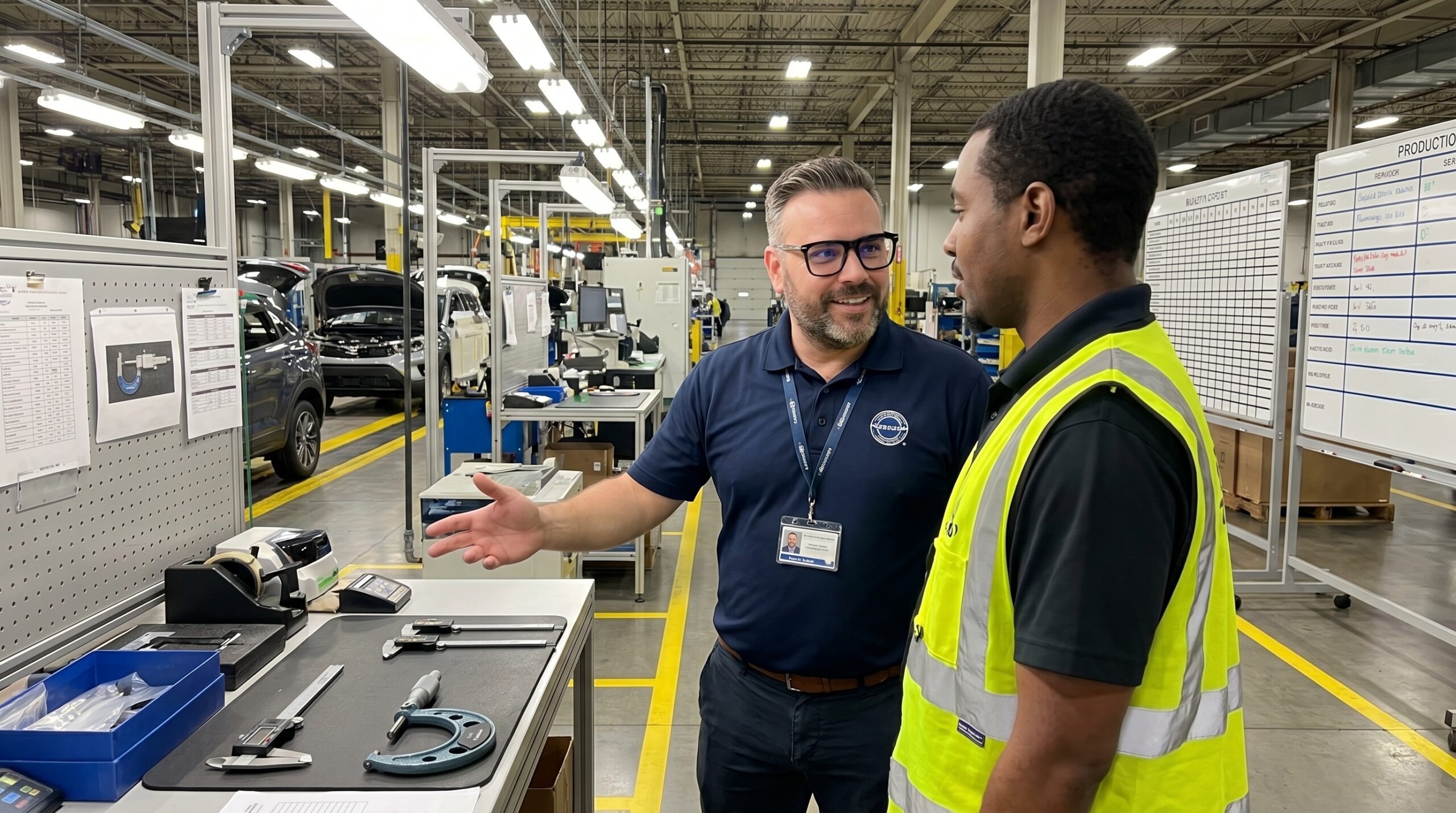
Shop Floor Coaching is a systematic approach to developing employees directly at their workstation, in real time, on real tasks. It is not classroom training, a closed-door performance review, or a passive Gemba walk. It is a targeted conversation between a supervisor and an operator with a specific intent: to build competence, strengthen autonomy, and deepen the understanding of quality.
Most factories fail at implementation because they confuse coaching with instruction. An operator makes an error. The supervisor arrives, points out the defect, states the correct method, and leaves. Three days later, the operator makes the exact same error.
The failure occurs because the operator was never given space to think. They were not asked a question; they were handed an answer. An answer handed on a plate is never retained like one discovered independently.
Instruction vs. Coaching
Instruction says: "Do it this way." Coaching asks: "What did you notice? How would you handle this? What happens if this parameter shifts?"
Instruction creates dependence. The operator learns to mechanically repeat steps without understanding the underlying logic. When an unusual situation arises—a material variance, a parameter drift, an atypical defect—they lack the mental framework to react, because they have never been challenged to think.
Coaching creates independence. The operator learns to think critically about the process, not merely execute tasks. In automotive and aerospace manufacturing, where a single defect can trigger a costly recall or a field failure, you cannot afford operators who blindly follow procedures. You need operators who understand the procedures and can adapt when reality deviates from the standard.
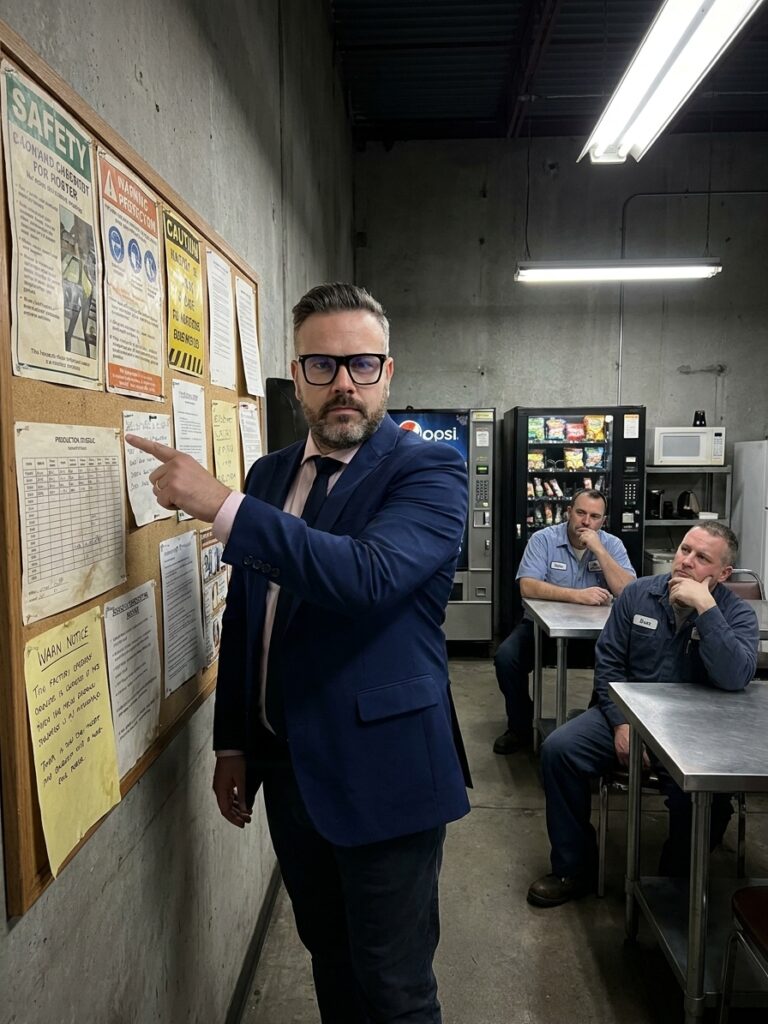
Supervisor Approach to Deviations
Instruction (The Default)
- Focuses on immediate correction of the defect
- Supervisor provides the solution directly
- Creates mechanical repetition of steps
- Operator dependent on supervisor for future issues
Coaching (The Target)
- Focuses on developing the operator's process logic
- Supervisor asks questions to guide discovery
- Builds understanding of underlying variables
- Operator equipped to handle novel deviations
The Five Phases of a Coaching Conversation
An effective coaching conversation on the line follows a strict sequence. It takes 10 to 15 minutes. It is structured, repeatable, and focused entirely on the operator's thought process.
The Shop Floor Coaching Sequence
- 011. Observe (Watch)Stand alongside the operator. Monitor the work silently. Document what they do well, not just what needs fixing.
- 022. Inquire (Ask)Ask two or three open-ended questions about the process. Never ask questions to test the operator; ask to understand their logic.
- 033. Reflect (Feedback)State exactly what you observed and ask the operator to explain the reasoning behind their specific actions.
- 044. Collaborate (Solve)If you find a problem or an inefficiency, do not solve it for them. Ask the operator how the process could be improved.
- 055. Commit (Agree)End with a mutual agreement on a specific action, including a hard date for follow-up. Always return on that date.
The questioning phase is the most critical. Ask questions you genuinely need the answer to, such as: "How do you verify that parameter is in tolerance?" or "What would happen if that temperature shifted by two degrees?" If you observe the operator double-checking a dimension, ask why. You might discover a gauge reliability issue that your control plan missed.
During the problem-solving phase, let the operator think. They work with the equipment every day. Their solution for preventing a defect is often more practical and robust than anything engineered from an office.
Recognising When to Instruct vs. Coach
Shop Floor Coaching is not a replacement for instruction; it is a complement. Knowing when to apply each method is a core supervisory competency.
Instruct when onboarding new personnel who lack basic procedural knowledge. Instruct during safety-critical operations where there is absolutely no room for trial and error. Instruct when an immediate containment action is required—such as stopping a non-conforming run during an active audit or a customer visit.
Coach when operators have baseline competence but need to develop autonomous problem-solving skills. Coach during stable production runs. Coach when you identify recurring defects that indicate a systemic gap in process understanding.
If someone could be seriously injured or a severe quality incident is imminent, instruct. In all other scenarios, attempt to coach.
Implementation: The First 30 Days
Do not mandate that every supervisor begins coaching immediately. Without preparation, execution will vary wildly, the methodology will degrade, and the initiative will be abandoned within a month. Start with a focused 30-day rollout for two or three willing shift leaders.
Week one is observation only. Shift leaders observe their operators on the line without speaking, taking notes, or evaluating. The goal is to begin seeing the work through the operator's eyes.
Week two focuses on inquiry. Each leader asks one operator one process-related question per shift, then listens carefully to the answer. This builds the psychological safety required for dialogue.
Week three requires each participating leader to conduct three complete coaching conversations using the five-phase sequence. Week four brings the leadership team together to review the experience, standardise the approach, and integrate coaching into the daily routine.
Integration with ISO 9001 Requirements
Shop Floor Coaching is not an isolated HR initiative; it is a direct mechanism for satisfying core QMS requirements. ISO 9001:2015 Clause 7.2 (Competence) and Clause 7.1.6 (Organizational Knowledge) demand systematic capability development. Coaching records serve as direct evidence of this.
These records do not need to be bureaucratic. A functional coaching log requires five fields: date, operator name, topic discussed, agreed actions, and the date for follow-up verification. This provides objective evidence of active competence management during external audits.
Furthermore, Clause 5.1 (Leadership) requires top management to demonstrate—not merely declare—commitment to quality. A plant manager who spends 15 minutes on the line conducting a coaching conversation sends a clearer signal about organisational priorities than any published quality policy. Conversely, a manager who preaches coaching in meetings but never visits the shop floor undermines the entire initiative.
Avoiding the Common Traps
I have audited plants where coaching initiatives fail, and the pattern is always the same. The most frequent failure occurs when supervisors use a coaching session as a disguised fault-finding mission. Operators immediately recognise the trap, defensiveness rises, and the dialogue collapses.
The second trap is rapid-fire interrogation. A supervisor unloads ten questions in two minutes. The operator freezes. A successful coaching session requires two or three high-quality questions over 15 minutes, allowing the operator time to process and respond.
The final, fatal trap is the lack of follow-up. A supervisor holds an excellent conversation, the operator agrees to trial a new method, and the supervisor never returns to verify. This signals that the agreement was merely performative. Without exception, the agreed follow-up date must be honoured, or the coaching framework loses all credibility.
Quality does not happen in the inspection lab at the end of the line. It happens in the operator's head, at the point of execution. The role of the supervisor is to use structured coaching to help the operator discover that capability for themselves.