
Walk into any plant with ISO 9001 or IATF 16949 certification and you will find the quality policy framed in the reception area. Walk onto the shop floor and ask a line supervisor who owns the 8D corrective actions for their cell. The answer, in the majority of facilities, is "the quality department." That response is not a simple misunderstanding. It is the exact point where a compliant quality management system diverges from actual quality assurance.
Total Quality Management demands that every function owns the quality of its output. In practice, most organisations default to a delegated model. Production owns throughput. Engineering owns the tooling. Quality owns the defects. The quality department becomes the single point of accountability for problems it did not create, cannot design out, and is not authorised to fix on the line.
I have audited dozens of automotive and aerospace facilities where this accountability gap is the primary driver of scrap. The operators see the defects forming. The shift supervisors see the takt time slipping. The engineers see the SPC charts drifting. Because ownership is centralised in a silo, nobody acts until a customer rejection forces a containment event. Breaking this cycle requires dismantling the delegation habit and assigning specific, in-process ownership to the roles that generate the variation.
The Shift Supervisor and the Delegation Trap
The plant supervisor is the most critical node in any TQM structure, yet they are consistently measured against output metrics alone. When a supervisor is incentivised to hit a shift target at the expense of process capability, they will invariably push nonconforming product downstream. They are not acting negligently. They are optimising for the scorecard they were handed by management. If the scorecard lacks a quality dimension, the supervisor has effectively been authorised to trade conformity for volume.
Across two decades in automotive and aerospace manufacturing, I have never seen a reactive inspection bay prevent a recurring defect. The inspection bay catches the failure, quarantines the parts, and triggers a corrective action loop. It does not address the tool wear, the thermal expansion issue, or the misaligned guide rail causing the failure. The supervisor running that line holds the mechanical authority to stop the drift, but they must be given the operational mandate and the metric structure to do so.
To close this gap, the supervisor's daily scorecard must integrate the cost of quality. When a shift output target sits directly beside a first-time-through rate and a scrap value, the decision calculus changes. The supervisor is no longer evaluating whether to stop the line for a fixture adjustment; they are weighing two competing financial realities on the same ledger.
Engineering's Role in Pre-Empting Failure
In a functional TQM model, the quality department does not write the corrective action for a dimensional failure. The process engineer who designed the fixture updates the PFMEA and implements the permanent corrective action. Engineering departments frequently treat process failures as an execution problem on the floor rather than a design deficiency in the industrialisation phase. This is a structural abdication of ownership. If a retaining clip requires a locator pin to seat correctly, the absence of that pin on the initial drawing is an engineering failure, not an operator error.
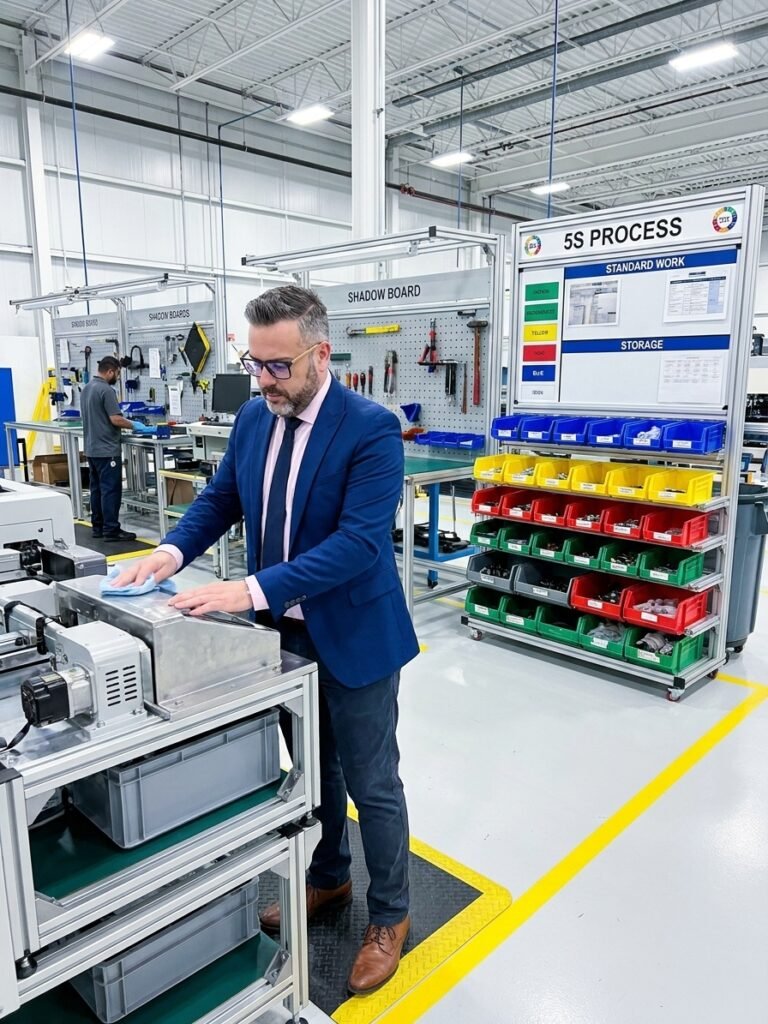
Process engineers must own the capability of their processes. This means verifying that the tooling, the work instructions, and the tolerances actually yield a Cpk of 1.33 or higher under production conditions. When a plant experiences a high rate of dimensional nonconformance, the first investigation should not be a retraining of the operator. It should be a review of the process design and the control plan. Blaming the operator for a poorly engineered fixture is the most common and most expensive deflection in manufacturing.
To operationalise this ownership, engineering performance metrics must include downstream defect rates. When the engineer who launched the cell is held accountable for its scrap rate during the first six months of serial production, the industrialisation process becomes far more rigorous. The engineer will demand tighter incoming inspection on supplier components and validate the assembly fixtures before the launch, rather than relying on the quality department to filter out the fallout.
The Operator as the First Responder
The machine operator is the first person to detect a change in the process. They feel the increased assembly resistance. They see the surface finish degrading. They hear the press cycling at a different pitch. Traditional quality systems ignore this sensory data because it is not quantified on a control chart. TQM demands a mechanism to capture and act on this operator knowledge before it becomes a measurable defect.
This mechanism is the Andon system. Giving an operator the authority to stop the line is the single most powerful quality tool on the shop floor. It forces the entire management chain to respond to a process deviation in real time. It converts a silent workaround into a visible, mandatory intervention. The operator stops being a passive observer of a degrading process and becomes the primary trigger for corrective action.
The system fails if the line stop is treated as a nuisance. If the supervisor or plant director punishes an operator for pulling the Andon, the flow of real-time floor data ceases instantly. The operator will revert to forcing the part through, and the defect will travel to final inspection. Sustaining operator ownership requires leadership to treat every line stop as a process improvement opportunity, not a disruption to the schedule.
I once observed a greenfield plant launch where operators submitted 127 improvement ideas within four months of installing a visible shift board. One night-shift operator suggested a two-millimetre guide rail adjustment that eliminated a chronic burr issue and saved thousands in material scrap. That operator had the solution on day one. The system simply needed to ask for it and provide the authority to implement it.
Accountability: Delegated vs. Distributed
Delegated QA Model
- Quality engineers write 8D reports for defects they did not cause.
- Supervisors maximise takt time and push variance downstream.
- Process engineers treat defects as floor-level execution errors.
- Operators force nonconforming parts to maintain shift output.
Distributed TQM Model
- Cross-functional teams own the root cause investigation at the source.
- Supervisors are accountable for first-time-through yield on their scorecards.
- Engineers hold ownership of process capability and Cpk validation.
- Operators hold the Andon authority to halt drift before scrap is generated.
Cross-Functional Ownership of the 8D Process
The 8D corrective action methodology is frequently reduced to a paperwork exercise completed by a quality engineer sitting at a desk. This completely defeats the purpose of the tool. An 8D investigation must be a cross-functional Gemba activity. The operator who identified the defect, the engineer who designed the process, and the supervisor who manages the shift must jointly investigate the failure at the physical location where it occurred.
When the 8D is owned by a single department, the root cause analysis invariably defaults to human error. The investigation documents that the operator failed to follow the work instruction. A containment action is issued, the operator is retrained, and the defect recurs three weeks later. This cycle is a direct symptom of siloed accountability. The engineer who specified an unachievable tolerance and the supplier who shipped marginal material are never brought into the corrective loop.
If the authority to act is not decentralised, the system is just traditional QA with a TQM label.
Mandate that every 8D above a defined severity threshold requires sign-off from production, engineering, and quality. This forces a genuine technical debate. Production highlights the takt time impact, engineering evaluates the tooling and material limits, and quality ensures the containment logic is sound. The friction created by this cross-functional review is exactly the mechanism that prevents superficial root cause determinations.
Structuring the Accountability Shift
- 01Integrate Supervisor MetricsAdd first-time-through rate and scrap cost directly to the daily shift output scorecard.
- 02Assign Andon AuthorityGrant operators the explicit mandate to stop the line for process drift without supervisory override.
- 03Embed Engineering in 8DRequire process engineers to validate Cpk and fixture integrity on the floor during root cause analysis.
- 04Deploy Tier BoardsVisualise near-misses and implemented operator suggestions daily to reinforce floor-level ownership.
- 05Lock Leadership DisciplineEnsure the plant director never overrides a line stop to protect a shipment, preserving systemic trust.
When Leadership Quietly Opts Out
The most damaging opt-out does not happen at the operator level. It happens in the plant director's office. When leadership approves a deviation shipment to hit a monthly delivery target, the entire TQM structure collapses. Every operator who pulled the Andon, every engineer who validated a fixture, and every supervisor who tracked first-time-through yield learns that the system is conditional. Quality is a priority until it threatens the schedule.
This leadership override is rarely documented as a systemic failure. It is framed as a pragmatic business decision. The reality is that every authorised concession teaches the organisation that the process can be bypassed. The next time a line supervisor faces a marginal part, they will pass it. They know management has already established the precedent that schedule supersedes conformity. The cost of a single deviation shipment is not just the customer complaint risk. It is the erosion of the entire floor-level ownership structure you spent years building.
Sustaining TQM requires leadership to enforce the standard work even when it hurts. If the Andon is pulled, the line stops. If the defect is marginal, the part is quarantined. The plant director must be willing to absorb the short-term takt loss to protect the long-term capability of the process. Without that visible, costly commitment from the top, the accountability structure remains hollow.
The operator forcing a retaining clip for three weeks knew there was a problem. The solution was a simple locating pin. The pin cost twelve euros and took two hours to install. The three weeks of forced assemblies cost the plant over fifteen thousand euros in scrap and complaint handling. The operator had the answer on day one. The system simply lacked the accountability pathways to ask for it, evaluate it, and implement it.