Every quality professional has lived through the monthly review: management presents a dashboard showing customer complaints down 12% and scrap at 2.3%. Someone at the table asks what specific action drove the improvement. The room goes quiet. The answer requires connecting a figure on a screen to a process parameter on a specific machine, and that causal linkage was never mapped.
This disconnect is systemic. Quality departments inherit metric structures from ISO 9001 surveillance audits, IATF 16949 customer specific requirements, and whatever the previous quality manager tracked. The result is a disconnected collection of indicators rather than a hierarchical architecture. The strategic numbers sit at the board level, the operational numbers sit on the shop floor, and nobody has drawn the lines between them.
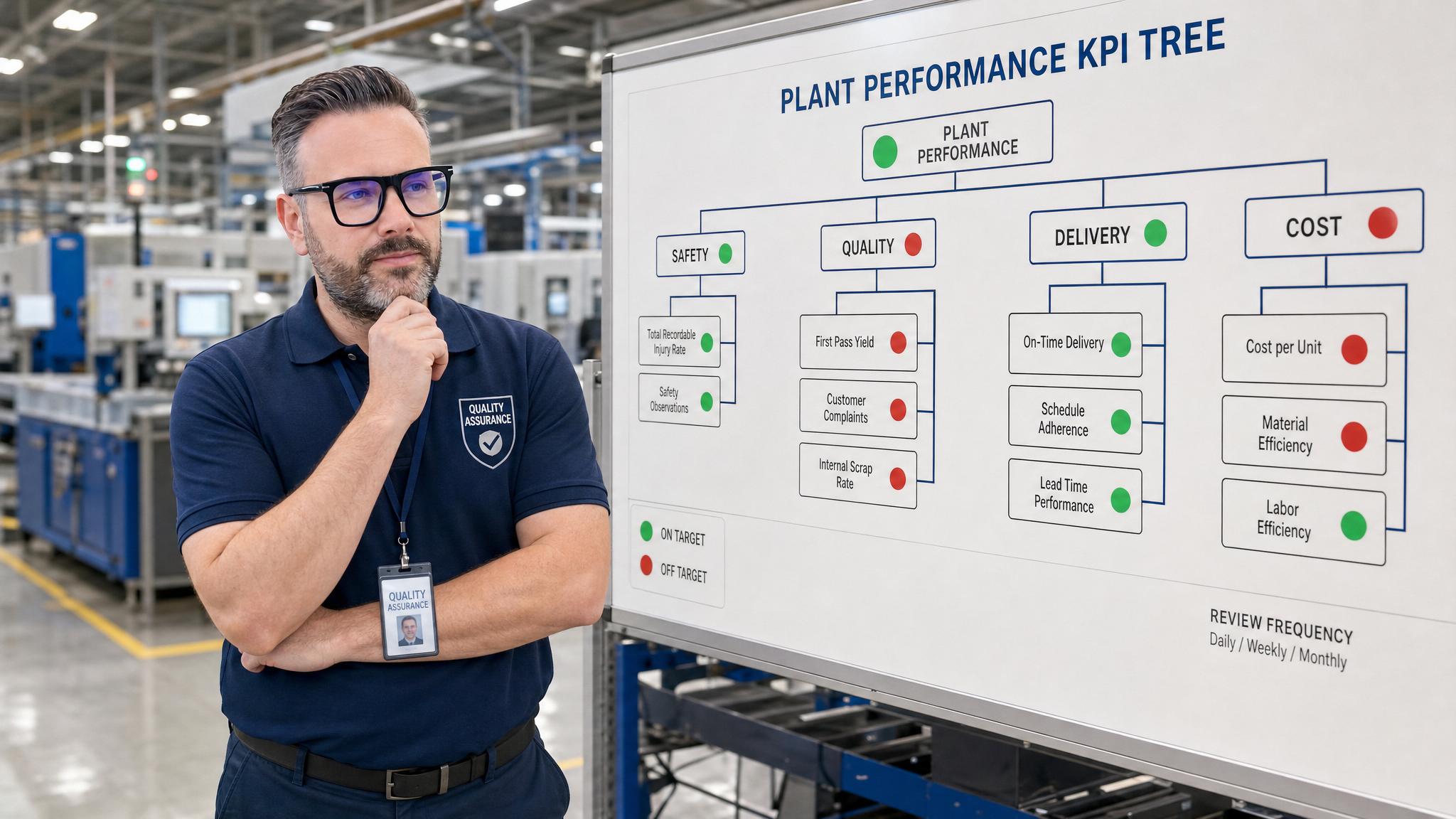
A Quality KPI Tree solves this by defining explicit parent-child relationships between metrics. It starts with strategic outcome indicators and cascades them down through tactical and operational layers until it reaches individual process parameters that a machine operator can adjust in real time. This structure transforms abstract quality reporting into a direct control mechanism.
Why Inherited Metrics Fail
Most quality departments did not architect their KPI structure. They accumulated it over years of customer audits, certification requirements, and internal reactive problem-solving. A typical plant tracks 40 to 60 separate quality metrics across different departments, most of which overlap, contradict each other, or measure activity rather than outcome.
The core failure is ownership gaps. A plant manager tracks scrap cost in euros. A line supervisor tracks scrap weight in kilograms. An operator tracks reject count in pieces. These are three views of the same manufacturing loss event, but without a mapped relationship, they function as three disconnected data silos. Nobody can trace how the operator's piece count rolls up into the plant's financial loss.
A KPI Tree forces you to resolve these disconnects during construction. You cannot place a metric on the tree without defining its parent, its children, and its owner. This structural requirement alone eliminates the orphan metrics, the duplicated counts, and the vanity indicators that consume reporting bandwidth without driving any corrective action.
The Four Levels of a Manufacturing KPI Tree
A functional KPI Tree in an IATF 16949 or AS9100 environment typically runs to four levels. The first level captures strategic outcome metrics: external PPM, warranty cost as a percentage of revenue, and overall quality cost. These are the indicators reported to leadership and tracked during management review.

The second level decomposes those strategic targets into tactical metrics. External PPM breaks down into internal scrap rate, customer rejection rate at incoming inspection, and field failure rate. The third level gets operational: customer rejection rate decomposes into outgoing inspection escape rate, dimensional nonconformance rate, and surface defect rate.
The fourth level is where the tree touches the production floor. Surface defect rate decomposes into specific, controllable process parameters: surface roughness measured as an Ra value on the profilometer every 50 parts, coolant concentration checked twice per shift, tool wear tracked via spindle load monitoring, and fixture clamping force verified at changeover.
Applying MECE to Quality Decomposition
At each branch of the tree, the decomposition must be Mutually Exclusive and Collectively Exhaustive. Borrowed from structured problem-solving methodologies, this rule ensures that child metrics do not overlap and together fully account for the parent metric. Without MECE, the tree develops gaps and leaks that destroy its analytical value.
Consider scrap rate decomposition. If you break it down into dimensional scrap and surface defect scrap but omit material nonconformance scrap, the tree has a gap. The numbers will never reconcile to the total. If you classify a part with both a dimensional and surface defect in both categories, the tree has a leak. The metrics overlap, and improvement actions get double-counted.
The MECE test also exposes vanity metrics that do not drive the parent outcome. Tracking the number of 8D corrective actions issued is a bureaucracy counter. Tracking the number of 8Ds effectively implemented and verified within the target cycle is an improvement driver. The tree forces you to keep the latter and discard the former.
The Four-Level KPI Decomposition
- 011. Strategic LevelExternal PPM, warranty cost, overall quality cost. Owned by the Quality Director.
- 022. Tactical LevelInternal scrap rate, customer rejection rate, field failure rate. Owned by Quality Managers.
- 033. Operational LevelDimensional nonconformance, surface defect rate, inspection escape rate. Owned by Quality Engineers.
- 044. Process ParametersRa value, coolant concentration, tool wear, clamping force. Owned by Operators.
Mandatory Ownership and Directional Logic
Every node on the tree must have a single accountable owner responsible for both reporting and acting on the metric. Strategic nodes belong to the Quality Director. Tactical nodes belong to Quality Managers. Operational nodes belong to Quality Engineers and Production Supervisors. Process parameters belong to Operators and Line Technicians.
If you cannot assign an owner, the metric is either too broad or irrelevant. Keep decomposing it until a single person or role can take action on it. A metric without an owner is an orphan. It will not be measured consistently, it will not trigger corrective action, and it will eventually be dropped from reporting altogether.
Every parent-child relationship must also be directional. You must be able to state the causal mechanism clearly: if the child metric improves, the parent metric will improve. If you cannot make that statement with confidence, the relationship is either wrong or the metric is a correlated bystander rather than a causal driver.
Prioritising Leading Indicators at the Base
At the top of the tree, lagging outcome metrics are appropriate. They tell you where the organisation stands against customer expectations and regulatory requirements. But as you cascade downward, the balance must shift toward leading indicators and process parameters that predict outcomes before they occur.
This is the critical distinction between reactive and preventive quality management. By the time a field failure rate registers at the strategic level, the defective parts are already in the customer's hands. By the time surface defect rate registers at the operational level, the parts are already scrapped. The further down the tree you monitor, the earlier you detect the deviation.
Surface roughness is a leading indicator of surface defects. Coolant concentration is a leading indicator of surface roughness. The further down you go, the further ahead you can see.
This principle dictates how you allocate measurement resources. The lowest nodes on your tree should be the ones you check most frequently. You verify coolant concentration and tool wear every shift because they predict the surface finish. You calculate field failure rate monthly because it is a lagging confirmation of what your process parameters already told you weeks ago.
Common Structural Failures in Deployment
The most common deployment failure is the Phantom Tree. The organisation builds a comprehensive KPI Tree, presents it at a management review, prints it on a large format poster for the quality department wall, and then proceeds to ignore it entirely. Metrics continue to be reported in silos and decisions continue to be made on instinct.
The antidote is to embed the tree into the daily and monthly operating rhythm. Start every quality review by walking through the top-level nodes. When a strategic metric deviates, trace it downward through the tree to identify the specific operational or process driver. Make the tree the mandatory diagnostic pathway, not an optional reference chart.
The second failure is over-engineering. Some organisations build trees that go seven or eight levels deep, generating hundreds of leaf nodes that require a database administrator to maintain. Three to four levels is sufficient for most manufacturing operations. If you need software to navigate your own metric structure, you have lost the diagnostic clarity the tree was meant to provide.
Static Dashboard vs. Live KPI Tree
Flat dashboard approach
- Management notes customer PPM is trending upward.
- Quality team launches a broad investigation across all processes.
- Root cause analysis takes days of data mining and cross-departmental meetings.
- Corrective action is reactive and delayed.
KPI Tree diagnostic approach
- Management notes customer PPM deviation on the top node.
- Analyst drills down to tactical level to identify the specific driver.
- Path leads directly to a shifted process parameter at level four.
- Operator receives immediate notification to adjust the parameter.
Sustaining the Tree Through Audits and Digital Integration
A KPI Tree is one of the most effective tools for navigating external audits. When a VDA 6.3 auditor or an IATF 16949 customer representative asks how you ensure quality performance at the process level, you do not hand them a stack of control plans and hope they find the connection. You show them the tree and trace the explicit path from their specific requirement down to the process parameter that controls it.
The tree serves the same function for internal onboarding. Instead of handing a new quality engineer a 40-page metrics manual and expecting them to reverse-engineer the relationships, you provide the tree. They see exactly how the quality system is connected, where their responsibilities sit, and why their specific operational metrics matter to the strategic outcome.
Modern QMS platforms can digitise the tree, rendering each node green, yellow, or red based on real-time data feeds. When a top-level node turns red, you click through the hierarchy to find the specific process parameter that has drifted out of range. The technology is available, but it requires the logical architecture first. You cannot digitise a tree you have not built.
Schedule a formal review of the tree every six months. Processes change, equipment is replaced, and customer requirements shift. A tree that perfectly described the manufacturing reality eighteen months ago may now point to obsolete metrics and miss critical new drivers. Treat the tree as a living document that evolves with the production system it describes.