
A Space Shuttle launch cost approximately $1.5 billion. The James Webb Space Telescope carried a $10 billion price tag and exactly zero opportunity for a service visit. When the payload fairing closes, there is no rework loop, no warranty claim, and no second shift. There is only the physics of launch and the expectation that millions of parts, welds, and lines of code will perform exactly as specified.
The space industry succeeds because it builds quality systems that treat every failure mode as an existential threat. Manufacturing organizations face different consequences. A defective automotive part triggers a recall. A nonconforming batch triggers SCAR and containment. These outcomes are serious, but they unfold over time, offering opportunities for detection and correction. In aerospace, the feedback loop between error and consequence is measured in milliseconds.
The gap between good enough for Earth and good enough for orbit reveals where most quality systems rely on luck. Having implemented and transitioned AS9100 and IATF 16949 systems, I have seen how automotive and aerospace requirements overlap in theory but diverge in practice. The principles of mission assurance scale. The mindset transfers. Applying them requires shifting from compliance documentation to systemic risk elimination.
Root Cause Analysis as Forensic Investigation
When the Mars Climate Orbiter disintegrated in the Martian atmosphere in 1999, the root cause was a unit conversion error. One engineering team used metric units while another used imperial. A spacecraft worth $327 million was destroyed by a discrepancy that a first-year engineering student should have caught. NASA's response was not to add another inspection step. It was to fundamentally examine how interfaces between teams are managed and how requirements are verified.
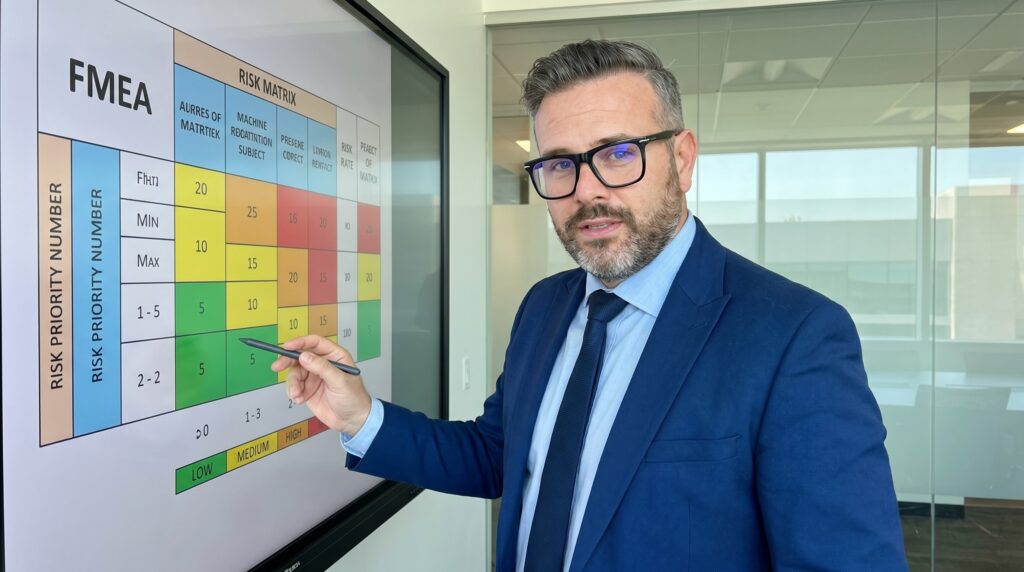
The resulting Failure Mode and Effects Analysis (FMEA) was a forensic investigation that produced systemic changes across every subsequent mission. In manufacturing, root cause analysis too often becomes root blame analysis. A defect occurs, an operator is held responsible, a corrective action is written, and the form is filed. The space industry treats every failure, near-miss, and anomaly as data. Nothing is dismissed as human error without asking what system allowed the human to err.
When your last defect occurred, did you change the process or retrain the person? If you simply retrained the person, you addressed the symptom. The underlying PFMEA and control plan remained untouched. A systemic approach asks what specific process design made the defect possible, and what engineered control eliminates that possibility permanently. Effective 8D methodology requires this depth. Closing an 8D with retraining as the primary corrective action is an admission that the root cause remains unaddressed.
I have audited plants that proudly showed me stacks of completed 8D reports where every single corrective action was retrain operator or remind operator to follow instructions. This is quality theatre. The space industry would reject this approach outright. They would demand to know why the system permitted the error and what interlocks now prevent it.
Engineering Out Single Points of Failure
Space vehicles are engineered with layered redundancy. The Space Shuttle had five general-purpose computers. Four ran identical software, while the fifth ran a completely independent software implementation developed by a different team. This ensured that a single software bug could not take down all five systems. This architecture was a practical recognition that any single point of failure in a complex system will eventually fail.
Manufacturing organizations frequently treat redundancy as operational waste. Management questions why two people must verify a safety-critical torque value or why a secondary containment is necessary when the primary control achieves 99.9% reliability. A process operating at 99.9% yields one failure per thousand units. In a plant running a thousand units daily, that is a guaranteed daily defect. In aerospace, that constitutes a lost mission.
Map your single points of failure using PFMEA. Sit down with your process and ask what happens if a specific sensor, fixture, or inspection point fails. If the answer is that a critical-to-quality characteristic reaches the customer, you need engineered redundancy. This is not a reflection of operator incompetence. Competent people working in inadequate systems will still produce nonconformances. Redundancy is the engineered barrier that compensates for inevitable human variation.
Fault tolerance in manufacturing versus aerospace
Typical manufacturing approach
- Single-point inspection relying on operator vigilance
- Corrective action focused on retraining the individual
- Validation under ideal ambient conditions
- Documentation treated as auditor compliance
Aerospace mission assurance
- Layered interlocks and independent verification
- Corrective action targeting the system interface
- Validation at operational environmental extremes
- Documentation treated as the product itself
Traceability as a Product Feature
In aerospace, documentation is not administrative overhead. Every weld on a pressure vessel is recorded. Every torque value on every fastener is documented. Every material certificate, test result, and deviation disposition lives in a traceability chain that can be reconstructed years later. The product cannot be accepted without the documentation. The paperwork is the product.
When the Columbia Accident Investigation Board convened in 2003, they traced the fatal foam strike back through organizational decisions, schedule pressures, and normalized deviance. The paperwork did not prevent the disaster, but it made the investigation possible. Manufacturing organizations frequently treat documentation as a compliance burden. Operators fill out the form because the ISO 9001 auditor expects it, not because the data has operational value.
Your quality records are not for the auditor. They are for the engineer who needs to understand why a lot failed in the field six months from now. Every time an operator shortcuts a record because it is just paperwork, they destroy evidence. Without a complete traceability matrix linking material batches, machine parameters, and operator shifts to a specific serial number, containment becomes guesswork. Treat the record as part of the product specification.
Test Like You Fly: Validation Under Realistic Conditions
Test like you fly, fly like you test is a foundational aerospace principle. Validation conditions must mirror operational conditions. The Apollo 1 fire killed three astronauts during a ground test because the cabin was pressurized with pure oxygen. This was a test condition that would not exist during actual flight, but it was used to simulate differential pressure. The test environment did not match the flight environment, and the crew paid the ultimate price.
Space programs obsessively recreate operational environments using thermal vacuum chambers, vibration tables, and electromagnetic compatibility testing. Manufacturing organizations routinely validate processes under laboratory conditions. A process validated at 22 degrees Celsius by an experienced technician during first shift behaves differently at 28 degrees with a new operator on third shift. The PPAP submission looked flawless, but production reality introduced variables the validation never accounted for.
Your validation protocols must stress your process the way production will stress it. Run Measurement System Analysis (MSA) and capability studies at the edges of your material specifications. Test with your least experienced operators. Conduct capability studies during shift changes and when preventive maintenance is overdue. If your Cpk only holds under controlled laboratory conditions, you do not have a production process. You have an experiment waiting for variables to align against you.
Institutional Authority Over Hierarchy
In aerospace launch culture, speak-up is institutionalized authority. NASA's pre-launch Go/No-Go poll gives every station explicit veto power. A weather officer, a range safety officer, or a propulsion engineer can say No-Go and the launch stops. There is no management override. This protocol exists because the Challenger disaster in 1986 demonstrated what happens when engineering concerns are silenced by schedule pressure. The Rogers Commission found that the information regarding O-ring degradation in cold temperatures was available, but the organizational culture silenced the warning.
A culture that punishes the messenger will eventually be blindsided by the message.
Manufacturing plants routinely create conditions where shop floor operators detect anomalies but do not escalate them. A machine operator hears an unusual vibration but chooses not to submit a maintenance request because the last three were ignored. A quality technician notices a dimensional drift but does not initiate containment because slowing the line generates friction with production management. The organization systematically disables its own early warning sensors through social pressure.
Build a system where the newest operator can stop the line based on a documented deviation, and where that decision is treated as a contribution rather than an interruption. Management must be required to escalate and reward these interventions, not quietly discourage them to protect OEE metrics. If your production metrics incentivize running nonconforming product, your performance management system is generating defects on purpose.
Configuration Management and Process Coherence
When SpaceX rapidly iterates on rocket designs, they can do so safely because they maintain strict configuration management. Every revision is tracked. Every change is evaluated for its impact on interfacing systems. The bill of materials and the work instructions are living documents that reflect the exact reality of what was built. Without this discipline, rapid iteration collapses into chaos.
In manufacturing, configuration drift is endemic. The standard work instruction specifies one torque setting, the fixture is configured for another, and the operator has developed a personal method that differs from both. Over months, the documented AS9100 or IATF 16949 system and the actual floor process diverge entirely. When an auditor finally visits, nobody can explain the discrepancy.
If you cannot describe exactly what is happening on your floor right now, you do not have control of your process. Configuration management is the difference between managing a production system and hoping it functions adequately. Implement strict engineering change control. Lock your work instructions to specific revisions. Audit the actual floor practices against the documented control plans weekly, not annually.
Translating mission assurance to the production floor
- 01Map failure modesIdentify single points of failure using PFMEA and link them to customer impact severity.
- 02Engineer interlocksImplement layered redundancy or mistake-proofing rather than relying on operator vigilance.
- 03Validate at extremesRun capability and MSA studies under worst-case environmental and staffing conditions.
- 04Enforce traceabilityTreat quality records as product features, linking every parameter to a specific serial number.
- 05Protect the signalGrant shop floor personnel the explicit authority to stop the line without managerial override.
Culture as the Ultimate Quality System
Every aerospace prime contractor has voluminous quality manuals spanning thousands of procedures. Yet when you study the major failures, the root cause is never that the procedure was technically inadequate. The root cause is invariably that the organizational culture allowed the procedure to be bypassed, ignored, or marginalized. Schedule pressure, cost overruns, and normalized deviance override the documented system.
This is the most critical lesson for manufacturing leaders. It is entirely possible to maintain a technically perfect IATF 16949 system on paper and still produce systemic defects. The quality management system does not run the process. People run the process. People are governed by the operational culture, which either rewards rigorous adherence to standards or implicitly celebrates production shortcuts.
Quality is not a departmental function. It is an operational property of the organization. The space industry learned these principles through catastrophic failures that cost lives and billions of dollars. Manufacturers have the advantage of applying these lessons without paying the original price. Your factory floor is not a launch pad, but every defect that reaches your customer represents a failure of the system you built to prevent it.