
Manufacturing customers rarely leave over a single dramatic failure. They leave over an accumulation of minor, undocumented friction. By the time your sales team notices a volume drop, the relationship is already damaged beyond the reach of a corrective action.
The events that erode trust happen daily and remain invisible to your dashboards. Three deliveries arriving late by a few hours, a dimension drifting to the edge of tolerance, or a phone call returned a day late. None trigger a formal escalation against your ISO 9001 system. All register firmly on the customer's mental scoreboard.
Your certificate and your Cpk values do not build loyalty. Customers evaluate you on the cumulative experience of interacting with your quality system. When that experience consistently builds trust, you gain a partner. When it erodes trust, you lose an account.
Defining Loyalty Beyond Price and Inertia
Customer loyalty is not securing orders because you are the cheapest supplier. That is price captivity, and it vanishes the moment a competitor undercuts you by two percent. Loyalty is also not keeping business because switching suppliers requires significant effort. That is operational inertia, and it always has an expiration date.
True loyalty in manufacturing is when a customer chooses you despite a competitive alternative. It is when they give you the benefit of the doubt during a supply disruption. It is when they involve you earlier in their APQP process because they trust your engineering judgment, not just your production capacity.
In most organisations, the quality department touches more customer-facing moments than any other function. Inspection reports, PPAP packages, 8D responses, and audit readiness are all relationship-defining events. Your quality system must treat these interactions as primary drivers of customer retention, not administrative overhead.
The Architecture of Trust in Manufacturing
Trust is built by a pattern of small, consistent behaviours that create predictability. The foundation is proactive communication. The trusted supplier calls before the customer needs to call them. When a dimension trends toward the limit, they do not wait for a failure. They notify the customer, explain the situation, and present the corrective action.
Consistency in small details matters more than perfection in major deliverables. Customers expect reliable predictability over impossible perfection. If your documentation is complete, your packaging is stable, and your inspection reports arrive on time, you build a foundation that survives an occasional quality escape.
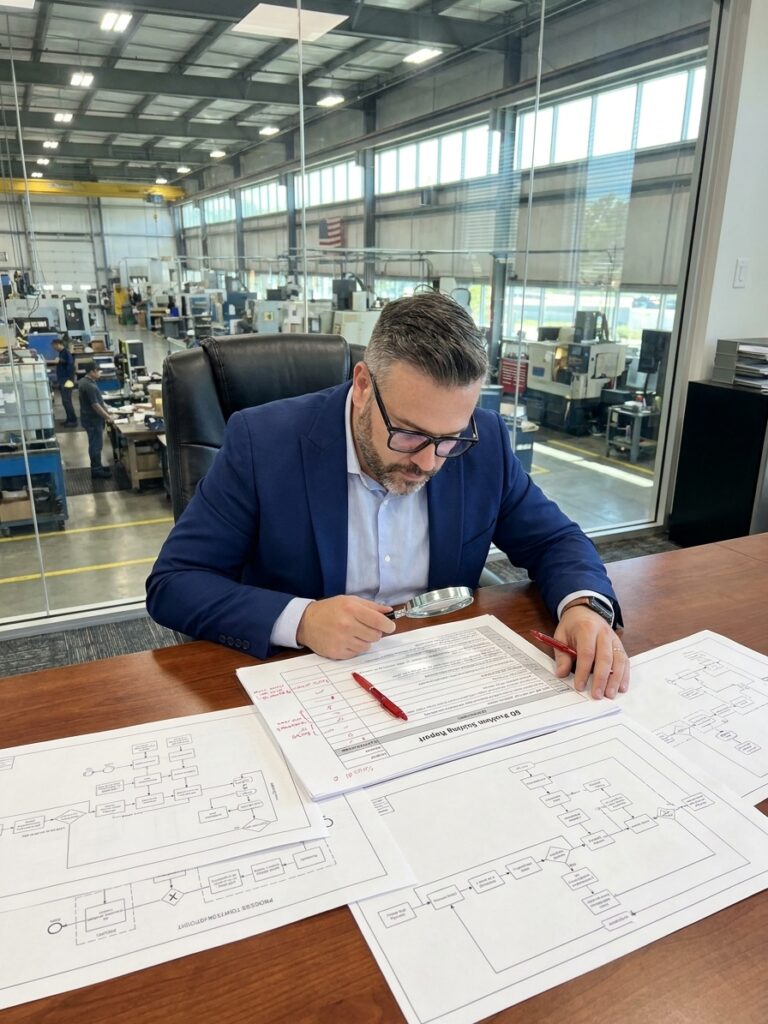
How you handle failures defines the relationship more than how you handle successes. The difference between losing a customer and strengthening a bond is the speed and transparency of your response. A thorough 8D report delivered in 48 hours makes the customer feel respected. A generic form citing operator error and retraining, delivered three weeks late, makes them feel insulted.
Compliance-Driven vs Loyalty-Centered Quality
Compliance-Driven Approach
- Asks: Does this meet the minimum requirement?
- Sends pass/fail inspection data without trend context.
- Notifies customer of changes only when contractually required.
- Treats customer concerns as formal bureaucratic processes.
Loyalty-Centered Approach
- Asks: Does this make the customer want to stay?
- Includes trend data and engineer commentary on reports.
- Proactively communicates all process and material changes.
- Initiates a phone call to address concerns before sending forms.
Loyalty Killers Your Quality Dashboard Misses
A slow process drift is a primary loyalty killer. Your process is in control, your Cpk is above 1.33, but your mean shifts toward the lower specification limit for six months. You remain within tolerance, so your system shows green. But the customer's incoming inspection flags the trend. They see a supplier who is not watching their own process.
Unacknowledged changes destroy trust rapidly. You change a raw material supplier or adjust a heat treatment parameter without notifying the customer. The product still meets specification, so you bypass communication. The customer always finds out. What they learn is not just that you changed a variable, but that you withheld critical information.
Bureaucratic responses to minor concerns ensure customers stop communicating. A customer reports a cosmetic observation and receives a formal corrective action request form demanding extensive data. What they wanted was a conversation. What they got was a rigid procedure. Next time, they will not bother telling you.
Binary pass/fail reporting hides critical context. Your inspection report states a dimension is 12.45 mm against a specification of 12.40 to 12.60 mm. What it hides is that the dimension was 12.42 mm three months ago. The pass result masks a process walking toward a cliff. Your customer wants to see the trajectory, not just the final destination.
Building a Loyalty-Centered Quality System
Transitioning to a loyalty-centered system requires asking a fundamentally different question during management reviews. Instead of asking if a deliverable meets the requirement, ask if the deliverable makes the customer want to keep doing business with you. This shift changes how you format data, how you structure your PPAP submissions, and how you manage routine communications.
Redesign your inspection reporting to eliminate the binary pass/fail blind spot. Include trend data and context on every batch. Add a one-line summary from the quality engineer: process stable, no action required, or minor trend noted, monitoring increased. Provide the information the customer would want if they were standing next to your machine.
Elevate your corrective action response from a form to a relationship moment. When a customer reports a concern, the first response must be a phone call, not an automated email. Acknowledge the concern, ask clarifying questions, and commit to a timeline. Formal 8D documentation follows, but human connection comes first.
Institute a quarterly customer experience review. Sit down with the full picture of a key account's interactions. Examine late shipments, communication gaps, unaddressed data trends, and uncommunicated process changes. Produce a short, honest assessment and one action item to address a concern the customer has not voiced yet.
The Loyalty-Centered Corrective Action Response
- 01Initiate voice contactA quality engineer calls the customer immediately to acknowledge the concern and ask clarifying questions.
- 02Define containmentAgree on immediate sorting or replacement actions to protect the customer's assembly line.
- 03Commit to timelineProvide a clear schedule for the formal root cause analysis and interim updates.
- 04Deliver transparent 8DSubmit the formal documentation early, demonstrating genuine root cause analysis rather than generic operator retraining.
The Economics of Customer Retention
Acquiring a new manufacturing customer costs significantly more than retaining an existing one. The financial drain appears in quoting, sampling, PPAP development, first article inspections, and the steep learning curve of a new relationship. Losing an account to a quality-perception problem wastes your original acquisition investment.
Loyal customers provide a larger share of wallet. When a customer trusts your quality system, they consolidate volume and move additional part numbers to your floor. They involve you in new development programs earlier. A satisfied customer gives you their current business. A loyal customer gives you their future business.
Disengaged customers say nothing until they are gone. Loyal customers provide critical, early feedback. They tell you about minor problems when they are inexpensive to fix. They share development roadmaps so you can prepare your capacity. The cost difference between a collaborative problem-resolution process and a defensive one is enormous.
Redefining the Quality Professional's Mandate
Ensuring compliance is the minimum baseline of a quality professional's role. The actual mandate is to ensure that every interaction your quality system has with a customer builds trust rather than depleting it. You must think like a relationship architect, not just a technical auditor chained to an IATF 16949 checklist.
This means evaluating your deliverables through the customer's lens. Ask not just if the product is in spec, but if the customer would feel confident seeing your raw data. Ask not just if you responded within the required timeline, but if the customer felt heard during the exchange. Transparency is not a risk to be managed. It is the primary asset that retains manufacturing customers.
I have audited plants that excelled technically but failed commercially because their quality system was entirely self-referential.
They met the standard but ignored the human experience. The professionals who succeed are those who align their rigorous data with proactive, transparent communication. They treat every 8D, every PPAP, and every deviation report as a chance to demonstrate competence and respect for the customer's process.
Start tomorrow morning with your most important customer. Pull every inspection report, corrective action, and delivery record from the last twelve months. Review them not through your internal metrics, but through the customer's eyes. Make one process improvement. Loyalty-centered quality begins when you prioritise the relationship over the checkbox.