
Manufacturing engineers know the routine. The production board ticks upward, cycles per hour look strong, and the takt time is consistently met. Customer orders ship on time, and overall equipment effectiveness (OEE) remains green. The line appears perfectly balanced on paper, operating exactly as the time study intended.
Then you examine the defect Pareto. The same three stations keep surfacing month after month. You initiate Kaizen events, retrain operators, and tighten tolerances. You add supplementary inspection points and implement new error-proofing. Despite these targeted interventions, the defects persist.
The root cause is rarely operator error or a flawed PFMEA. The problem is the line balance itself. Line balancing is universally treated as a productivity tool designed to distribute work evenly and eliminate idle time. Rarely do organisations analyse what happens to quality when a line is imbalanced.
Line Balancing Beyond the Textbook
Standard line balancing distributes total work content across workstations so that each cycle time approaches takt time without exceeding it. The objective is mathematical: eliminate idle time, minimise station count, and keep the line flowing. You calculate takt time, break the work into elements, sequence them logically, and assign them to stations.
This textbook approach treats every work element as a binary operation: done or not done. It fails to account for cognitive load, variability in task difficulty, or human factors. A station loaded to 95 per cent utilisation performing high-precision tasks will yield entirely different quality outcomes than a station at 95 per cent utilisation doing simple, repetitive work.
Line balancing for productivity asks whether each station can finish its work within takt time. Line balancing for quality asks whether each operator can perform their work correctly, consistently, and without cognitive overload, cycle after cycle. Answering only the first question guarantees a line that looks efficient but actively generates defects.
The Mechanics of Imbalance
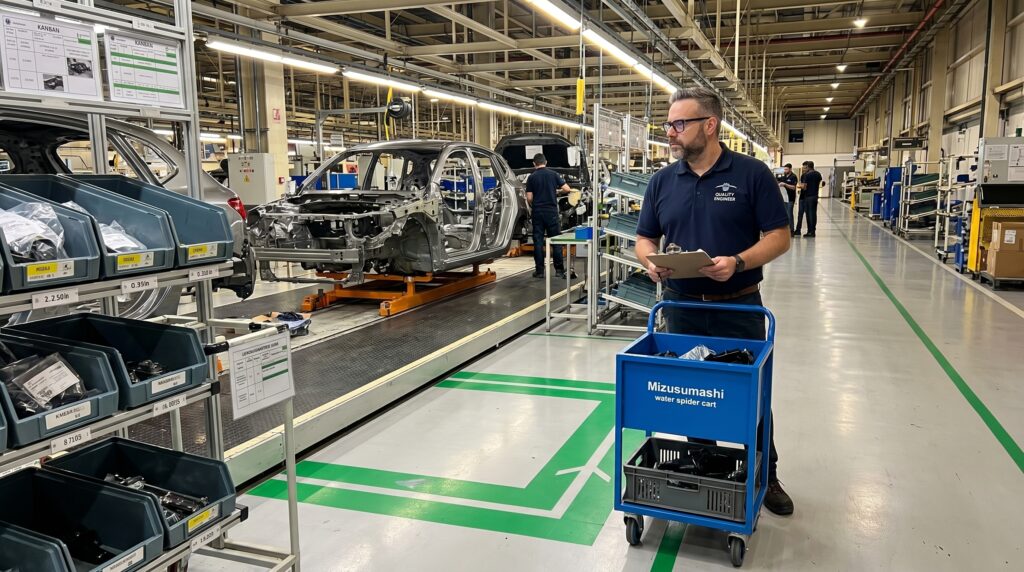
Imbalanced lines create predictable failure modes. The most common is the Rush Station, loaded to 98 or 99 per cent of takt time. The operator races every cycle with zero margin for error. They subconsciously cut micro-corners to maintain pace. A torque check that requires three seconds gets two. A visual scan of five features becomes a cursory glance.
These micro-shortcuts compound across a shift. When you investigate the resulting defects, they present as classic operator error. You issue an 8D corrective action and retrain the operator, but the defects return. The actual root cause was a station that systematically denied the operator enough time to execute the standard work.
The Boredom Station presents the opposite hazard. Loaded to perhaps 40 per cent of takt time, the operator finishes in seconds and waits. This is a severe quality problem. Long idle gaps destroy rhythm and degrade muscle memory. When the next part arrives, the operator's attention has drifted, resulting in misaligned components and incomplete verification.
Further down the line, the Bottleneck Buffer Trap decimates feedback loops. Upstream stations build work-in-process (WIP) inventory before the bottleneck. If a part was defective two stations ago, the defect is buried in the buffer for minutes or hours. The feedback loop between cause and effect is broken, making containment expensive and root cause identification significantly harder.
Hidden Consolidation and Skill Concentration
Balancing a line purely on time often forces incompatible tasks together. A station might require fine motor precision, such as placing a delicate seal, immediately followed by a gross motor task like torquing a large bolt. The operator must shift cognitive and physical modes dramatically within the same cycle. This switching cost is invisible in time studies.
An operator who just performed a heavy torque operation does not instantly transition to delicate precision. Their grip remains firm, and their touch is too rough. The micro-defects introduced here escape standard visual inspection but accumulate over the product's service life, leading to warranty claims.
Conventional balancing also concentrates complex tasks at the fewest stations to minimise the need for highly skilled operators. This creates single points of failure for quality. When one skilled operator suffers from fatigue or mild illness, the defect rate spikes because the consolidated tasks are unforgiving. A well-balanced line distributes complexity, building systemic resilience.
Productivity Balancing vs. Quality Balancing
Productivity-focused balancing
- Targets maximum cycle time utilisation
- Ignores cognitive switching costs
- Concentrates complexity at minimal stations
- Relies on end-of-line inspection
Quality-focused balancing
- Targets sustainable operator rhythm
- Groups tasks by natural mental flow
- Distributes precision work evenly
- Embeds verification into the process
Building a Quality-Focused Balancing Framework
Diagnosis must lead to treatment. Traditional time studies measure how long a task takes. Quality-weighted time studies measure how long a task takes when performed correctly, with built-in quality checks. This requires documenting standard cycle time, verification time, historical defect frequency, and severity for every work element.
Calculate a Quality-Adjusted Cycle Time (QACT) using your historical data. Multiply the standard time by one plus the product of the defect rate and the defect cost multiplier. This metric transforms line balancing from a pure productivity exercise into a quality-aware optimisation. Stations with high historical defect rates automatically receive more allocated time.
Alongside QACT, conduct cognitive load mapping. Score every station on memory load, precision demand, decision complexity, sensory demand, and interruption vulnerability. Establish a strict rule: no station should have a cognitive load total more than 20 per cent above or below the line average. This prevents both Rush and Boredom stations.
The Quality-Driven Rebalancing Sequence
- 01Quality-Weighted StudiesIncorporate verification times and defect rates into baseline cycle times.
- 02Cognitive Load MappingScore stations on precision, memory, and decision complexity.
- 03Task SequencingGroup preparation, execution, and verification phases naturally.
- 04Quality BuffersIntentionally design small time windows for self-inspection and reset.
- 05Dynamic MonitoringAudit defect data monthly and adjust assignments quarterly.
Task Sequencing and Quality Buffers
When reassigning work elements, group tasks by the natural flow of operator attention rather than simple tooling proximity. Cluster preparation tasks like selecting and orienting, execution tasks like fastening and connecting, and verification tasks together. This creates a predictable rhythm: set up, execute, verify.
Operators develop a consistent mental pattern that supports quality subconsciously, much like an aerospace pre-flight checklist. Structure reduces errors not by adding steps, but by organising them to match human cognitive behaviour. Disrupting this flow with random task assignments guarantees intermittent defects.
Instead of allowing WIP inventory to accumulate between imbalanced stations, build intentional quality buffers into the standard work. Designate small time windows for self-inspection, error-proofing verification, and mental resetting between cycles. These are not idle moments; they are active quality controls that are exponentially cheaper than downstream rework.
The Financial Case for Rebalancing
Quality arguments require financial translation. I have audited automotive assembly lines producing 400 units per shift where three stations contributed 65 per cent of all defects. Investigation revealed a rush station at 99 per cent takt, a boredom station at 35 per cent, and a bottleneck creating a 15-minute WIP buffer.
You cannot inspect your way out of a systemic quality problem, but you can balance your way out of one.
In that scenario, the internal scrap cost was 180,000 dollars monthly, with rework adding another 95,000 dollars. Customer complaints triggered warranty costs of over 15,000 dollars per month. The total monthly quality cost directly attributable to these imbalanced stations was approximately 290,000 dollars.
The cost of rebalancing the line included 40 hours of engineering time, 16 hours of operator retraining, and one shift of temporary production loss. The total one-time investment was roughly 75,000 dollars. The payback period was less than three weeks, and defect rates at the problematic stations dropped by over 50 per cent without adding new inspection tools.
Sustaining the Balance
A perfectly balanced line will drift. Products evolve, operators develop new skills, and equipment ages. Without active monitoring, a line balanced for quality today will become imbalanced within six months. Establishing a monthly review cycle is critical to maintaining the gains achieved through rebalancing.
Pull defect data by station for the past 30 days and compare it against the previous period. Flag any station where defects increased by more than 20 per cent. Investigate whether the increase correlates with workload changes, operator turnover, or subtle shifts in cycle times. Adjust station assignments quarterly based on this hard data.
Dynamic rebalancing is a management discipline, not a one-time project. Organisations that monitor and adjust their lines consistently see defect rates decline year over year. They are not constantly adding quality tools; they are maintaining the foundational conditions that make quality possible.
Rebalancing a line for quality requires leadership courage. Short-term throughput numbers may dip temporarily. Operations managers will push back. But a line producing fewer defect-free units is infinitely more profitable than a high-speed line generating scrap. The best quality system cannot overcome a poorly balanced line. Fix the foundation first.