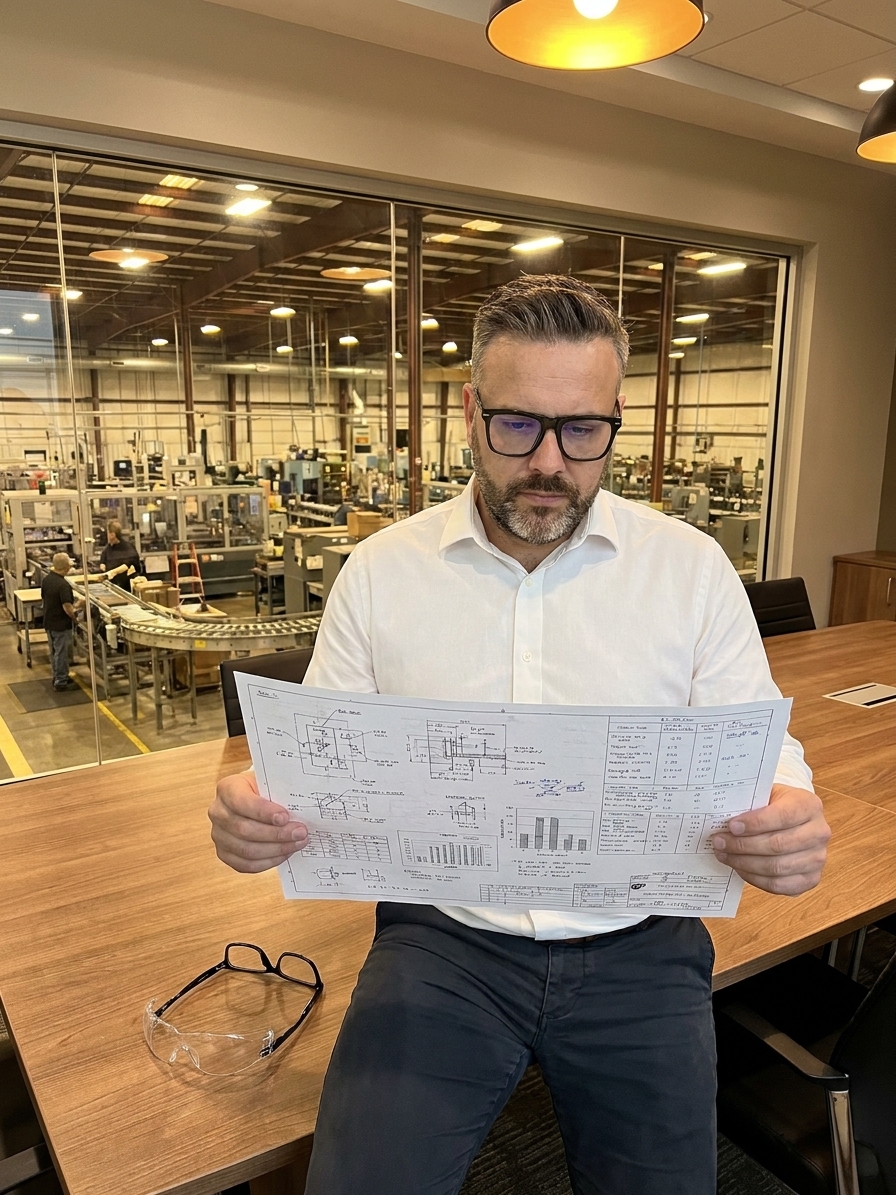
I have audited countless plants where an 8D investigation or CAPA is presented in a forty-slide deck. The team wastes hours formatting organisational charts, arguing over fonts, and building timelines. The core logic of the corrective action gets buried. When the customer follows up three weeks later with the exact same defect on a different batch, everyone is surprised.
The failure was not in the technical competence of the engineering team, but in their methodology. They confused presenting data with solving the problem. A high-volume automotive line or an aerospace assembly cell generates thousands of data points. Without a ruthless mechanism to distil that data into actionable logic, teams default to firefighting.
A3 Thinking solves this. Originating at Toyota, it is a structured problem-solving methodology that forces an engineer to map the entire logic of an issue onto a single sheet of paper. It demands data over opinion. It requires linking root causes directly to targeted countermeasures. It replaces the slide deck with a disciplined thinking process.
The Architecture of an A3 in Quality Management
An A3 is not a blank piece of paper. It is a highly structured template divided into specific sections that follow the Plan-Do-Check-Act (PDCA) cycle. Each section forces a particular type of analytical rigour. Skipping a section breaks the logical chain and guarantees an incomplete corrective action.
The left side handles the Plan. It demands a business case, a data-driven current condition, a specific target, and a deep root cause analysis. The right side handles Do, Check, and Act. It requires a concrete implementation plan with named owners, verification metrics, and standardisation steps. The constraint of fitting this onto one page forces absolute clarity.
In my experience transitioning quality systems at SNOP and a major aerospace manufacturer, the discipline of the A3 format eliminates ambiguity. When a team is forced to draw a value stream map or plot Cpk data by hand in a small box, they immediately see what information they actually have versus what they are guessing at. The format exposes intellectual laziness.
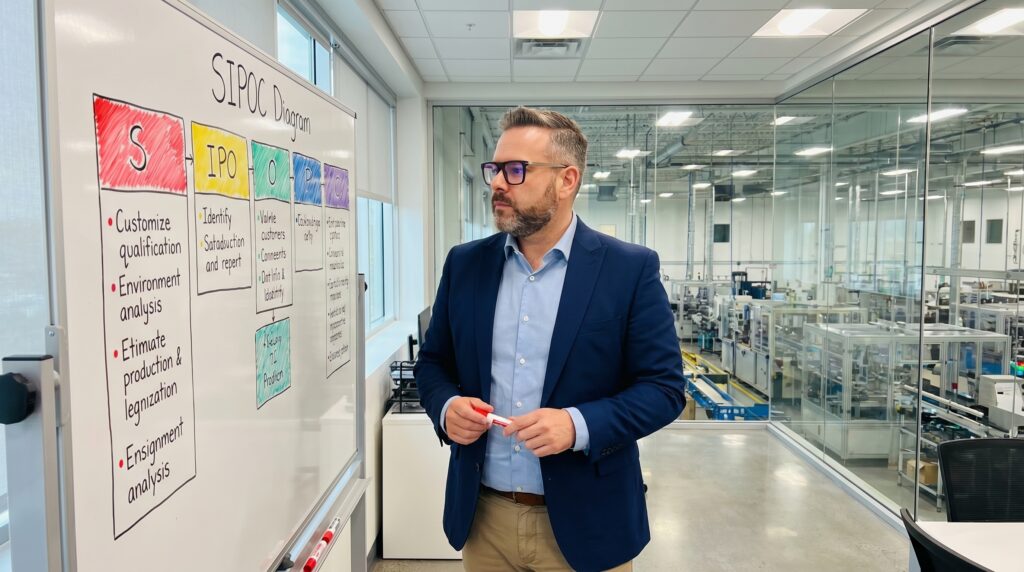
Current Condition: Go to Gemba, Ignore the Visio Diagrams
The current condition section is where most problem-solving efforts fail. Engineers sit in conference rooms and theorise about machine capability. They rely on anecdotal reports from supervisors. A proper A3 demands a precise, quantified reality plotted over time. You need to show scatter plots, control charts, or Pareto analyses of the actual defects.
Go to the actual workplace. In automotive stamping or aerospace machining, the reality of the process is never fully captured in a SAP notification. Stand at the line, watch the cycle, and measure the variation. A hand-drawn sketch of the workstation layout showing where non-conformances occur is worth more than a polished digital floor plan that has never been validated against physical reality.
The current condition must make the problem undeniable to anyone who reads it. If you cannot clearly state the baseline defect rate, process capability index, or specific dimensional failure, you do not have a problem statement. You have a vague complaint. Vague complaints cannot be solved.
Root Cause Analysis: Stopping the Operator Error Excuse
When a root cause analysis stops at "operator error" or "machine malfunction," the investigation has failed. This is the most common trap in 8D reports. Human error is never a root cause. It is a symptom of a broken process, a flawed work instruction, or a management decision regarding resource allocation.
The A3 methodology demands relentless interrogation. It typically uses the 5 Whys technique, pushing the team past the immediate symptom. The first why identifies the failure mode. The third why usually uncovers a process gap. The fifth why almost always exposes a systemic policy, such as inadequate supplier qualification standards, insufficient MSA on a gauge, or a lack of operator training.
This deep dive is required to prevent recurrence. If you implement a countermeasure against a superficial root cause, the defect will return. A robust PFMEA relies on accurately identifying these failure modes during the planning phase, but when they escape to production, the A3 forces the exhaustive investigation that should have happened during the APQP process.
Target Condition and Countermeasure Alignment
Goals on an A3 must be measurable and anchored to a specific process step. "Improve quality" is a wish. "Reduce connector dimensional non-conformances from 3.2 percent to under 0.5 percent by Q3, measured at final inspection station IF-04" is a target. The specificity allows for objective verification during the follow-up phase.
Countermeasures are not brainstormed wish lists. They are engineered solutions directly tied to the root causes identified in the previous section. Every countermeasure on the A3 must trace back to a specific failure point. If an action does not address a root cause, it does not belong on the page.
Corrective Action Definition: Vague vs. Specific
What teams default to
- Retrain the operator on the work instruction
- Increase the frequency of the quality patrol
- Add an extra sorting operation at the end of the line
- Tell the supplier to improve their process
What structured A3 logic demands
- Redesign the jig to prevent incorrect part loading
- Install Poka-Yoke sensor to halt the cycle on misalignment
- Adjust cooling time in the injection moulding program to resolve shrinkage
- Tie Cpk improvement target directly to the gauge MSA study
Each proposed countermeasure must be evaluated for feasibility, impact, and risk. If a fix requires capital expenditure that delays the deadline, it is not feasible. The team must rank the solutions and select the ones that deliver the highest impact with the lowest risk of unintended consequences.
The Implementation Plan: Eliminating Ambiguity
An implementation plan is an action tracker. It assigns a specific task to a named individual with a hard deadline. If the plan relies on collective nouns like "the maintenance team" or "the quality department," accountability vanishes. The A3 requires single names and specific dates.
This section replaces the endless email chains and unstructured meetings. During my time implementing Routing Verification KPIs at a major aerospace manufacturer, the implementation table was the single most important driver of velocity. When everyone knows exactly what they are delivering by Friday, the 8D loop closes faster. We reduced lead time dramatically by forcing the action plan onto a single visible page.
The follow-up section closes the PDCA loop. The team must reconvene, review the process data, and confirm whether the countermeasures actually moved the metric. If the Cpk improved and sustained, the new method becomes the updated standard work instruction. If the target was missed, the team opens a new A3 to investigate the remaining gap.
A3 Coaching: Why the Dialogue Matters More Than the Document
The most misunderstood aspect of A3 Thinking is its purpose. The document is not the product. The dialogue is the product. At Toyota, the A3 is a vehicle for mentoring. An engineer writes the A3, and a manager reviews it by asking questions. This conversation, often called nemawashi, builds consensus and develops critical thinking skills.
If your root cause is 'operator error,' you haven't finished analyzing. You've barely started.
Managers must resist the urge to dictate solutions. The coaching process requires asking the engineer how they verified their data, why they stopped at the third why, and what evidence supports their chosen countermeasure. This forces the problem-solver to defend their logic with facts, not opinions.
When organisations adopt the A3 template without the coaching dialogue, the system collapses into bureaucracy. I have seen quality departments file hundreds of completed A3s in binders, yet their customer complaint metrics never improved. They adopted the form but missed the discipline. The thinking capability never developed because management treated the document as a checkbox, not a coaching tool.
Maturity Stages: Evolving from Form-Filling to a Thinking Culture
Organisations do not adopt A3 Thinking overnight. The transition from reactive firefighting to systematic problem-solving occurs in distinct maturity stages. Recognising where your facility currently operates is critical for driving the cultural change required to sustain quality improvements.
At the lowest level, the A3 is merely a mandatory reporting format used to satisfy IATF 16949 or AS9100 auditor requirements. Engineers fill it out after the problem is already solved. No one coaches them. The document becomes a post-hoc rationalisation of decisions made through trial and error, filed away and forgotten.
A3 Cultural Maturity in Manufacturing
- Level 3: Thinking CultureA3 is the default problem-solving language. Managers coach through dialogue, countermeasures become standardised work, and the organisation builds problem-solvers.
- Level 2: Problem-Solving ToolTeams follow the PDCA steps and use real data, but coaching is absent. Quality depends entirely on the individual engineer's skill, leading to inconsistent results.
- Level 1: The Form FillerA3 is a bureaucratic reporting requirement. It is completed retroactively to satisfy audit trails. No root cause depth, zero organisational learning.
At the highest level, A3 Thinking becomes embedded in the plant culture. It is how people approach any anomaly, from a minor 5S deviation to a major scrap event. Managers actively coach, the dialogue drives consensus, and standard work is continuously updated based on verified countermeasures. This is how a plant achieves sustainable operational excellence.
Building the Habit: A Structured Rollout Plan
Implementing A3 Thinking requires a deliberate pilot programme. Select a single, high-impact quality issue that is currently active. Do not use a hypothetical scenario or a historical defect. Assign one dedicated owner who will carry the A3 from the blank page to the final follow-up.
The owner's direct manager must act as the coach. Schedule short, frequent sessions, two to three times a week. These are not status update meetings. They are focused dialogues on one specific section of the A3 at a time. The coach challenges the data sources, the root cause logic, and the feasibility of the countermeasures.
Once the pilot A3 closes the loop successfully, the owner presents the logic to the broader engineering team. This scales the methodology. Over the next quarter, every new customer complaint, internal non-conformance, or yield drop should trigger the A3 process. Consistency builds the shared language necessary to transition to a Level 3 culture.