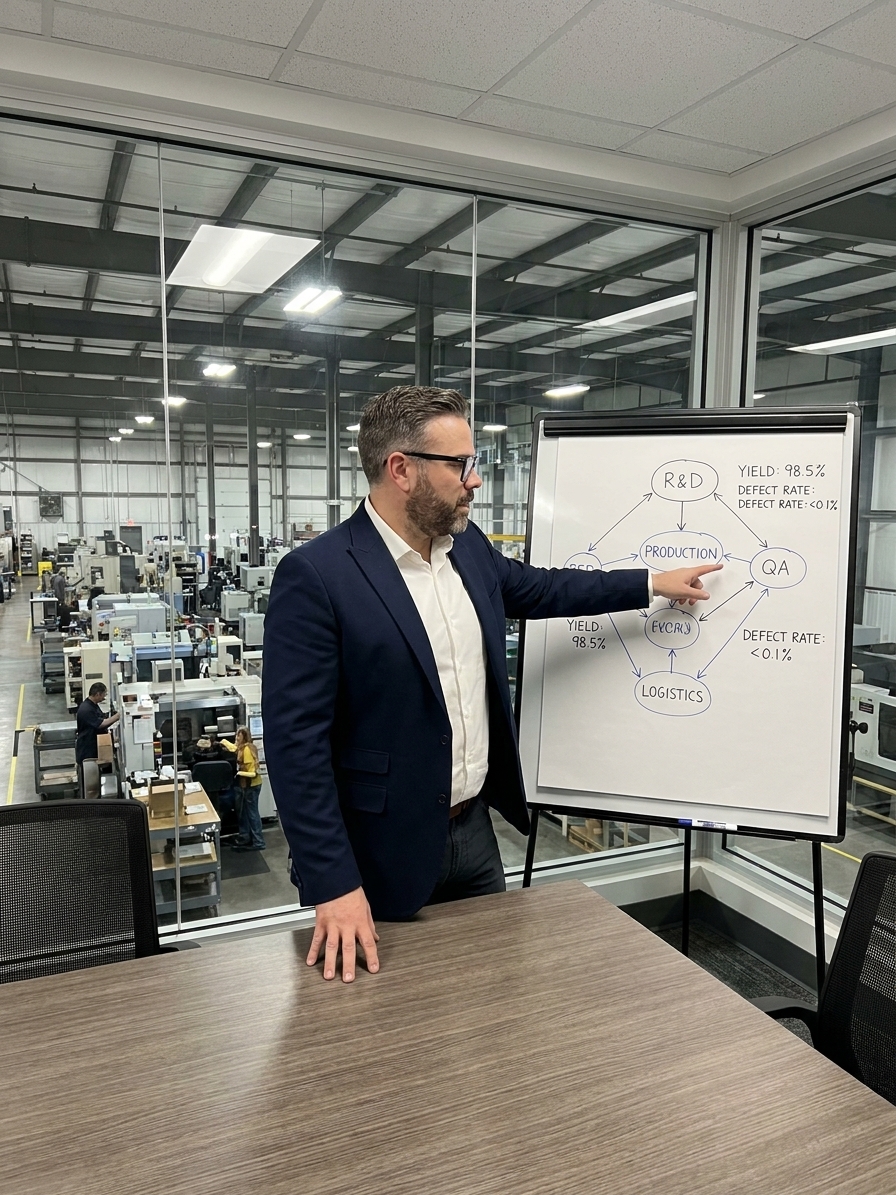
Production wants to hit volume targets. Purchasing wants to cut material costs. Engineering wants to push the design envelope. Quality wants zero defects. Each department, acting rationally from its own perspective, makes decisions that seem smart in isolation but trigger catastrophic results across the value stream.
Production skips a secondary inspection to save twelve minutes of cycle time. Purchasing switches to a cheaper supplier whose material is 'basically the same.' Engineering releases a drawing with a ±0.01mm tolerance that looks flawless in CAD but is impossible to hold on a Friday night shift. The customer finds the defect. The organisation pays for it.
This is not a failure of intelligence or a lack of operator training. It is the Prisoner's Dilemma, and it is the most common structural failure mode in manufacturing quality. Every department played its own game correctly. The organisation lost because the system incentivised defection over cooperation.
The mechanics of local optimisation
The original Prisoner's Dilemma demonstrates that individually rational choices produce collectively irrational outcomes. Replace 'prisoners' with 'departments' and 'confessing' with 'optimising local metrics,' and you have the exact dynamic destroying your process capability. The math is simple, and it is unforgiving.
Consider the tension between throughput and defect rates. Production is measured on OEE; quality is measured on PPM. When production pushes speed and quality pushes caution, both departments respond to the incentives they were given. The optimal outcome—high throughput and low scrap—requires setup discipline and real-time data sharing. Instead, production hides early warning signs, and quality retaliates by adding inspection gates.
Purchasing saves fifteen percent on a critical component by approving an alternate supplier. The new material carries a slightly higher defect rate. Those failures do not appear on the purchasing scorecard. They surface as internal scrap, 8D investigations, and warranty claims. Purchasing wins its metric while the organisation absorbs costs that dwarf the initial savings.
Why the conflict is invisible to management
The defect is insidious because the people involved are doing exactly what their KPI dashboards demand. A production supervisor who keeps a line running despite a minor dimensional drift is responding to a bonus structure tied to volume. He is not being reckless. He is being rational within the system he operates in.
I have audited plants where the engineering team specified tight tolerances because the design review process rewarded precision over manufacturability. The resulting scrap was logged as a production failure. When you measure departments in isolation, the system is perfectly designed to hide the true cost of local decisions.
Exhorting teams to 'work together' fails because it asks people to act against their rational self-interest. The moment production pressure increases—and in manufacturing, pressure always increases—people revert to their core incentives. If cooperation is not tied to compensation and advancement, it will not survive a shift target.
Metric Alignment vs. Metric Conflict
Isolated KPIs (Defection)
- Production judged purely on machine uptime and OEE
- Purchasing evaluated solely on piece-price reduction
- Quality measured by outgoing PPM and scrap rates
- Departments hide early warnings to protect scores
Shared KPIs (Cooperation)
- Production carries a shared weight for first-pass yield
- Supplier cost includes calculated downstream scrap risk
- Quality measured on prevention and containment speed
- Departments escalate issues early without penalty
The erosion of trust in iterated cycles
Manufacturing is an iterated game. The same departments interact every shift, every week. In game theory, 'tit-for-tat' is a dominant strategy: start by cooperating, then mirror the other player's last move. In theory, this builds mutual trust. In practice, trust erodes rapidly because departments respond to what they expect will happen next, not what happened last.
Production expects quality to slow the line, so they stop flagging marginal issues. Quality sees the hidden issues and mandates more inspection gates. Engineering sees the infighting and stops consulting production during design reviews. Each round of interaction reinforces the belief that the other side will not cooperate. The cycle deepens.
This is not a personality clash. It is a structural failure. Throwing a problematic cross-functional team under the bus or replacing a shift leader will not fix it. The new personnel will adapt to the existing incentive structure within a month. Breaking the cycle requires altering the rules of the game.
Restructuring the payoff matrix
The most powerful intervention is making cooperation more rewarding than defection. If production's bonus depends partly on final customer PPM, and quality's bonus depends partly on OEE, both departments instantly have skin in the game. The individually rational choice becomes the collectively optimal choice. Balanced scorecards work, but only when shared metrics carry real weight.
I have implemented shared scorecards in automotive plants where a single 'right first time' metric determined a significant portion of both production and quality variable compensation. The cultural shift was immediate. Conversations changed from 'your scrap is killing my rate' to 'what do you need from us to hold this tolerance?' Same operators. Same tooling. Different incentives.
Shared metrics must be tied directly to ISO 9001 or IATF 16949 management review objectives. If they are not audited and enforced by site leadership, they are just posters in the breakroom. The metric must force a trade-off: if a purchasing manager's sourcing decision directly impacts their department's scrap allowance, the calculation changes instantly.
The system is perfectly designed to produce the outcomes it is getting. If you want different outcomes, you need a different system.
Extending the shadow of the future
In game theory, cooperation increases when players expect to interact many more times. The 'shadow of the future' makes short-term defection less attractive because tomorrow brings consequences. In manufacturing, this means building permanent, cross-functional structures rather than ad-hoc problem-solving teams that disband after the 8D is closed.
Job rotation is the most effective tool here. When a production manager used to be a quality engineer, cooperation is not abstract—it is personal. Rotating high-potential leaders through quality, production, and engineering gives them a structural understanding of how their decisions ripple through the value stream.
Joint Gemba walks are another mechanism. When production, quality, and maintenance leaders walk the line together daily, they share context. Maintenance can point out a worn bearing. Quality can explain why a marginal part matters. Production can request adjustments before the Cpk drops below 1.33. These interactions build the relational debt required for sustained cooperation.
Mechanisms for Sustaining Cross-Functional Cooperation
- 01Align compensationTie a percentage of variable pay to shared metrics like first-pass yield, not just departmental targets.
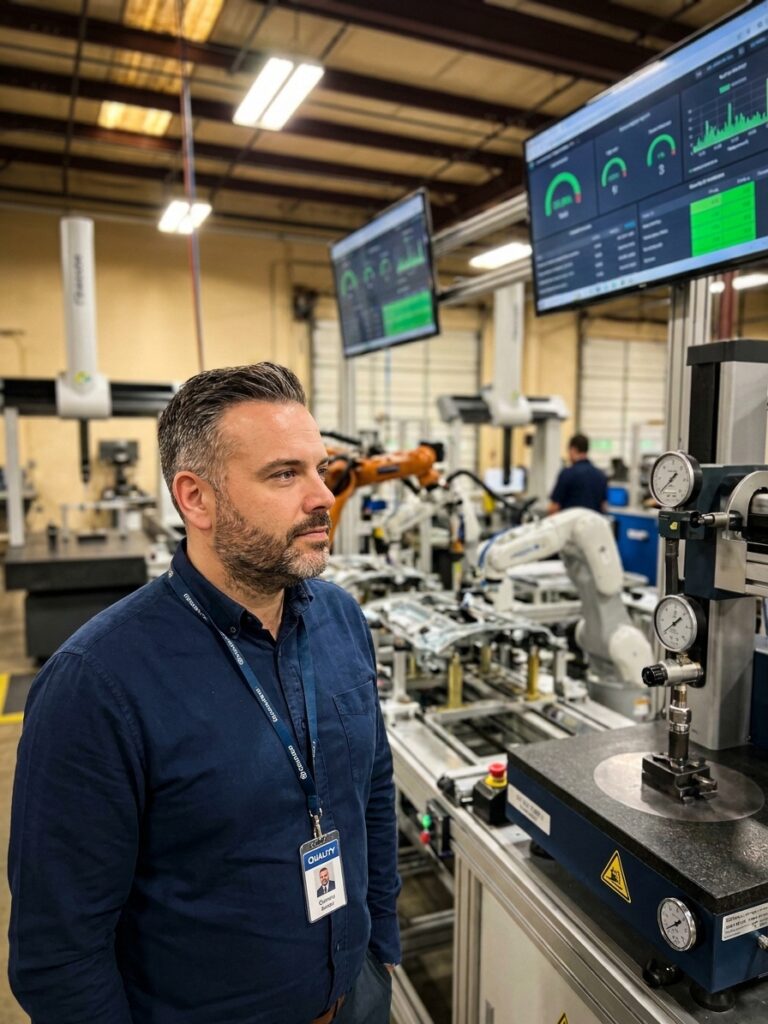
- 02Create transparencyImplement shared digital dashboards showing real-time OEE, defect rates, and maintenance status side-by-side.
- 03Enforce escalationEstablish a quality council with authority to resolve disputes and penalise local optimisation at system expense.
- 04Rotate rolesMove engineering and production leaders through quality roles to build structural empathy and operational context.
Building identity beyond the department
The most durable defence against the Prisoner's Dilemma is shifting primary identity from the department to the plant. When operators see themselves as members of the site first, cooperation stops being a favour. It becomes a natural expression of shared purpose. This is what 'quality culture' actually means—not slogans, but a genuine shift in accountability.
This shift requires governance. Escalation paths must bring cross-functional conflicts to senior leadership before they calcify. Regular reviews must make trade-offs explicit. If a cheaper supplier's defects are traced back to the sourcing decision and reflected in purchasing's performance review, the structural incentive to defect is neutralised.
Your biggest quality problems are not caused by bad people making bad decisions. They are caused by good people making rational decisions inside bad systems. If you want to stop defects at the customer, change the structure of incentives, information, and identity that governs the floor. Make cooperation the rational choice, not just the noble one.