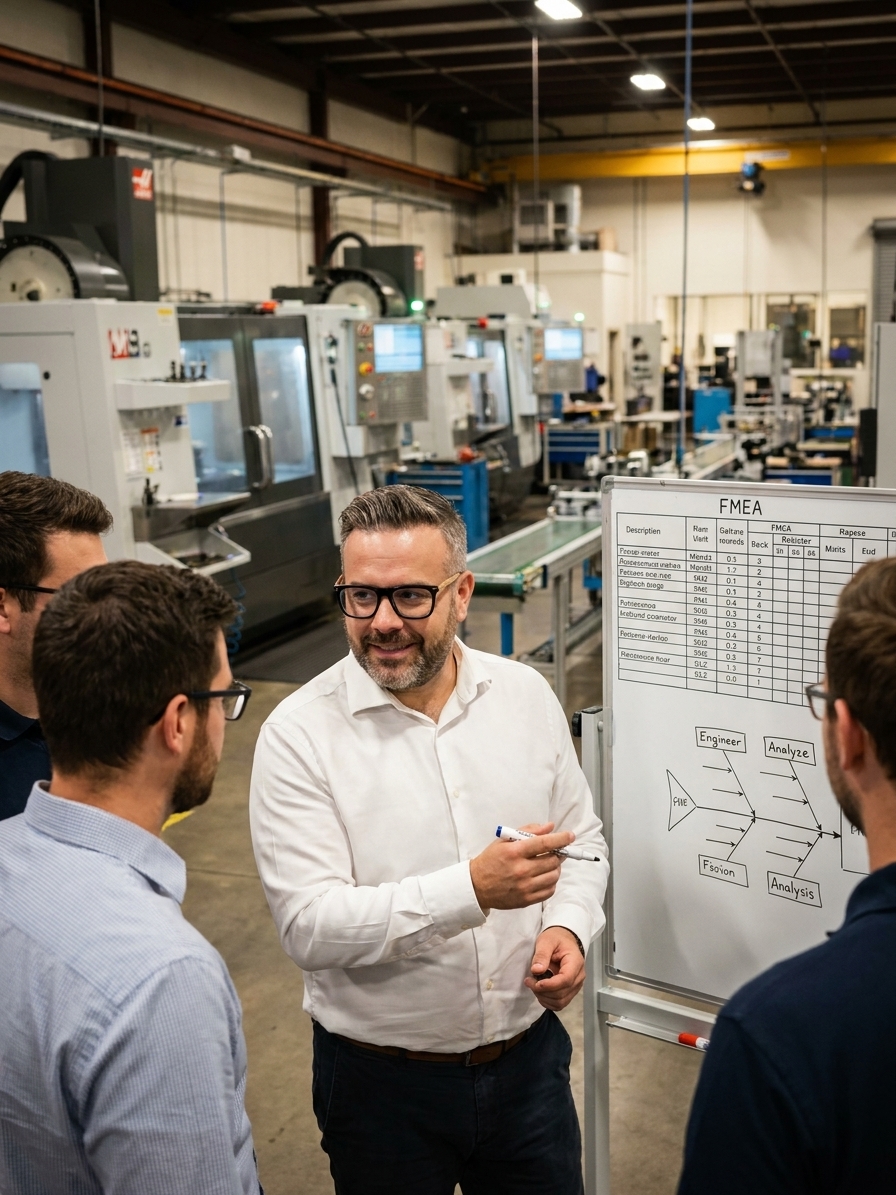
Most quality organisations are built around a specific hierarchy of expertise. The senior quality engineer, the lead auditor, and the plant quality manager act as the primary analytical filters. Their experience is genuinely valuable, but their position in the decision hierarchy creates a systemic vulnerability. When a single mind overrides the collective input of the team, the quality system loses its dynamic accuracy and becomes brittle.
In 1906, Francis Galton observed 787 people guess the weight of an ox at a county fair. The crowd included butchers, farmers, and bystanders with no expertise. The median guess was 1,207 pounds. The actual weight was 1,198 pounds. No individual expert was as accurate as the aggregated, independent guesses of the crowd. Galton published this in Nature under 'Vox Populi', documenting what is now called the wisdom of crowds.
Quality organisations already apply this principle to their metrology. Statistical Process Control relies on the aggregate pattern of many independent measurements, not a single trusted data point. Measurement Systems Analysis uses multiple operators and trials to verify reliability. Yet when it comes to root cause analysis, FMEA scoring, and corrective action selection, organisations abandon aggregation. They default to hierarchy, letting the loudest voice dictate the outcome.
The Mechanics of Collective Intelligence
For collective intelligence to function, four conditions must be met. These are not abstract concepts; they are specific operational constraints. First, there must be diversity of perspective. The production operator views a defect differently than the design engineer, the supplier quality manager, and the maintenance technician. Each perspective is incomplete. Together, they cover the full failure scope.
Second, judgments must be made independently. The moment the most senior person speaks first, independence is destroyed. Junior staff and operators anchor to the expert's opinion, consciously or subconsciously. Third, knowledge must be decentralised. The person physically closest to the process holds critical information that the manager in the office will never possess. The system must surface this distributed knowledge.
Fourth, there must be a structured aggregation mechanism. Hierarchy, where the boss decides, and consensus, where everyone agrees, do not produce wisdom. They produce conformity. A proper aggregation mechanism mathematically or structurally combines independent inputs without allowing early discussion to bias the results. When any of these four conditions fail, the crowd becomes dangerously wrong.
The Four Conditions for Collective Intelligence
The FMEA Anchoring Trap
Consider a standard PFMEA session. The facilitator gathers a design engineer, a process engineer, a quality engineer, a production supervisor, and a maintenance technician. The goal is to identify failure modes and score severity, occurrence, and detection on the 1-to-10 scale. In theory, this cross-functional team provides the diversity required for collective intelligence.
In practice, the quality engineering manager with twenty years of experience offers the first opinion on a failure mode. They state severity is an 8, occurrence is a 4, and detection is a 3. Everyone else nods. The RPN is calculated at 96. The team moves to the next line item. The FMEA is completed with full cross-functional sign-off, but the output is dangerously compromised.
The design engineer, who has field failure data suggesting a severity of 10, stays quiet. The production supervisor, who knows the occurrence is closer to 6 based on scrap rates, defers to the senior expert. The maintenance technician, aware that the detection rating is optimistic because the inspection method is unreliable, says nothing. The expert's presence destroyed the independence of the group.

Restructuring Root Cause Analysis
The cost of expert-biased systems is measurable. An automotive supplier fought a persistent dimensional nonconformity on a machined housing. The defect appeared roughly once every 500 parts. The internal quality team ran four separate 8D investigations over eighteen months. Each time, the most senior quality engineer led the root cause analysis.
The team cycled through sophisticated hypotheses: tool wear, material variation, fixture alignment, thermal expansion. They implemented corrective actions for each. The defect persisted. The system failed because the investigation was anchored to one perspective. The senior engineer's initial hypothesis framed the entire discussion, preventing the team from exploring simpler, localized explanations.
To break the cycle, I replaced the standard 8D brainstorming session with a silent generation method. I gathered seven people: the operator, the setup technician, the maintenance mechanic, the incoming inspector, the process engineer, the quality technician, and a newly hired production supervisor. I asked each person to independently write down the most likely root cause before any discussion occurred.
Four out of seven people independently identified the identical root cause. The operator noted coolant pressure dropped during third shift. The maintenance mechanic stated the auxiliary pump on machine seven had an intermittent fault. The new supervisor noticed the pressure gauge fluctuated. The defect disappeared immediately after the pump was replaced. The crowd had the answer; the system just never asked for it independently.
The crowd never gets to be wise because the system never lets it be independent.
Separating Generation From Evaluation
The most critical structural change in quality decision-making is separating idea generation from evaluation. Before any group assesses an FMEA score orbrainstorms a root cause, every participant must document their input independently. This is not a suggestion for better meeting etiquette. It is a strict procedural rule that prevents anchoring bias from corrupting the data pool.
I have audited plants that allow open discussion before independent scoring, and the results are consistently skewed toward the highest-paid person's opinion. Research on aggregate estimates shows that independent averaging is more accurate than the estimates of the vast majority of individual participants. In quality engineering, where a missed failure mode can trigger a customer escape or a safety recall, this accuracy differential is transformational.
Execution is simple. Distribute the FMEA worksheet or the 8D problem description forty-eight hours in advance. Require participants to arrive with their preliminary scores or hypotheses written down. Collect these inputs before opening the floor. The discussion then begins from a collective baseline, rather than the baseline of the most vocal or senior attendee.
Structured Aggregation Workflow
- 01Distribute DataProvide FMEA scope or 8D problem statement to the cross-functional team.
- 02Independent GenerationEach member documents scores or root causes alone, without discussion.
- 03Blind AggregationCompile inputs into a single view. Identify clusters and outliers.
- 04Group EvaluationDiscuss aggregated results. Debate outliers, not seniority.
Implementing Structured Disagreement
Agreement is not accuracy. In quality meetings, rapid agreement is often a symptom of social pressure, anchoring bias, and conflict avoidance. When an 8D team reaches a consensus on root cause within the first thirty minutes, it usually means they have adopted the first plausible hypothesis offered. This is how corrective actions fail and defects recur months later.
Build structured disagreement into your quality operating system. Assign a designated challenger role during root cause analysis. This person is tasked with attacking the leading hypothesis. Require that PFMEA teams consider at least one failure mode that the senior engineer dismisses as improbable. Create a formal, anonymous channel for junior operators and inspectors to submit risk assessments without facing the hierarchy.
The goal is not to manufacture conflict or delay corrective actions. The goal is to force the diversity of perspective into the open. If the designated challenger agrees with the root cause after rigorous testing, the team proceeds with high confidence. If the challenger finds a flaw, the team has saved itself from implementing an ineffective corrective action. Disagreement becomes a verification tool.
Expert-Led vs. Structured Aggregation
Traditional Expert-Led Session
- Senior engineer states hypothesis first.
- Team anchors on initial severity and occurrence scores.
- Junior staff defer to org chart authority.
- 8D corrective action targets wrong root cause.
Structured Collective Intelligence
- Team reviews problem statement independently.
- Scores and hypotheses submitted in writing.
- Aggregated data reveals actual consensus.
- Corrective action addresses verified failure mode.
Tracking Systemic Accuracy
Quality organisations meticulously track Cpk, OEE, and scrap rates. They measure the effectiveness of their tools but never measure the effectiveness of their human decision-making processes. Most plants have no mechanism to determine whether their 8D investigations or FMEA scores are actually accurate over time. They assume the system works because experts signed off on it.
Start tracking collective accuracy. After every major corrective action, record whether the implemented solution permanently eliminated the defect. Track how often the initial root cause hypothesis matched the final verified root cause. If your structured aggregation process is working, your first-time-right corrective action rate will climb. Your recurrence rate will drop.
This data proves the value of structural humility. The most resilient quality systems do not rely on a single brilliant mind. They distribute decision-making, aggregate diverse perspectives, and trust verified collective input over individual authority. The best quality engineers I have worked with understood that their job was not to have all the answers, but to structure the process so the room produced them.