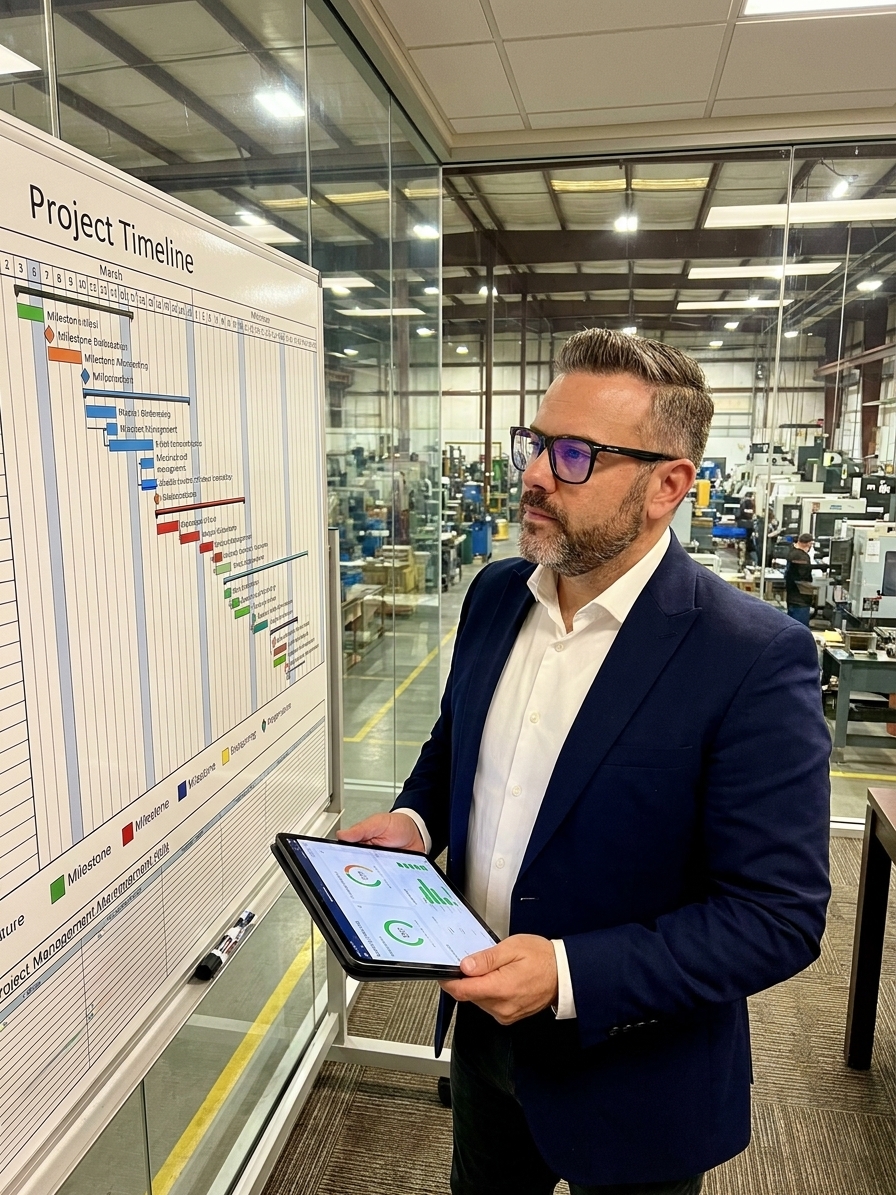
A corrective action request lands with a strict deadline. The quality manager builds a logical plan: identify root cause, validate the fix, implement across all shifts, and confirm effectiveness with 30 days of production data. The timeline looks tight but achievable. Twelve weeks later, the team is still collecting data because tooling modifications took three weeks to procure and the initial defect reduction missed the customer's threshold.
Nobody was incompetent. The timeline was simply wrong, in exactly the same way the previous five timelines were wrong. This is the Planning Fallacy. Documented by psychologists Daniel Kahneman and Amos Tversky, it is a systematic cognitive bias where people estimate how long a task will take by imagining a best-case scenario, consistently ignoring their own historical data showing similar projects take significantly longer.
I have implemented and transitioned ISO 9001 systems at plants across automotive and aerospace manufacturing. In my experience, quality departments are uniquely vulnerable to this bias. We operate in cross-functional environments where we control neither the resources nor the outcomes, yet we routinely issue deadlines as if we dictate both. This systematic underestimation quietly destroys organizational credibility, one missed deadline at a time.
Why Quality Departments Are Uniquely Vulnerable
Quality work is structurally dependent on other functions. A corrective action is not executed by the quality team alone. It requires engineering to redesign fixtures, maintenance to modify tooling, production to update work instructions, and purchasing to source materials. Every internal handoff is a dependency, and every dependency is a potential delay. Yet, when estimating a timeline, managers routinely calculate duration as if they fully control those shared resources.
Unlike building a wall, quality improvements have highly uncertain endpoints. The outcome is often binary. Either the process capability reaches the required Cpk threshold, or it does not. You can consume ninety percent of your planned timeline and remain at zero percent progress toward a validated solution. This uncertainty makes accurate estimation nearly impossible, but it does not stop teams from issuing precise, overly optimistic dates.
Customer pressure artificially compresses estimates. When a major automotive or aerospace customer issues an 8D with a 60-day deadline, quality teams do not estimate how long the root cause analysis will actually take. They estimate how long they can afford to tell the customer it will take. These are rarely the same number. The customer then builds their production schedule around your optimistic timeline, and when you inevitably miss it, the relationship damage compounds rapidly.

The Cascading Cost of Missed Deadlines
Every missed deadline teaches the customer that your commitments are unreliable. After two or three missed 8D timelines, the customer stops believing your reports and starts managing you instead. They demand more on-site audits, more frequent status calls, and stricter oversight. Each of these oversight activities consumes engineering and quality resources that should have been spent on actual defect prevention, creating a downward spiral of increasing demands and decreasing capacity.
Internal trust erodes just as quickly. When the quality team consistently misses its own targets, other departments stop prioritizing quality requests. Engineering will not rush to support a fixture redesign because they know the deadline will be extended anyway. Production will not prioritize a new control plan because the effective date always gets pushed back. The original optimistic estimate creates a self-fulfilling prophecy of organizational inertia.
Resource allocation collapses when timelines stretch. If you plan a PPAP submission for six weeks, you staff and sequence your portfolio accordingly. When week eight arrives and the project is still running, it collides with the next project that was scheduled to start in week seven. You are suddenly managing two late projects with the resources allocated for one, virtually guaranteeing that both will fail. The portfolio effect turns a single missed estimate into a systemic backlog.
The Impact of Systematic Underestimation
The Reference Class: Your Strongest Corrective Tool
The antidote to the Planning Fallacy is reference-class forecasting. Instead of estimating a project's duration by imagining the individual steps, you estimate by looking at how long similar projects actually took in the past. You ignore the specifics of the current task and rely on the statistical distribution of previous outcomes. This forces the historical reality of your organization's actual execution speed into the forecasting model.
Pull the records for your last ten major 8D or corrective actions. Calculate the actual duration of each one, from initiation to confirmed effectiveness. Calculate the ratio of actual time to planned time. If your average ratio is 1.8, your new estimate should be 1.8 times whatever your inside-view estimate tells you. If the inside view says six weeks, the reference class dictates an eleven-week timeline.
This approach faces immediate resistance. Management argues the number is too high, and the quality manager worries the customer will reject it. But the customer would almost always rather receive an honest twelve-week estimate that you meet than a dishonest six-week estimate that you miss by one hundred percent. An accurate forecast builds trust. An optimistic forecast destroys it. The data must override the gut feeling.
Practical Strategies for Neutralizing the Bias
Beyond reference-class forecasting, specific operational tactics help neutralize this cognitive bias. Decompose every corrective action into its smallest component activities before estimating. Estimate the time for the PFMEA update, the tooling modification, and the MSA study individually. Summing these granular estimates reduces overall bias, because humans estimate concrete, short-duration tasks more accurately than abstract, multi-week projects.
Add explicit buffers for cross-functional dependencies. Every handoff to another department should carry a built-in contingency. If engineering says they can redesign a checking fixture in five days, plan for eight. This is not a lack of trust; it is an acknowledgment that engineering has their own operational priorities, their own production interruptions, and their own systematic planning biases.
The customer would rather receive an honest twelve-week estimate that you meet than a dishonest six-week estimate that you miss.
Separate estimation from aspiration. When a plant director asks how long a corrective action will take, they are usually asking for a commitment to pacify the customer. Provide a three-number answer: state the best historical estimate, the target delivery you will push the team toward, and the number you recommend communicating externally. This preserves data integrity while maintaining operational ambition.
Three-Number Estimation Protocol
- 01Historical EstimateThe baseline duration derived from actual past performance of similar 8D or corrective action projects.
- 02Internal CommitmentThe aggressive but plausible target used to drive cross-functional execution teams.
- 03External PromiseThe realistic, buffered timeline communicated to the customer to protect delivery credibility.
Building Organizational Awareness
Portfolio awareness is critical for realistic forecasting. If your quality engineering team is already managing seven open corrective actions, the eighth will not proceed at the same speed as the first. Capacity is finite. Timeline estimates that ignore the rest of the active quality portfolio are works of fiction. Before committing to a new deadline, map the existing resource allocation across all active 8Ds, PPAPs, and audit responses.
Run pre-mortems before finalizing any timeline. Gather the core team and ask them to imagine it is six months from now and the corrective action is three months late. Ask what specifically went wrong. The answers will immediately illuminate the risks that the optimistic inside view filtered out. Factor those identified risks into the final timeline as explicit contingencies rather than hoping they do not materialize on the shop floor.
Track and publish your estimating accuracy. Post a chart in the quality department showing planned versus actual timelines for every major project. Make the gap visible and undeniable. When the organization sees that actual durations consistently double the planned estimates, the data becomes the argument you cannot lose. Over time, this radical transparency creates internal pressure to estimate more honestly rather than optimistically.
The Leadership Challenge: Rewarding Accuracy
The hardest part of fighting the Planning Fallacy is cultural. In many organizations, the manager who provides the most aggressive timeline is rewarded. Their estimate sounds decisive, confident, and action-oriented. The cautious estimator who references historical data and demands longer timelines is seen as negative or obstructionist. This dynamic actively institutionalizes failure.
A leader who demands aggressive timelines and routinely accepts missed deadlines is not driving performance. They are teaching the organization that commitments are performative. They signal that sounding confident in a meeting is more valuable than actually delivering a validated process change on the agreed date. This destroys the foundational trust required for effective cross-functional collaboration in any manufacturing environment.
You can negotiate a missed specification, and you can recover from a failed audit. But once your customers and your internal colleagues stop believing your timelines, every interaction becomes a negotiation. Every request for engineering support becomes conditional. Every project starts with a trust deficit that quality must overcome before any real problem-solving can begin. Credibility is the quality department's most valuable asset.
The organizations that successfully break this pattern treat a missed deadline as a systemic failure, not an individual one. They track estimating accuracy religiously, reward honest forecasting, and build their project plans around what historically happens on their shop floor, not what they wish would happen. In quality management, disciplined realism is a genuine competitive advantage.