
A Tier 1 supplier submits a spotless PPAP package. The IATF 16949 certificate is current. The control plan dictates every dimensional and material specification. Yet the customer's supplier quality engineer arrives for a routine surveillance audit and finds that the entire production line operates on tribal knowledge. The documentation is a perfect facade. The customer sees through it within hours.
Across two decades in automotive and aerospace, I have witnessed this exact paradox repeatedly. The gap between a compliant management system and actual manufacturing reality is rarely a technical failure. It is a structural breakdown. Quality exists as a downstream department filtering defects, rather than an operational discipline integrated into the process itself.
Customers do not pay for your certificate; they pay for reliable parts. Total Quality Management (TQM) is the mechanism that forces your operation to deliver exactly that. It treats quality as a behavioural standard embedded across every role, ensuring the system promised on paper matches the reality the customer experiences on the assembly line.
The customer's actual demand: process evidence over inspection
When an OEM evaluates a supplier, they look past the ISO 9001 or AS9100 wall plaque. They evaluate the process. Modern procurement standards dictate that quality must be designed into the manufacturing parameters, not inspected at the end of the line. A plant relying on end-of-line sorting is a liability, and supplier quality engineers are trained to spot it immediately.
I have audited plants where the paint was fresh but the process capability was non-existent. Customers evaluate risk. If your operation relies on detection rather than prevention, the customer absorbs the risk of your process drift. This is why OEMs mandate strict Cpk targets for critical characteristics. They are demanding statistical proof that your process can tolerate variation without producing a defect.
TQM dictates the specific behaviours that generate this proof. It demands that quality is built upstream. A plant can hold a flawless certification and still suffer from high scrap rates. When a customer audits your facility, they measure the distance between your documented procedures and the actual friction on the shop floor. If that gap is wide, you lose the business regardless of your documentation.
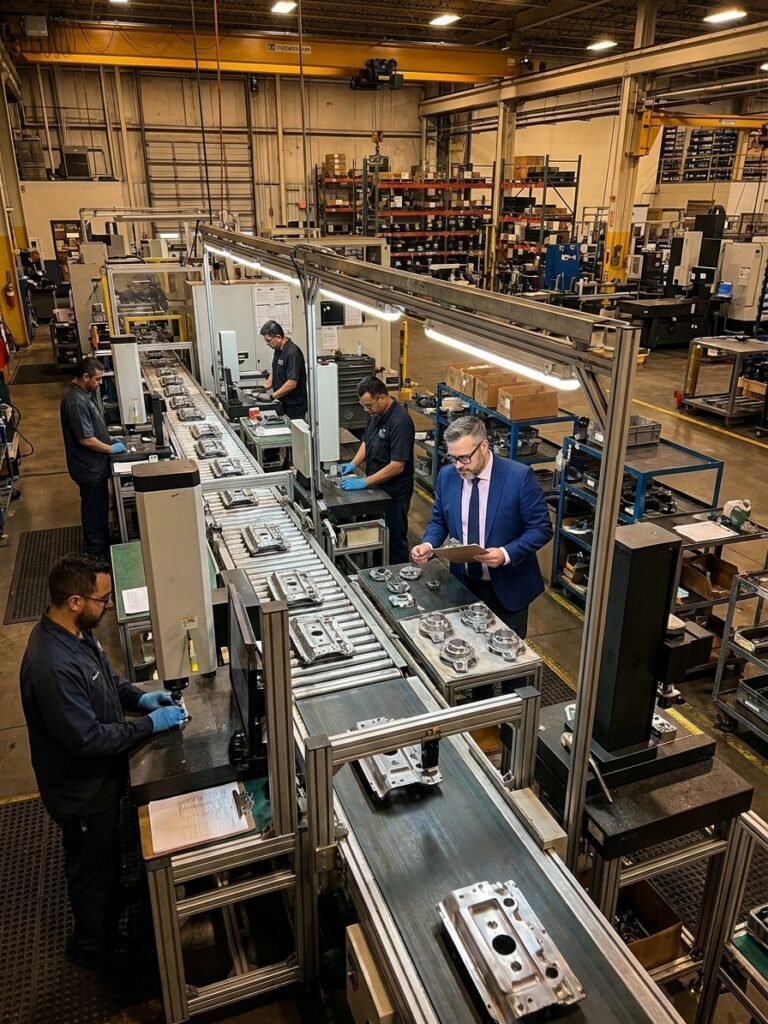
Treating the next station as the paying customer
In a traditional setup, the customer is the entity paying the invoice. In TQM, the customer is anyone who receives your work. The operator passing a component to the next station is a supplier. The assembly department is the customer of the press shop. The press shop is the customer of the material warehouse. This internal supply chain must operate with the same rigor as the external one.
This shift in logic is radical. An operator once asked me: "If I receive a bad part from the previous station, should I return it instead of trying to fix it?" The answer is unequivocally yes. Reworking the part hides the defect from the system. Returning it forces the upstream process to confront its failure and address the root cause. Concealing defects destroys the process data the customer ultimately demands.
Internal rejections must carry the exact same weight as external customer complaints. If a shift delivers non-conforming work to the next cell, the system must log it and investigate it using an 8D approach. Accepting internal scrap normalises failure. It guarantees that defects will eventually bypass your containment and reach the paying customer, triggering costly field returns and warranty claims.
Compounding daily improvements the customer can measure
TQM without continuous improvement is inert. Improvement does not mean massive transformational projects driven by external consultants. It means hundreds of small, daily adjustments executed by the people who run the processes. This is Kaizen applied as a baseline operational standard. Customers measure the output of this continuous improvement through stable delivery and consistent PPM performance.
Consider the mathematics of micro-improvement. An operator suggests a modification to a tool holder that saves three seconds per cycle. Across a 10,000-piece daily run, that single observation yields 30,000 seconds saved. One operator recovers over eight hours of machine time per day. The customer never sees the tool holder, but they directly benefit from the recovered capacity through shorter lead times and on-time delivery.
Sustaining this requires visual management and visible recognition. Improvement ideas must be tracked, measured, and rewarded. When teams present their Cpk improvements or setup reductions at morning board meetings, the operational culture shifts entirely. Recognition among peers, not just financial compensation, is the engine that sustains TQM and drives the operational stability your customer demands.
Micro-improvement mathematics
Dismantling silos to ensure the customer gets a unified result
Most organisations fail at total engagement because their internal structure actively prevents it. Quality has its KPIs. Production has throughput targets. Maintenance measures uptime. Logistics tracks inventory turns. These departments rarely look at the same data, let alone share the same operational objectives. The customer experiences the result of this fragmentation as delayed shipments and non-conforming product.
At a Central European component manufacturer, I diagnosed a 4.2 percent scrap rate coupled with an 18 percent annual employee turnover rate. Production pushed volume while ignoring process drift. Quality inspected the fallout at the end of the line. The silos ensured that neither function solved the problem, and the customer was actively preparing to source the part elsewhere.
We dismantled this by installing cross-functional teams for every critical process. An operator, a process engineer, a quality technician, and a maintenance mechanic were given joint ownership of the line's OEE and scrap metrics. Within weeks, the operator suggested a press angle adjustment that dropped scrap at that station by 40 percent. Aligned metrics saved the customer account.
Cross-functional alignment must extend to procurement and HR. Buyers cannot evaluate suppliers on unit price alone; they must assess PPAP approval status and historical PPM performance. HR must transition from filling headcount to building a workforce where operators understand variability and are expected to flag it. The customer requires a unified supply chain, not a collection of competing departments.
Implementing TQM: A structural rollout, not a morale campaign
Implementation fails when it is treated as a morale campaign. It succeeds when it is treated as a systematic operational rollout. Skipping the foundation of leadership commitment and jumping straight to statistical tools guarantees failure. TQM requires structural changes to how meetings are run, how data is shared, and how people are evaluated. Customers notice when the system is actually enforced.
Defining quality is a critical early step. Generic quality does not exist. For an aerospace supplier, it might mean zero escaped defects and 100 percent on-time PPAP submission. For a high-volume automotive stamping plant, it might mean maintaining a Cpk of 1.67 on critical characteristics while holding scrap under one percent. These are the operational definitions the customer audits.
Training must move out of the conference room and onto the floor. Operators need Training Within Industry (TWI) standardisation. They need to understand the SPC charts they are signing. Engineers need to understand how their fixture designs drive variability. Managers need to look at the entire system, not just the daily output numbers. When an OEM auditor asks an operator a question about the process, the answer must be precise.
The TQM implementation sequence
- 01Leadership CommitmentExecutives must engage in Gemba walks, not just review monthly slide decks
- 02Operational DefinitionsDefine quality in specific terms, such as Cpk targets or zero-defect delivery
- 03Silo EradicationMandate cross-functional teams with shared metrics for OEE and scrap
- 04Floor-Level TrainingUse TWI methods and basic SPC to build process understanding at the machine
- 05Behavioural MetricsMeasure and reward system improvements and root-cause identification
Industry 4.0 and the future of customer assurance
Industry 4.0 technology does not replace TQM; it accelerates it. Digital twins allow PFMEA iterations before tooling is cut. IoT sensors provide real-time SPC data without manual gauging. Machine learning predicts spindle degradation before it causes a scrap event. Customers increasingly demand access to this live data, effectively blurring the line between the supplier's factory and the OEM's control tower.
But these advanced tools are useless if the organisational culture still relies on sorting bad parts from good ones. A predictive maintenance algorithm cannot fix a culture that normalises internal scrap. Technology amplifies the existing management system. If your management system relies on detection, technology will merely help you detect failures faster. If your system is built on TQM, technology proves your capability in real-time.
Deming's chain reaction remains the core business case for this transformation. Improve quality, and costs decrease because there is less rework, scrap, and warranty. Productivity rises because machines run uninterrupted. Market share grows because the customer receives exactly what they ordered. Starting this chain reaction does not require a complex software deployment. It requires going to the line, asking the operator what slows them down, and fixing that specific constraint daily.
A plant can hold a flawless certificate and still lose the contract if the floor operates on tribal knowledge.
The customer's demand is simple: prove that your process is stable, capable, and continuously improving. ISO 9001 provides the framework to document that proof. TQM provides the discipline to actually live it. When the auditor leaves and the customer opens the next shipment, the only quality system that matters is the one your operators practice every minute of the shift.