ISO 9001 and IATF 16949 transitions routinely fail on the floor, not in the management review. The technical architecture is sound, the training matrices are complete, and the Tier 1 audits pass. Six months later, the organization discovers operators have been running dual systems: entering data into the new digital trackers while maintaining their legacy paper logs in parallel. The new system is technically deployed but functionally ignored.
This parallel processing is not stubbornness; it is a rational prediction. When an organization announces a transformation, it asks people to abandon processes they have used for years — routines that feel like extensions of their judgment and professional identity. Letting go of that is never just a logical exercise. It is an emotional loss.
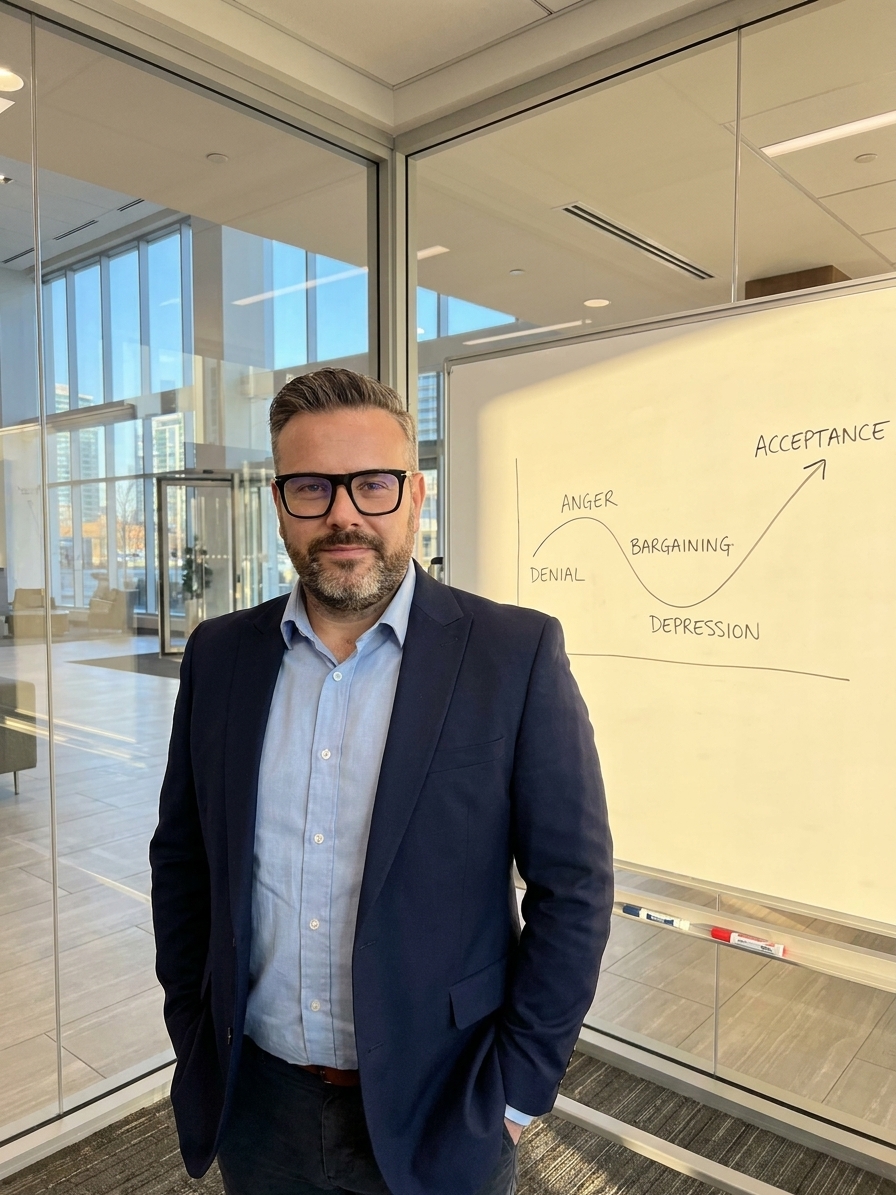
I have audited plants where the technical rollout was flawless but the cultural adoption was zero. The framework that best explains this gap is the Kübler-Ross change curve. When you ask people to abandon processes they have mastered, you trigger a grief response: denial, anger, bargaining, depression, and acceptance. Understanding this progression allows quality leaders to predict resistance and deploy targeted countermeasures, rather than simply demanding compliance.
Denial manifests as parallel processing
Denial in organizational change does not look like people lying on the floor refusing to move. It looks like compliance without commitment. Operators will go through the motions of the new process while quietly maintaining the old one, waiting for the initiative to fail.
Consider an automotive supplier transitioning from end-of-shift paper SPC cards to real-time digital data entry. For the first three weeks, operators enter data into the tablets and then write the same numbers on paper cards when nobody is looking. They are not distrusting the technology. They simply do not believe the change will last. They have seen multiple quality initiatives arrive with fanfare, consume weeks of training, and gradually fade back to baseline.
This behaviour is a rational prediction based on observed patterns, not ignorance. Why invest emotionally in a new QMS that history suggests will be abandoned? The quality manager detected this dual-entry pattern by comparing tablet timestamps to the paper cards. The operators were simply hedging their bets against management's predictable loss of interest.
The fix is not more training. Denial dissolves not when you argue against it, but when you outlast it. Public commitment to a twelve-month timeline, backed by weekly usage updates, proves consistency. By month four, the paper backups disappear on their own because the operators stop feeling the need for a safety net.
Anger targets professional identity, not technology
When a medical device manufacturer replaced manual visual inspection with an automated vision system, the experienced inspectors were furious. The anger was raw, personal, and existential. One inspector with twenty-three years of experience demanded to know if management genuinely believed a camera could replicate the defect detection she had spent a career perfecting.
The project team expected pushback on technology reliability and calibration. What they received was a challenge to professional identity. When you implement a quality change that alters how people work, you challenge their sense of competence and their belief that their accumulated mastery still matters. Anger in the change curve is the moment the reality of loss becomes undeniable, and the response is to fight the source of that loss.
The mistake is attempting to rationalize the anger away with benchmarking data and accuracy metrics. The angry inspector hears none of it, because the anger is about mourning, not measurement. What works is direct acknowledgment. The quality director must explicitly state that the expertise is being elevated, not replaced. Routine, fatigue-inducing checks shift to the machine, while human inspectors focus on complex, judgment-intensive cases the system cannot touch. Anger acknowledged becomes operational engagement; anger dismissed becomes entrenched resistance.
Bargaining creates permanent hybrid systems
Bargaining is the mind's attempt to negotiate with reality and soften the loss. In quality transformations, it takes predictable forms. An aerospace manufacturer implementing a new document control system faced immediate pushback from engineers. The team proposed maintaining their personal, annotated copies of work instructions alongside the formal digital workflow.
They argued it was a productivity measure, but it was covert resistance. Bargaining requests sound reasonable: phasing in gradually, keeping old forms as backups, customizing the new system to mimic the old process. Quality leaders must distinguish between productive adaptation and resistance disguised as compromise.
The aerospace manufacturer allowed annotated personal copies for a strict ninety-day transition period, after which all annotations had to be incorporated into the formal system. This was a genuine compromise with a defined endpoint, not a capitulation. Bargaining fails when it becomes permanent. The worst outcome is a hybrid system where the new process runs alongside the old indefinitely, creating two sources of truth, double the work, and audit trails that contradict each other.
Productive Adaptation vs. Covert Resistance
Productive adaptation
- Temporary transition periods with hard deadlines
- Customizing user interfaces for operator efficiency
- Gradual rollout by department with a fixed schedule
- Feedback loops that improve the new system itself
Covert resistance
- Maintaining legacy logs alongside digital inputs indefinitely
- Requesting open-ended pilot extensions
- Customizing workflows to replicate old process flaws
- Demands that specific departments remain permanently exempt
Depression looks like withdrawal from competence
Depression is the stage that catches quality leaders off guard because it does not look like resistance. It looks like withdrawal. A medical device company transitioned from manual assembly to semi-automated workstations. Operators who had been the fastest and most accurate in the plant suddenly struggled. They made basic errors, asked questions they would have been embarrassed to ask a month earlier, and watched their OEE metrics drop.
Their confidence collapsed. Several confided to their team leader that they felt stupid. One said, 'I used to be the person everyone came to with questions. Now I am the one who cannot figure out how to load a fixture.' Their competence — the attribute that defined their professional identity — felt stripped away. The old world was gone, and the new one was not yet comfortable.
These operators did not need more technical training. They understood the mechanics. They needed permission to be beginners again. The team leader organized peer pairing, matching each veteran with a younger colleague fluent in the technology. The veterans contributed their deep knowledge of defect patterns and quality standards; the newer workers helped with digital interfaces and automation sequences.
Competence is the cure for the depression phase, and competence takes time.
Within six weeks, the veterans were the best operators on the line because they combined years of quality instinct with the new automation capabilities. But the organization nearly lost them during the depression phase. Two had requested transfers, and one had mentioned retirement. Nobody had prepared them for the emotional valley between old mastery and new mastery.
Acceptance is the baseline, not the finish line
Acceptance in the change curve does not mean happiness. It means people have integrated the new reality and stopped fighting it. In a quality system rollout, acceptance looks deceptively ordinary. Operators use the new software without commenting on it. Engineers stop comparing the new PFMEA templates to the old ones. When auditors visit, the response to questions about the transition is a shrug and an explanation that it is just how things are done now.
The critical insight is that acceptance is not the end of the curve; it is the beginning of the next one. The moment people accept the new quality system, they start developing the same attachment to it that they had to the old one. They build expertise around it, create workarounds for its limitations, and develop tribal knowledge about its quirks. When the next transformation comes, they will grieve this system just as deeply.
Furthermore, the curve is not linear. People cycle through stages repeatedly, sometimes within the same shift. An operator might accept a new inspection protocol during morning training, feel angry about it during the afternoon shift when it slows them down, and bargain for exceptions the next morning. Quality leaders must recognize this oscillation as normal, responding with patience and consistency rather than disciplinary action.
Targeted Interventions for Each Stage of the Change Curve
- 01DenialDo not argue; demonstrate consistency. Publicly commit to timelines and share early wins to prove the change is permanent.
- 02AngerListen without defending. Acknowledge the identity threat, then reframe the change as elevation rather than replacement.
- 03BargainingSet hard boundaries. Allow temporary compromises with strict expiration dates; dismantle parallel processes immediately.
- 04DepressionNormalize the struggle. Use peer pairing to rebuild competence without judgment, and aggressively celebrate small wins.
- 05AcceptanceReinforce the new standard. Recognize adopters publicly and begin preparing the team for the next iteration.
Leaders navigate their own grief cycle
The Kübler-Ross model reveals one final dynamic that quality leaders prefer to ignore: the leaders themselves go through the curve. The plant manager who championed the new QMS experiences denial when the rollout hits its first major obstacle, assuming it is just a minor bump. They feel anger when the board questions the investment, certain that executives do not understand the vision.
They bargain with the timeline, proposing extended pilots to delay the full commitment. They experience depression when early Cpk metrics disappoint, wondering if they were wrong about the system's potential. If the leader is stuck in their own grief cycle while trying to guide others through theirs, the transformation is doomed.
The most effective quality leaders process their own emotional response first. They acknowledge their attachment to the old ways, their anxiety about the new technology, and their fear of failure. You cannot guide a team through a valley you refuse to acknowledge you are also walking through.
Organizations that ignore the emotional dimension of quality change pay a measurable price. The new system is implemented technically but never adopted culturally. People follow the letter of the new procedure while violating its spirit in a thousand undetectable ways. Quality metrics improve temporarily, then plateau below their potential. Treating the emotional journey as a legitimate project dimension — as critical as the IT infrastructure and as measurable as the defect rate — is what separates sustainable transformation from a temporary compliance exercise.