
Every quality system confronts a decision dozens of times a day: do we refine what we know, or investigate what we do not? It happens when a team debates tweaking an SPC control chart versus testing a completely different measurement method. It surfaces when a manager decides whether to squeeze another fraction of a Cpk point out of a stable process or investigate a fundamentally new approach.
This is the exploration-exploitation tradeoff, a concept from decision science that determines whether your operation evolves or calcifies. Exploitation uses established knowledge to maximize immediate performance. Exploration sacrifices short-term certainty to discover methods that might deliver step-change improvements. Both are required for long-term compliance and competitiveness.
The structural problem is that standard quality management metrics overwhelmingly reward exploitation. Organizations left to their own devices will choose to optimize the known every single time. Understanding and deliberately managing this bias is the difference between maintaining a standard and remaining competitive in your market.
Why Quality Management is Structurally Biased Toward Exploitation
The bias toward exploitation is not accidental; it is built into the framework of standard quality metrics. Your KPI dashboard shows defect rates, Cpk indices, and audit scores. All of these measure how effectively you execute your current process. None of them measure how aggressively you search for better processes to implement.
Standard improvement frameworks operate on short time horizons that actively punish exploration. Quarterly targets accommodate incremental gains like a 3% defect reduction. They do not accommodate a team spending six months investigating three alternative measurement approaches where two fail. The time pressure that drives lean execution simultaneously drives out the curiosity required for breakthroughs.
Risk aversion in certified environments strongly favors the known. Exploitation operates within a defined system and produces predictable results. Exploration is inherently risky because it admits your current approach might be suboptimal and requires investing resources with no guarantee of success. When failure carries a heavier penalty than stagnation, engineers stop exploring.
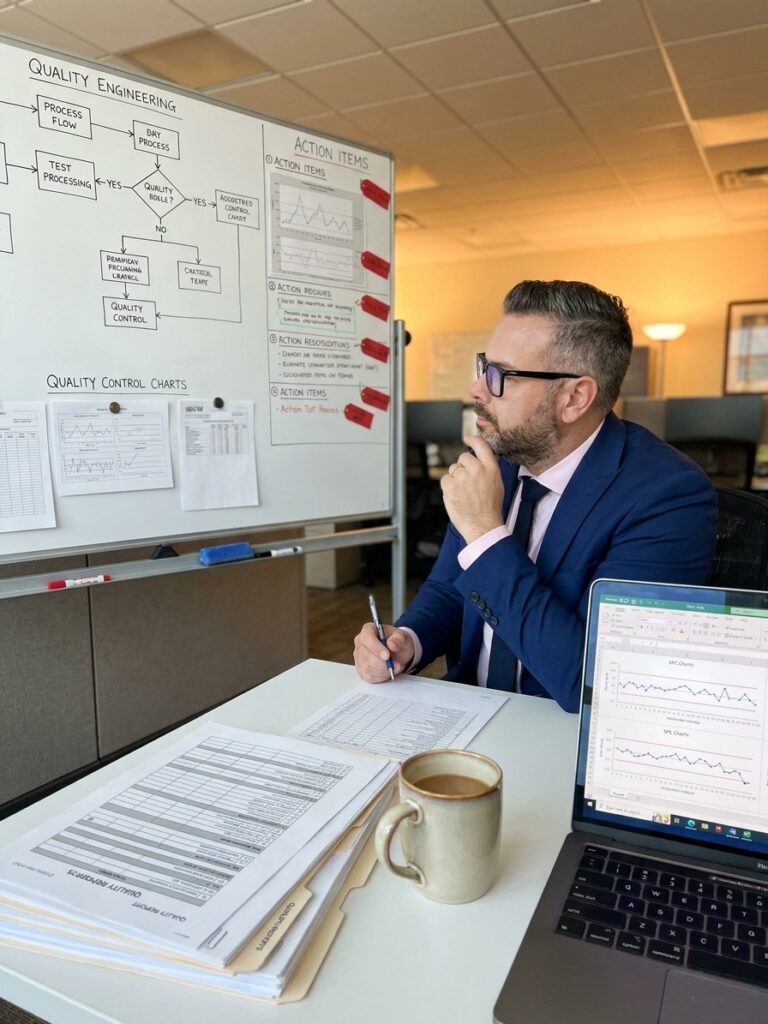
Deep technical expertise also creates tunnel vision. Your most experienced quality engineers and auditors are often your most committed exploiters. They have built their careers mastering the current system. Asking them to question the process asks them to devalue their own hard-won knowledge, intensifying the pull toward exploitation.
The High Cost of Optimizing Obsolete Processes
Organizations that exploit exclusively rarely feel like they are failing. Your defect rate holds steady. Your Cpk remains well above 1.33. Your IATF 16949 or AS9100 audit scores stay high. The standard metrics look healthy because they measure the current state, but underneath the stable numbers, the gap between what you achieve and what the industry is moving toward widens invisibly.
I have audited tier-one automotive suppliers that perfected their manufacturing processes over a decade. They understood every variable, interaction, and seasonal drift. Their exploitation game was flawless: Cpk values consistently above 2.0 and defect rates in single-digit PPM. By every conventional quality measure, they operated at a world-class standard.
Then a competitor introduced a coating technology that eliminated an entire failure mode the supplier had been managing through 100% sorting inspection. The supplier’s carefully optimized inspection protocol, refined over ten years, became irrelevant. They lost the contract not because their quality was poor, but because their system was optimized for a reality that no longer existed.
Recognizing the Symptoms of an Exploitation Trap
Identifying an exploitation trap requires looking past your dashboards. If your organization has not fundamentally changed a major quality methodology in three years, you are exploiting. If your approach to PFMEA, statistical process control, or corrective action looks identical to three years ago, you are hitting an optimization ceiling.
Another clear indicator is decelerating improvement rates. If your annual defect reduction was 20%, then 15%, then 10%, and now 5%, you are running out of exploitation headroom. You are investing more engineering effort for diminishing returns because the straightforward process optimizations have already been captured.
Predictability in problem-solving is a final warning sign. When every nonconformance triggers the same 8D response or the same standard DOE without considering alternative technologies, your team has stopped exploring. Your engineers solve problems faster, but with less creativity. High efficiency paired with low curiosity is exploitation disguised as operational excellence.
The most dangerous quality risk is not the defect you can measure. It is the improvement you never looked for.
The Dangers of Unstructured Exploration
The exploration-exploitation tradeoff goes both ways. Exploration without a solid foundation of exploitation produces chaos. Organizations can swing to the opposite extreme, chasing every new methodology, attending every industry conference, and piloting every digital tool without establishing a stable operational baseline.
I have reviewed plants that deployed artificial intelligence for predictive quality, digital twins, and automated vision systems simultaneously. They spent millions on pilot programs that never scaled into production. The quality team could speak eloquently about emerging technologies but could not reliably hold a Cpk of 1.33 on their core production lines.
The result of unstructured exploration is worse than stagnation. It is pure waste. Exploration without exploitation turns a factory into a research lab. To satisfy customer requirements and maintain compliance, you need relentless execution of known controls layered with deliberate, well-funded investigation.
| Dimension | Exploitation (Optimizing the Known) | Exploration (Discovering the New) |
|---|---|---|
| Primary Goal | Maximize process stability and yield | Find fundamentally better methods |
| Time Horizon | Short-term (daily, weekly, quarterly) | Long-term (1 to 5 years) |
| Risk Profile | Low risk, highly predictable outcomes | High risk, high failure probability |
| Typical Activities | SPC tightening, MSA refinement, 8D | New sensor testing, alternative materials |
| Standard Metric | Defect PPM, Cpk, OEE, Audit Score | Pilots run, methodologies evaluated |
A Practical Framework for Managing the Tradeoff
Managing this tension requires deliberate resource allocation. Adopt a portfolio approach to quality improvements, dividing your engineering bandwidth across different risk levels. Treat your quality initiatives like an investment portfolio where the mix of safe optimizations and high-risk bets is conscious, reviewed regularly, and adjusted based on manufacturing results.
Block out time quarterly for structured quality horizon scanning. This is a formal review of emerging technologies, industry shifts, and advanced methodologies that could be relevant to your processes in the next two to five years. This mechanism prevents your quality management system from becoming a museum of best practices from a decade ago.
Most importantly, leadership must protect the exploration budget from quarterly pressure. When production targets get tight, the first reaction is usually to cut non-essential activities like research and experimentation. This is backwards. The time to explore most aggressively is when your current approach is under stress, because stress signals that your existing process may be reaching its limits.
Resource Allocation for Continuous Improvement
Escaping the Local Maximum
In optimization theory, a local maximum occurs when you climb a hill in the fog. Every step upward feels like progress, but you might be on a small hill right next to a massive mountain. You will never find the higher peak if you keep exploiting the upward direction on your current hill. You have to go down temporarily to find it.
Most mature quality systems are sitting on local maximums. They have optimized their current IATF 16949 or AS9100 architecture as far as it will go. The next improvement is not another tweak to the PFMEA or a tighter control limit. It is a fundamentally different manufacturing technology or measurement system that requires accepting a temporary dip in performance while the new approach comes online.
This is the hardest part of the tradeoff to manage. Exploitation always looks good on the next monthly report. Exploration always looks risky, uncertain, and slightly reckless to production management. But the organization that refuses to leave its local maximum will eventually find that the ground underneath it is eroding.
The best quality operations do not pick one side of this tradeoff. They build systems that do both. They exploit relentlessly to maintain compliance and maximize yield, while exploring continuously in the background to find the next standard. Ask what quality improvement you missed this year because you were too busy optimizing the past.